My copy of the Modern Library edition of selected works of Ralph Waldo Emerson is inscribed “John Breithaupt December 29, 1964”, in the immature handwriting that within a year or two would change into the adult scrawl that it is today.
I read a half dozen of these essays over and over again; in “Self Reliance”, a favorite of mine, I had carefully underlined the sentence “To be great is to be misunderstood,” the slogan emblazoned on the banner behind which adolescence marches.
But I read hardly any of the poetry. Emerson was by reputation only an amateur poet with a defective ear. He tried to write like Longfellow, our greatest master of traditional English prosody (along with Robert Frost, a much greater poet) and failed. So it was said.
The little that I had read of his poetry seemed to back up this reputation.
But then there was “The Concord Hymn: Sung at the Completion of the Battle Monument, July 4, 1837”:
By the rude bridge that arched the flood, Their flag to April’s breeze unfurled, Here once the embattled farmers stood, And fired the shot heard round the world.
The foe long since in silence slept; Alike the conqueror silent sleeps; And Time the ruined bridge has swept; Down the dark stream which seaward creeps.
On this green bank, by this soft stream, We set today a votive stone; That memory may their deed redeem, When, like our sires, our sons are gone.
Spirit, that made those heroes dare, To die, and leave their children free, Bid Time and Nature gently spare The shaft we raise to them and thee.
This poem may be no more than very good occasional poetry, but it does show that Emerson was perfectly capable of writing poetry that was conventional in form.
And there is also “The Rhodora”, a good poem that suffers from having been pickled in anthological brine (to borrow a phrase from E. A. Robinson):
The Rhodora: On Being Asked ‘Whence Is The Flower?’
In May, when sea-winds pierced our solitudes, I found the fresh Rhodora in the woods, Spreading its leafless blooms in a damp nook, To please the desert and the sluggish brook. The purple petals, fallen in the pool, Made the black water with their beauty gay; Here might the red-bird come his plumes to cool, And court the flower that cheapens his array. Rhodora! if the sages ask thee why This charm is wasted on the earth and sky, Tell them, dear, that if eyes were made for seeing, Then Beauty is its own excuse for being: Why thou wert there, O rival of the rose! I never thought to ask, I never knew: But, in my simple ignorance, suppose The self-same Power that brought me there brought you.
Emerson’s best poems in conventional meter seem to me to be “Brahma”, “The Snowstorm”, and especially “Days”:
Days
Daughters of Time, the hypocritic Days,
Muffled and dumb like barefoot dervishes,
And marching single in an endless file,
Bring diadems and fagots in their hands.
To each they offer gifts after his will,
Bread, kingdoms, stars, or sky that holds them all.
I, in my pleached garden, watched the pomp,
Forgot my morning wishes, hastily
Took a few herbs and apples, and the Day
Turned and departed silent. I, too late,
Under her solemn fillet saw the scorn.
This poem seems to me to be an expression of Emerson’s residual Puritanism, but instead of believing, as the Puritans did, that the important thing in life is to be unremitting in our application to the tasks that life has set us to, lest we find ourselves in occasions of sin, the important thing in life is to to live. This was one of Emerson’s most deeply held convictions, and one that was shared by his friend/disciple/son Henry David Thoreau. In Walden, Thoreau wrote:
I went to the woods because I wished to live deliberately, to front only the essential facts of life, and see if I could not learn what it had to teach, and not, when I came to die, discover that I had not lived.
Emerson’s best poem, in my opinion, and the one of his poems that has the best title to greatness, is “Threnody”, a profoundly felt lament for his first-born son Waldo, who died of scarlet fever in 1842. The poem is too long to quote and too good to carve up into samples. It is a poem that I read and reread and find always more moving and impressive.
But what of the bulk of Emerson’s poetry, which often departs from regularity in form and meter? I am still trying to get a clear sense of what he was up to; my best guess is that he was not stumbling, but exploring the possibilities of form for expressing the thoughts and emotions that, because they were his, were also everyone’s, and yet could not be expressed in conventional form.
Sometimes, when I am tired of being myself, I read biographies and become the subject of each biography as I read it. Of course fiction can help me escape myself, but that’s different. I don’t like to identify too closely with the characters in fiction. I have no desire to be either Huck or Jim, however wonderful it is to read about their progress down the Mississippi. But when I read biographies, I identify myself with the subject, eagerly. Of course, I read biographies only of people whom I admire.
Here are some great biographies that I have enjoyed. Feel free to mention your own favorites in the comments section at the end of this article.
+++
Boswell’s Life of Samuel Johnson is of course supreme in this branch of literature. James Boswell (1740 – 1795) was a lawyer from Edinburgh and a rather contemptible person with boundless literary ambitions. Fortunately for literature, Samuel Johnson (1709 – 1784) was fond of odd, broken, disreputable people, and permitted Boswell to shadow him for much of the last twenty years of his life. During this time Johnson was able, thanks to a pension from the crown, to live for conversation. He “talked for victory” whenever he met with his drinking companions: David Garrick, Oliver Goldsmith, Edward Gibbon, and Edmund Burke, and others. (Edmund Burke, Johnson confessed, was the only one of his friends whose own powers of conversation inspired in him a degree of fear.)
Boswell’s great gift was for recording Johnson’s conversations with his friends — combative, learned, wise, and down-to-Earth conversation, a flow of opinion from the enormously well stocked mind of a man who had suffered in life most of what there is to suffer, and whose final months, which Boswell was to record, were to be harrowingly painful. It required very great gifts to make a convincing portrait of a man as complex as Johnson, who was both misanthropic and compassionate, and who was both a devout Christian and a tough-minded sceptic. Boswell had the gifts.
[John Gibson Lockhart’s Life of Sir Walter Scott is considered by many critics to be nearly as great a biography as Boswell’s LifeofJohnson. I’ve thrown it on my stack.]
+++
Lord Charnwood’s Abrahan Lincoln (1916) is the best written and most intelligent biography of Lincoln that I know of. Godfrey Rathbone Benson, 1st Baron Charnwood (1864 – 1945) wrote at perhaps the ideal moment for a biographer of Lincoln: long enough after Lincoln’s death that most of the local and temporary controversies surrounding him had subsided, but soon enough after his death that there were still people to talk to who remembered his life and times. One of these people was Charnwood’s friend Henry James, whose family had been passionately attached to the Union cause.
Recent biographies of Lincoln can take advantage of the never ending research into Lincoln’s life; outstanding among these is Michael Burlingame’s amazingly detailed Abraham Lincoln: A Life (2013). But no one had a more sympathetic understanding of America’s representative common man than Baron Charnwood. My opinion, of course.
+++
Henry James, Jr. wrote so much and so well that it is somewhat surprising to learn that he had time apart from his writing for — a life. Leon Edel’s justly esteemed five volume biography shows James to have been a kind and gregarious man who indeed had and loved a life apart from his writing. Any biography of Henry James has also to be a biography of the entire James family, to the great enrichment of the subject, and Edel manages to include the immensely gifted family without losing sight of his principal subject. Somewhat scanted is the question of James’ sexuality, and this is fine with me, because I cannot see how having a certain answer to this question could in any way increase my understanding or enjoyment of his writing.
James’ life is of interest to us because of what he wrote, and Edel had to find a way to incorporate discussion of his writings into the narrative of his life. I never felt in reading the biography that the discussion of his works was ever an intrusion into his life’s story, or that the discussion of the works was scanted to return to the life. I never felt, in reading this biography, that I was reading gossip, no doubt because Edel maintained his respect for James’ life even as he investigated it. In the end, James appears as a heroic character who worked steadily toward the same goal all his life, which was to elevate the English novel to the same aesthetic level with the west’s greatest music and painting. He died in the assurance that he had succeeded, and it is my paltry opinion that he was right.
+++
I recently had a minor medical procedure performed on me at Emerson Hospital in Concord, Massachusetts. I took along with me a copy of Emerson’s first book, Nature, to read in the waiting room. When I showed it to my doctor, he said, “I see, that’s funny. Your man there has the same name as this hospital.”
No, Ralph Waldo Emerson isn’t as well known today as he was in his lifetime, and he is less well known than his mentee and friend Henry David Thoreau.
But both men received something close to the attention they deserve in intellectual biographies by Robert Richardson. Richardson’s preparation for writing his books was the same: to read everything that his subject is known to have read. His subjects being great readers, Richardson needed about ten years to prepare to write each book.
Henry David Thoreau: A Life of the Mind (1986) reveals Thoreau to have been a scholar, something you might have guessed from reading Jeffrey Cramer’s wonderful annotated editions of his works. At Harvard, he read widely in Latin, Greek, French, Anglo Saxon, and middle and old English. After college, he studied German with Orestes Brownson, and began to read Goethe’s Italiensche Reise (Italian Travel Journals) in the original. He also translated Aeschylus’ play Prometheus Bound. (One of Aeschylus’s easier plays, which isn’t saying much.) And he continued his loving study of Homer’s Iliad and Vergil’s Georgics. Thoreau’s love of the Latin and Greek classics — he devoted a chapter of Walden to a defense of reading them in the original — set him somewhat apart from the other members of the transcendentalist set, who were in love with the German romantic writers. Thoreau’s classicism may account for his superior grasp of the demands of form that he displayed in Walden, certainly a more written book than anything that Emerson was producing.
Thoreau’s interests, as Richardson showed, were wide ranging and changed constantly throughout his rather short life. One of his convictions was constant, however. The lives of men and women were greatly impoverished for being estranged from nature.
Ralph Waldo Emerson: A Mind on Fire is more likely to change a reader’s idea of its subject that Richardson’s book on Thoreau. Thoreau was in fact somewhat like the popular conception of him — a rugged outdoor type. But Emerson is shown by Richardson not to have been the etherial type lost in contemplation of his oversoul that he is taken for. He too was rugged, outdoorsy, athletic. He was attached to the common joys of life, had a gift for friendship and an enormous love of family. [Personal note: I once worked as a technical writer in the same department as a great granddaughter of Emerson and am happy to be able to report that she was friendly, kind, and immensely likeable.)
Emerson was, like Thoreau, enormously well 8read, although he preferred to read foreign literature in English translation. He was hospitable to ideas from all sources, although he had one great idea to which he returned again and again all his life: that the human mind was not a tabula rasa but was brimming with a native fund of ideas — thus taking his stand with Kant against Hume. Emerson may have been on fire with ideas but he was passionately attached to the homely goodness of the world. It was no accident that his greatest disciple should be Walt Whitman, the connoisseur of leaves of grass.
The first Modern Library Giant that I bought and read was William Hickling Prescott’s History of the Conquest of Mexico. It was a couple of grades above my reading level at the time, but I remember liking its descriptions of Mexican scenery, and of course, being a normally bloodthirsty American boy, I was engrossed by its description of Cortes’ destruction of the Aztec empire.
The next Modern Library Giant that I bought was Don Quixote, with illustrations by Gustave Doré. I didn’t read Don Quixote until years later, but I spent hours looking at the Doré illustrations, which to this day make me incapable of enjoying any others.
I continued to acquire titles in this noble series. I have the Modern Library Giants for the complete works of Lewis Carroll and for the short stories of Edgar Allen Poe and Thomas Mann. I just bought the Giant that includes the essays of Charles Lamb. Someone recently gave me the complete works of Keats and Shelly, in one Giant.
I will go to my grave not having read everything in my Modern Library Giants, but I do take them up from time to time. There are excellent to have around.
Used Giants — that’s all there are anymore — cost between $20 and $25 dollars. This brings Gibbon’s Decline and Fall of the Roman Empire, in three volumes, within the reach of modest book-buying budgets.
How did such a good thing as Modern Library Giants come to be?
Modern Library Giants are descendants of books published by the firm of Boni and Liveright, starting in 1917. The intention of this firm was to provide the American self-educating public with affordable high quality reprints of the classics, along the lines of the British series Everyman Books. In 1925, Bennet Cerf and an associate bought out Boni and Liveright and founded the Modern Library Company.
In 1931, Cerf decided to publish War and Peace under the Modern Library imprint, but the book was too long for the Modern Library format. So Cerf created the Modern Library Giants line.
Cerf then founded a subsidiary of the Modern Library Company to reprint some of its titles, chosen more or less at random, in more expensive bindings. The subsidiary was accordingly named Random House. This subsidiary did so well that it became the controlling imprint in 1936.
The Modern Library Company continued to publish books until 1970. Until that melancholy moment, it kept true to its original purpose, to provide inexpensive but high quality versions of great books.
Unfortunately, copies of Modern Library books have become collectible, which is driving up the prices of individual volumes. This can only thwart the intentions of Boni, Liveright, and Cerf. Collectors of Giants are to be encouraged whenever possible to consider the joys of collecting glass telephone pole insulators instead.
But who is to say that the noble intentions of Boni, Liveright, and Cerf are no longer bearing fruit? Somewhere in this broad land there is a boy or girl, lonely and bored and without playmates, who will turn on a rainy afternoon to the parental bookshelf and perhaps will pull down the first Modern Library Giant in a set of three and begin to read therein the sonorous words of Edward Gibbon:
In the second century of the Christian Æra, the empire of Rome comprehended the fairest part of the earth, and the most civilized portion of mankind. The frontiers of that extensive monarchy were guarded by ancient renown and disciplined valor. The gentle but powerful influence of laws and manners had gradually cemented the union of the provinces. Their peaceful inhabitants enjoyed and abused the advantages of wealth and luxury. The image of a free constitution was preserved with decent reverence: the Roman senate appeared to possess the sovereign authority, and devolved on the emperors all the executive powers of government. During a happy period of more than fourscore years, the public administration was conducted by the virtue and abilities of Nerva, Trajan, Hadrian, and the two Antonines. It is the design of this, and of the two succeeding chapters, to describe the prosperous condition of their empire; and afterwards, from the death of Marcus Antoninus, to deduce the most important circumstances of its decline and fall; a revolution which will ever be remembered, and is still felt by the nations of the earth.
And perhaps that boy or girl, enthralled by the panorama of history set before them by Gibbon in unforgettable periodic prose, will resolve to become an historian. And who is to say that they will not become a great one?
I’m a sucker for how-to-write books. I buy them and put them on the shelf above the desk where I write. I seldom read them, but they admonish me to do my best when I add words to words to make sentences, and add sentences to sentences to make whatever that makes.
In general, I doubt that you can learn how to write by reading how-to-write books. You learn to write by reading. Reading stocks your mind with words, phrases, rhythms. When you write, you draw on your store of stocked words, phrases and rhythms. I marvel at the scandals surrounding published authors who fail to footnote everything in the books that they write. Plagiarism, they call it. Well, in academic writing I suppose it’s important to acknowledge your sources. But it’s all plagiarism. Alexander Pope stole from Isaac Watts, a hymn writer whom he mocked, and made brilliant poetry out of what he stole. Should we regret that Pope was a thief?
End of digression. There is one how-to-write book that did make a difference in how I write. If it hasn’t made me a good writer, it has kept me from being a much worse one. This book is The Reader Over Your Shoulder: A Handbook for Writers of English Prose, by Robert Graves and Alan Hodge. Graves was a poet andbthevauthor of I, Claudius and other historical novels. Hodge was a literary editor.
“as a result of having read [it]…I have taken about three times as long to write this review as is normal, and still dread committing it to print”.
The point of the book is not that writing well requires abilities superior to those possessed by Shaw, Eliot, and the other “fair copies” but that anyone, whatever their abilities, will write badly if they don’t pay close attention to
Did Abraham Lincoln really say all that stuff that they say he said?
Short answer: no.
Long answer:
Abraham Lincoln: His Speeches and Writings, edited by Roy P. Basler, is a better introduction to Lincoln’s life and thought than any biography of Lincoln that I know. The editor, Roy Basler, wrote an introduction to each selection in the book that explains its context in Lincoln’s life or American history. All these introductions come close to being a connected narrative. And then, of course, there are Lincoln’s own words, lucid and sharp from his earliest days, and slowly maturing into greatness.
After reading Basler’s anthology, you will have a good sense of the qualities of Lincoln’s prose: its tautness, logical rigor, and and the peculiar music that is Lincoln’s unmistakable signature. And very likely, you will wonder whether Lincoln could actually have been the author of this aphorism, which is commonly attributed to him:
You can fool some of the people all of the time, and all of the people some of the time, but you can’t fool all of the people all of the time.
You would be right to wonder, because Lincoln never said this. Two resources enable you to verify that he didn’t say it:
— The online version of The Collected Works of Abraham Lincoln, which is easily searchable, does not include this statement.
— The historians Donald E. Fehrenbacher and Virginia Fehrenbacher, in The Recollected Words of Abraham Lincoln, their study of sayings attributed to Lincoln after his death, found it very unlikely that Lincoln ever said this.
But having read Basler’s anthology, you will recognize this aphorism as a fake on your own, for the following reasons:
It is mere assertion, to be accepted on the authority of the person saying it. But Lincoln never spoke to his readers or hearers as an oracle. He tried to convince them of the truth of what he was saying by providing evidence or demonstrating the logical necessity of what he was saying.
Lincoln was a very busy man who did not time to think up platitudes à propos of nothing. He was not an author of refrigerator magnet wisdom.
The complacent, self-satisfied cuteness of this aphorism is more characteristic of the late radio broadcaster Paul Harvey (1918 – 2009) than of Lincoln.
Using Google, I searched for Lincoln quotations to find out just how bad is the problem of fake Lincoln quotes. I came across a web site named AZ Quotes, which lists the “Top 25” quotations from a variety of famous people (George Washington, Teddy Roosevelt, etc.) or on a variety of topics (Leadership, Motivational, etc.). This web site thinks highly enough of itself to show how it can be referenced in the standard citation formats.
Here are the first five quotations that AZ Quotes provides for Lincoln:
Nations do not die from invasion; they die from internal rottenness.
We the people are the rightful masters of both Congress and the courts, not to overthrow the Constitution but to overthrow the men who pervert the Constitution.
America will never be destroyed from the outside. If we falter and lose our freedoms, it will be because we destroyed ourselves.
Great men are ordinary men with extra ordinary determination.
The most reliable way to predict the future is to create it.
Not a single one of these quotations is genuine. Well, maybe the list maker just got off to a bad start, so I examined two more quotations from the remaining 20:
7. Nearly all men can stand adversity, but if you want to test a man’s character, give him power.
11. Better to remain silent and be thought a fool than to speak out and remove all doubt.
Two more fakes.
I searched the Internet for more lists of Lincoln quotations and found fakes, fakes, and more fakes.
For comparison, here are several genuine Lincoln quotations:
— Although volume upon volume is written to prove slavery a very good thing, we never hear of the man who wishes to take the good of it, by being a slave himself. Fragment on slavery, April 1, 1854
— We shall nobly save, or meanly lose, the last best, hope of earth. Annual Message to Congress, December 1, 1862
— As a general rule, I abstain from reading the reports of attacks upon myself, wishing not to be provoked by that to which I can not properly offer an answer. Last Public Address, April 11, 1865
The wording in these genuine quotations is not stale, the ideas that they express are not trite, and all have a controlled urgency.
The best article on Lincoln’s style, that I know of, is “Abraham Lincoln and the Art of the Word”, by the poet Mariane Moore. This article, and Basler’s anthology, will make you an authority on Lincoln’s style, ready to go forth and call out imposters wherever you find them, starting with the door of your refrigerator.
Henry David Thoreau is probably the least popular of our classic American writers. For many, he is too cocky or cranky or preachy. He seems to mock people for doing only what they have to do to get by in an unforgiving world. A very intelligent and well read young woman of my acquaintance said, after reading Walden on school assignment, “Thoreau is a jerk.”
I would reply to my acquaintance that I understand why you say that, but still I must disagree. He was not a jerk.
True, his manners could be forbidding, and he was, on occasion, cocky: literally, for he likened himself to chanticleer, crowing to wake up his slumbering fellow townsmen. “No way of thinking or doing, however ancient, can be trusted without proof,” he writes. Like Socrates, he believes that the unexamined life is not worth living. Like Socrates, he becomes unpopular by goading people into examining their lives.
But he was often kind and generous; he was true to his word in all his dealings with others; of all the transcendentalists, he alone had a sense of humor; for years he worked to support his family; he loved his brother John and was bedridden with grief when John died of tetanus poisoning; he quit a teaching job, which he badly needed, rather than cane his pupils; he risked a prison sentence helping a fugitive slave escape to Canada.
He was, in addition to all that, a beautiful prose stylist, our greatest nature writer, a courageous fighter for social justice, and a philosopher in the sense that Socrates understood the term, someone who lives philosophy rather than preaching it.
He was still other things, too: a reader of the literatures of Latin, Greek, German, Italian, French, and of Old, Middle, and modern English, a surveyor whose services were sought after because of his accuracy, and the inventor of a superior kind of pencil.
And I would add what I find especially admirable: he alone of the transcendentalists could do things. There was a reason Emerson’s wife liked having him around the house. He could make almost any needed household repairs.
I believe, no, I know, that most people would abandon their dislike of Thoreau on better acquaintance. Making a better acquaintance with Thoreau has become much easier in recent years with the publication of new editions of his works and books about him.
Walden, his masterpiece, is available in numerous paperback editions, with introductions by distinguished writers such as John Updike and Joyce Carol Oates. A fully annotated edition has been produced by Jeffrey Cramer.
Jeffrey Cramer also produced an annotated edition of The Maine Woods.
The Journal of Henry David Thoreau, 1837-1861, selections by Damion Searls, is a treasury of patient and loving observations of nature.
A single volume edition of Thoreau’s essays and occasional writings has been published in the Library of America series. This volume is somewhat expensive but look for change behind the cushions of your couch — it is well worth it to have his great essays all in one volume.
Henry Thoreau: A Life of the Mind, by Robert Richardson, is a brilliant, beautifully written intellectual biography.
Henry David Thoreau: A Life, by Laura Dassow Walls, is another brilliant biography.
But what was the point of the millions of words that he left us in books, essays, and journals? It is, I believe, that mankind cannot truly flourish when estranged from nature. This is, of course, a commonplace that has enabled outfitters of weekend outdoor enthusiasts such as L. L. Bean to create commercial empires. But for Thoreau, this was no commonplace. “In wildness is the preservation of the world,” he wrote. His beautiful words brace us to our task, which is to preserve wildness itself from the effects of our radically disrespectful spoliation of nature — that nature of which we are, like it or not, inescapably a part.
This web site is dedicated to the subject of reading and writing. It is appropriate then that the first article .posted to the site should be about someone whose achievements as a reader and a writer should be enough to force David Hume, the great skeptic, to reconsider his demonstration of the impossibility of miracles.
Helen Keller (1880 — 1968) is remembered to this day for the courage and resourcefulness that she brought to her struggle to overcome her twin handicaps of total blindness and total deafness. She became a writer, a champion of the rights of the disabled, a lecturer, and a political activist — refusing ever to give in to discouragement.
But the most impressive of her many accomplishments, to my mind, was learning to write truly distingued prose — vivid, pleasing, grammatically perfect, and adequate in every way to her need for expression.
The following paragraph is a fair specimen of her writing; it is from her autobiography, ‘’The Story of My Life’, and it describes the moment when her teacher Annie Sullivan brought her to discover the existence of language:
‘’I stood still, my whole attention fixed upon the motions of her fingers. Suddenly I felt a misty consciousness as of something forgotten — a thrill of returning thought; and somehow the mystery of language was revealed to me. I knew then that w-a-t-e-r meant the wonderful cool something that was flowing over my hand. The living word awakened my soul, gave it light, hope, set it free!’’
How, I would like to know, did she gain such mastery of the texture and flow of language without ever having heard it? Where did she learn about alliteration (‘’a thrill of returning thought‘’) and asyndeton (‘’awakened my soul, gave it light, hope, set it free!’’)? How did she know that ‘’I then knew that’’ sounds better than ‘’Then I knew that’’ or ‘’I knew then that’’?
She must have gained some sense of the pacing and vibrations of the spoken word by placing her fingers on people’s lips as they spoke — the Tadoma method of ‘’speechreading’’. But this method cannot have taught her much about the harmony of consonants and vowels or the hundreds of other aspects of the spoken language that are learned automatically by people who hear.
She did a vast amount of reading in Braille, and this reading taught her vocabulary, syntax, grammar, and sentence structure. But Braille could not make her see the speaking face or hear the speaking voice. The expressive and aural aspects of language would forever remain a mystery to her. She often said that the greatest disappointment of her life was not being able to learn to speak clearly enough to make herself intelligible to people who were not familiar with her harsh and eccentric enunciation.
She had been born with normal vision and hearing. She became blind and deaf as a result of a severe illness that she suffered when she was 19 months old — apparently a form of meningitis. It is possible that her experience of normal sight and vision in the first months of her life gave her something to build on when she began the arduous task of learning to communicate with other human beings. This is speculation.
But there was no question that she was brilliant. Her progress under the tutelage of Annie Sullivan at the Perkins School for the Blind in Boston was spectacular. By the age of 14, she was beginning to be famous.
It was now that she met the person who, with Annie Sullivan, was to become thémm person whom she trusted, relied on, and loved above all others: Mark Twain.
Mark Twain had read essays that Helen Keller had written about her life as a severely disabled person and thought that while they would have been impressive merely as juvenilia, they were astounding coming from som4$$$$$$one who could neither see nor hear. He got himself introduced to her at a conference:/ vv for supporters of greater opportunites for the disabled and told her about his admiration for her writing. He told her that he would pay for as much education as she should care to get — a promise that he would make good.
For a young woman only recently escaped from the terrible solitude imposed on her by her handicaps, to be thus sought out and praised by the country’s most famous and popular author — was a stunning experience. She confessed that she adored him, often saying that he was one of the few people who treated her as a rational being and not as a freak.
And in spite of the great difference in their ages, their interests were converging. With his great creative work behnd him, Mark Twain’s interests were becoming political. He wrote fierce criticisms of McKinley’s and Teddy Roosevelt’s imperialistic projects as well as a savage lampoon of King Leopold of Belgium, whose exploitation of black workers on rubber plantations in the Congo would fit almost any definition of genocide. He supported the attempt by Russian revolutionists to establish a Russian republic in 1905.
Helen Keller became a champion of underdogs of all varieties, declaring herself for women’s suffrage and finally joining the Socialist Party. She was one of the seven founders of the American Civil Liberties Union.
But it was to hardships of the deaf and blind that her thoughts always returned, and one of the last of the many letters that she wrote to Mark Twain over the years was one of her most brilliant; Mark Twain declared it a classic.
7‘’To know what the blind man needs, you who can see must imagine what it would be not to see, and you can imagine it more vividly if you remember that before your journey’s end you may have to go the dark way yourself. Try to realize what blindness means to those whose joyous activity is stricken to inaction.
‘’It is to live long, long days, and life is made up of days. It is to live immured, baffled, impotent. All God’s world shut out. It is to sit helpless, defrauded, while your spirit strains and tugs at its fetters, and your shoulders ache for the burden they are denied, the rightful burden of labor.
‘’The seeing man goes about his business confident and self-defendent (sic). He does his share of the work of the world in mine, in quarry, in factory, in counting room, asking of others no boon, save the opportunity to do a man’s part and to receive the laborer’s guerdon. In an instant accident blinds him. The day is blotted out. Night envelops all the visible world. The feet which once bore him to his task with firm and confident stride stumble and halt and fear the foreward (sic) step. He is forced to a new habit of idleness, which like a canker consumes the mind and destroys its beautiful faculties. Memory confronts him with his lighted past. Amid the tangible ruins of his life as it promised to be he gropes his pitiful way. You have met him on your busy thoroughfares with faltering feet and outstretched hands, patiently “dudging” the universal dark, holding out for sale his petty wares, or his cap for your pennies; and this was a man with ambitions and capabilities.
‘’It is because we know that these ambitions and capabilities can be fulfilled that we are working to improve the condition of the adult blind. You can not bring back the light of the vacant eyes; but you can give a helping hand to the sightless along their dark pilgrimage. You can teach them new skill. For work they once did with the aid of their eyes you can substitute work that they can do with their hands. They ask only opportunity, and opportunity is a torch in the darkness. They crave no charity, no pension, but the satisfaction that comes from lucrative toil, and this satisfaction is the right of every human being. . . .’’
Toward the end of his life, Mark Twain said that Helen Keller was one of the two most remarkable people produced by the nineteenth century. The other one, he said, was Napoleon.
Long ago my mother picked up a 33 1/3 rpm recording of Charles Ives’ ’’Second Symphony’’ and ‘’The Fourth of July’’ somewhere and my brothers and I played it over and over until it wasn’t good to listen to any more. The performances on the record were conducted by Leonard Bernstein, and I have never been able to enjoy other versions, even though the others have generally been very fine. It seemed to me that Bernstein ’’got’’ Ives better than the other conductors — he saw the invisible markings that said ’’jokingly with reverence’’, ‘’let’s make them wake up in their expensive seats’’, and ‘’with innocent delight.’’ The major influences on Ives seem to be Johannes Brahms and Stephen Foster. He composed with gusto. There’s no one like him (that I know of).
His short composition titled ’’The Fourth of July’’ may not be one of his very best compositions, but it’s fun to listen to, especially when you are in the mood to set off firecrackers. I would put ‘’The Unanswered Question’’ and the Second and Fourth Symphonies first among the things of his that I know. And ’’General William Booth Enters into Heaven.’’
Here’s Bernstein conducting the Second Symphony:
In his music Ives expressed gratitude to Europe for the musical riches that it bestowed on us — and went on being American, joyously and unapologetically. He’s a good composer to listen to on the Fourth of July.
One of my favorite books by Henry James is The American Scene (1907), based on his travels through the eastern United States in 1904 and 1905. I’ll explain below the reasons why I like this overlooked work so much.
James had been away from the United States for 20 years, living in England and traveling in Europe and writing most of the novels and stories that are the basis of his enduring fame. But now, in the early 1900s, he began to feel a need to visit the country of his birth, which had never, at any rate, ceased to be in his thoughts or to nourish his imagination.
His family and friends urged him not to go; he would be appalled by the changes that were taking place, they told him. No more the Jeffersonian nation of small farms and independent businesses, selling to local markets; no more the heroic idealism of abolitionism, or the misty fruitfulness of transcendentalism, or the tragic figure of Lincoln, or the benign presence of Emerson, a family friend.
Instead there was now an industrialized commercialized land presided over not by poets or patriots, but by rich men striving to become richer and to live on as large a scale as possible. It was a land too infatuated with the future to care much for the past, traces of which survived mainly by chance in small eddies alongside the torrent of growth and progress.
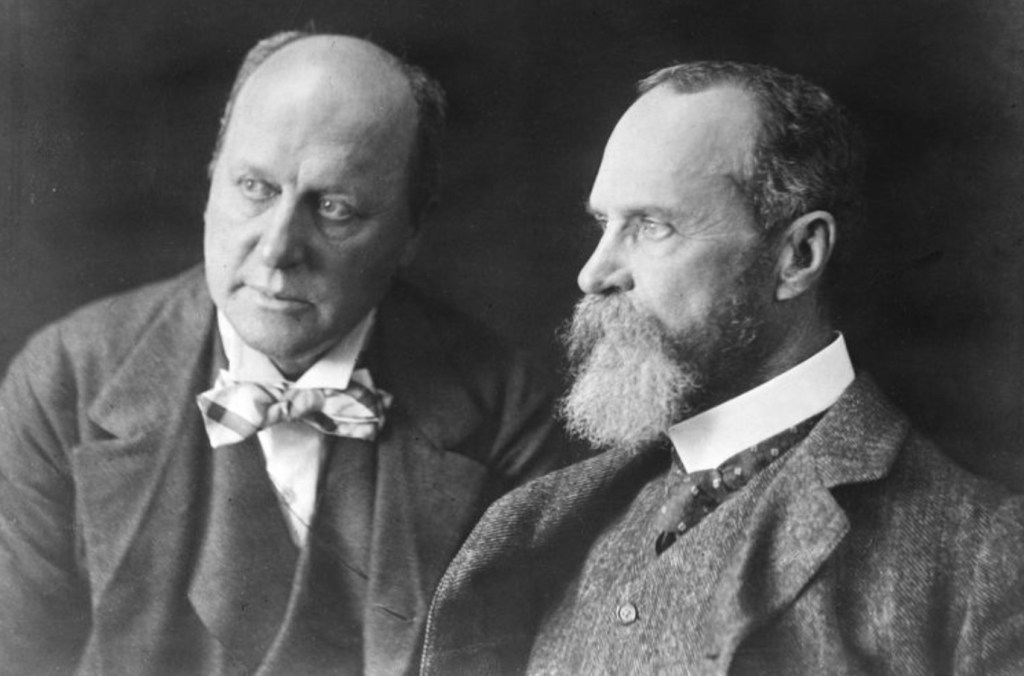
Henry (left) and William James, at William’s house in Cambridge, Massachusetts, 1904
He planned to visit all parts of the country, and succeeded; but back in England he had so many writing projects to start or finish that he was able only to write about New England, the mid-Atlantic states, and the south.
The grounds of my enjoyment of The American Scene are partly literary. The American Scene is written in a complex style often referred to as “late James” in contrast with the simpler style of his earlier novels and stories. Subordination, qualification, restatement, and refinement are basic features of this later style. It asks readers to read it slowly and then to read it slowly once more, to worry out of it the subtle perceptions and precise distinctions with which it is loaded. The critic Irving Howe says that no more than two or three pages of The American Scene should be read at a sitting. I’ve found that to be about right.
And I love this language, even if I have to read some passages over and over again to understand them. (I majored in classics, after all.) Reading it this way, I become reacquainted with the rich harmonies of English, with its prodigious vocabulary and oratorical power. To read such prose is refreshment after constant exposure to the castrated English in which even serious novels are written today.
But I also like The American Scene on non-literary grounds. James was a dismayed lover of the country of his birth, and so am I. It was Henry’s brother William who complained about their country’s devotion to “the bitch goddess success.” Henry saw changes brought about by that devotion everywhere as soon as he disembarked from his ship at Hoboken (to be the setting fifty years later of the movie On the Waterfront). He saw rows of expensive mansions along the Jersey shore, built to proclaim their extreme expensiveness but hapless to do anything else. In the headlines today we read about parents risking jail to get their children accepted by Ivy League colleges, the ultimate measure of success. James loved his country without in the least idealizing it; that is what I try to do.
The American Scene is about what America is not what it should be. James came chiefly as an observer, not a critic. In a passage about the Bowery, he uses the phrase “swarming jewry” to describe the crowds of jewish immigrants, mostly from eastern Europe, that he saw there filling the streets and the shops and the crowded tenements. The phrase sounds anti-semitic, but James had no desire that jews be excluded from America’s future. He visited their shops and the tenements and attended yiddish theatre. He was fascinated by the yiddish language and expected that it would enter into the making of the language of the future. He had none of the modern anti-semite’s fear of being “replaced”.
James sought to register the impersonal characteristic facts on his awareness for later transfer to his book. Throughout the book, he refers to himself as a “restless analyst” but he never intended to be an analyst of American institutions or mores in the way that Alexis de Tocqueville or James Bryce were. He said that he was “incapable of information.” More importantly for his purposes there are:
features of the human scene, there are properties of the social air, that the newspapers, reports, surveys and blue-books would seem to confess themselves powerlessb to “handle,” and that yet represented to me a greater array of items, a heavier expression of character, than my own pair of scales would ever weigh, keep them as clear for it as I might.
For some, The American Scene will be disappointingly impersonal. So famous a writer as Henry James now was could hardly avoid having to meet and dine with celebrities, and he met and dined with many. His first stop after his arrival at Hoboken was the home of the owner of Harpers, the firm that had agreed to publish the book that he would make out of his travels in America. Mark Twain was already a guest at the owner’s house, and what these two giants of American literature said to each other would be of the greatest interest. But neither the owner nor Mark Twain is mentioned in The American Scene. Neither is there any mention of James’ stay with Edith Wharton and her husband in western Massachusetts, or of the occasion, after dinner there, when James read out loud from Whitman’s Leaves of Grass, and Out of the Cradles Endlessly Rocking, and When Lilacs Last in the Dootyard Bloomed — read in a sort of subdued ecstasy. For details such as this, there is Leon Edel’s great biography of James.
James was more at home in refined settings such as the home of the gracious Whartons; he knew that he was, and on this trip to America he sought out unfamiliar settings where he knew that his capacity for receiving impressions would be tested.
James was surprised and dismayed by much of what he saw, but in most cases confined himself to recording his impressions. In a few cases, however, he could not contain his contempt, and then he was withering. For example, in New Hampshire he came across the following group of vociferous young people on vacation near North Conway:
The freedoms of the young three who were, by the way, not in their earliest bloom either were thus bandied in the void of the gorgeous valley without even a consciousness of its shriller, its recording echoes. The whole phenomenon was documentary ; it started, for the restless analyst, innumerable questions, amid which he felt himself sink beyond his depth. The immodesty was too colossal to be anything but innocence yet the innocence, on the other hand, was too colossal to be anything but inane. And they were alive, the slightly stale three : they talked, they laughed, they sang, they shrieked, they romped, they scaled the pinnacle of publicity and perched on it flipping their wings ; whereby they were shown in possession of many of the movements of life.
We learn from James’ biographer Leon Edel that he visited his brother William and his family in Chicorua, New Hamphire and took long walks in the hills, marveling at the autumn colors:
The apples are everywhere and every interval, every old clearing, an orchard ; they have ” run down ” from neglect and shrunken from cheapness you pick them up from under your feet but to bite into them, for fellowship, and throw them away ; but as you catch their young brightness in the blue air, where they suggest strings of strange-coloured pearls tangled in the knotted boughs, as you note their manner of swarming for a brief and wasted gaiety, they seem to ask to be praised only by the cheerful shepherd and the oaten pipe.
But amidst the “Arcadian” beauty of the New Hampshire autumn, he found poverty and squalor, and a degradation of the manners of the people suffering this poverty and squalor. Emerson had written “The god who made New Hampshire taunted the lofty land with little men” and James was of the same mind. He speculated that this degradation of manners was owing to the lack of two features of the English and European social landscape, the squire and the parson.
Didn’t it appear at moments a theme for endless study, this queer range of the finer irritability in the breasts of those whose fastidiousness was compatible with the violation of almost every grace in life but that one? “Are you the woman of the house?” a rustic cynically squalid, and who makes it a condition of any intercourse that he be received at the front door of the house, not at the back, asks of a mattresse de maison, a summer person trained to resignation, as preliminary to a message brought, as he then mentions, from the “washerlady.”
In New York City, he was overwhelmed by the presence of “the alien” — the recent immigrants to be found everywhere, but especially on the “electric cars” that James used to get around the city. But James wondered whether the term “alien” had any meaning in this new America:
Which is the American, by these scant measures?—which is not the alien, over a large part of the country at least, and where does one put a finger on the dividing line, or, for that matter, “spot” and identify any particular phase of the conversion, any one of its successive moments?
James wonders at the ease with which immigrants feel accepted in the New World:
The great fact about his companions was that, foreign as they might be, newly inducted as they might be, they were at home, really more at home, at the end of their few weeks or months or their year or two, than they had ever in their lives been before; and that he was at home too, quite with the same intensity: and yet that it was this very equality of condition that, from side to side, made the whole medium so strange.
But he found the new immigrants unapproachable, as if they were wholly engrossed by working out for themselves the import of their new life as Americans. He could not say for himself whether this made them “promising or portentous”.
The pages that James devotes to Boston, Concord, Salem, and the mid-Atlantic states are filled with the same brilliance and originality of perception; and in spite of being 120 years old, these perceptions do not seem to be of a foreign county or a far distant time, but very much of here and today.
He had little to say about the south, except that it still bore the marks of defeat (Appommatox having been a mere forty years before), and, presciently, that hatred of the liberated black was the chief note of society there. He found the blacks demoralized but praised W. E. B. Dubois’ book The Souls of Black Folks as the only book of real distinction to have come out of the South.
Why is The American Scene less read and commented on than most other works by James? It is not the only difficult book that James wrote. It may be that its unpopularity is owing not only in its style, but also to its refusal to be summarized. What James saw in 1904 and 1905 was a rapidly growing country of complexity unexampled on the face of the Earth. It was too large, too marked by contradictions, to be resolved into findings. Instead, “I would take my stand on my gathered impressions, since it was all for them, for them only, that I returned.” The uneasiness pervading those impressions, however, is unmistakeable. Would the people be worthy of the greatness of the land? In his preface to Leaves of Grass, Whitman had written “The largeness of nature or the nation were monstrous without a corresponding largeness and generosity of the spirit of the citizen.” James’ travels in America had left him unsure that there was a corresponding largeness and generosity of the spirit of the citizen.
But he had never ceased to be an American, it was still his native land, and because of the love he felt for it, he paid it the honesty of his gathered impressions.






 Books Matter