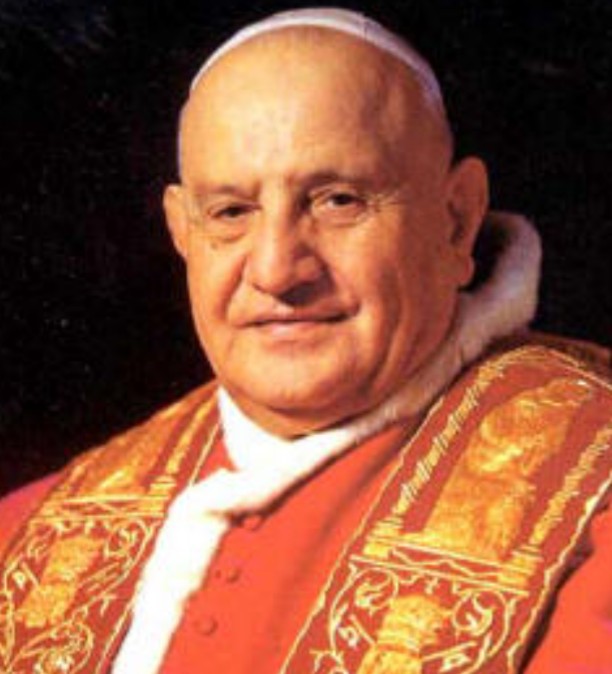
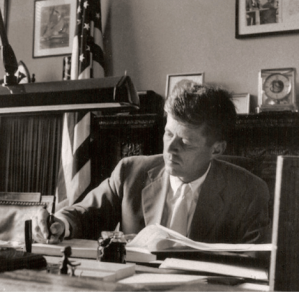
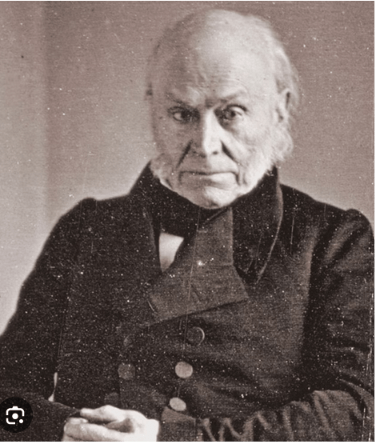
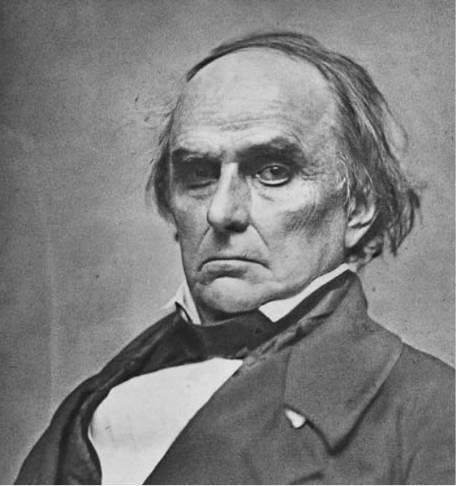
It is said of the music of Beethoven and Mozart that it is greater than can be performed. After listening to recitations of Lincoln’s Gettysburg Address by several famous actors, I was starting to think that Lincoln’s famous 272 words might be better than can be recited. In these recitations, something adventitious always seems to obscure the sense of the words and their matchless construction — something corny sired by Disney on Sandburg. What is lost is the nature of the address — its severe verbal economy, its passionate reasoning, making it an example of what the poet Marianne Moore said was Lincoln’s essential style, a “Euclid of the heart.” Continue reading “Gettysburg at Last?”
Articles and Comments
A Musical Hero
The other day I was able to add a name to the list of my musical heroes: Ferenc Fricsay (1914 – 1963), a Hungarian conductor whose recordings of Beethoven’s symphonies are considered unsurpassable by people whose knowledge of and love for the music entitle them to hold opinions like that. All I can say for myself is that his conducting of Beethoven gives me the pleasure that I look for from music, in abundance.
The pleasure that I look for from music I can get from other sources as well — it’s any pleasure that frees me from competitive and selfish impulses. It’s the kind of pleasure that I get eating vanilla ice cream. I can enjoy the ice cream without needing to believe that I am enjoying it better than anyone else, and I feel no need to have all the vanilla ice cream in the world to myself. When Christ returns in glory to judge the living and the dead, I hope He finds me enjoying a vanilla ice cream cone or listening to a recording of a performance by Ferenc Fricsay.

Fricsay was in poor health most of his life and died young. He kept conducting as long as he was physically able, without any apparent diminution of the joy that music gave him.
In YouTube, search for “Ferenc Fricsay Rehearses and Conducts Smetana’s Moldau”; there you will find a movie, made in 1960 for German television, of Fricsay rehearsing the Symphony Orchestra of the South-German Radio Stuttgart, in spite of pain and weakness.
Adlai Stevenson’s Victory in Defeat
On July 25, 1952, Governor Adlai Stevenson of Illinois was drafted by the the Democratic National Convention in Chicago to be the party’s candidate for President of the United States. It was the improbable beginning of a political campaign that is still remembered, by older Democrats at least, as a model for what political campaigns can and should be. Stevenson began his campaign by urging his fellow Democrats to talk sense to the American people, to tell them the truth — and he then proceeded to follow his own advice, to the best of his remarkable abilities. That he lost the election, by one of the widest margins in modern American history, seemed only to add luster to his foredoomed campaign.
For no one believed that Stevenson, or any other Democrat, could be elected President in 1952. President Truman was deeply unpopular, largely because of his inability to end the Korean War; Democrats had occupied the White House for twenty years, and the voters were quite reasonably wondering if it weren’t time for a change; and the Republican candidate for President was Dwight David Eisenhower, an authentic war hero who was liked and admired by people in both parties. Stevenson himself would later say that running against Eisenhower was like running against the ketsup on the kitchen table.

And in fact, Stevenson lost by a landslide. Eisenhower carried 39 of the 48 states, and received 55% of the popular vote. Stevenson carried only 9 states, all of them southern or border states where voting for a candidate of the party of Lincoln was still unthinkable. He even lost liberal, elitist Massachusetts — by over 100,000 votes. In addition, the Republicans won control of both houses of Congress, although by small margins.
But in spite of having led his party into electoral catastrophe, Stevenson developed a stubbornly loyal following within the party, and he would be the party’s voice and conscience for the remainder of the decade. His influence would extend far beyond the era of his political activity and would cross party lines. Political figures as diverse as Ted Kennedy, Donald Rumsfeld, and Henry Kissinger claimed to have been inspired to enter public life by Stevenson’s example. And the cartoon character Mike Doonesbury would take to bed wondering what would happen to our country if it were no longer inspired by Stevenson’s example.

Shortly after Stevenson’s death in 1965, the journalist Eric Severeid, who knew him well, wrote, ““All I know as a political reporter is that Adlai Stevenson injected humor and happiness and sophistication into American political life, and you have to have spent half your life listening to the normal run of American politicians to really understand what a fantastic accomplishment that was.”
In this post I will try to describe the qualities of Stevenson’s 1952 campaign for the presidency that made it so memorable.
**********
Stevenson’s nomination was owing to a set of unusual circumstances. President Truman had decided not to seek re-election after losing the New Hampshire primary to Senator Estes Kefauver of Tennessee. Going into the convention, Kefauver had more delegates pledged to him than any other contender for the nomination, but was still short of the number that he needed to be nominated. None of the other contenders for the nomination had a significant amount of support outside of their home states.

Truman detested Kefauver, who, to be fair to Truman, was widely disliked within the party for his sanctimonious manner. He and other party bosses began to look for someone other than Kefauver to be the party’s nominee, and they settled on Stevenson, who had been elected Governor of Illinois by the largest margin in state history. During the war, he had worked in the Department of the Navy and the State Department and had been a member of the original American delegation to the United Nations. But Stevenson had already announced that he would seek a second term as governor, and felt honor-bound to follow through on that commitment. Besides, his work as governor was well respected, he and his dalmation dog “King Arthur” were beloved figures in the streets of Springfield, and he was almost certain to be re-elected.
In the absence of a strong contender for the nomination, the Democrats were facing the prospect of a long convention, requiring many ballots to settle on a candidate. Although party officials had far more influence over conventions than they do today, Truman was powerless to avert this outcome.
This was the situation when Stevenson, as governor of the state hosting the convention, was invited to deliver a welcoming address. He told the delegates:
Here on the prairies of Illinois and the Middle West we can see a long way in all directions. We look to east, to west, to north and to south. Our commerce, our ideas, come and go in all directions. Here there are no barriers, no defenses, to ideas and aspirations. We want none; we want no shackles on the mind or the spirit, no rigid patterns of thought, no iron conformity. We want only the faith and conviction that triumph in free and fair contest.

Stevenson’s eloquence impressed the delegates, and even the least attentive among them must have realized that Stevenson was here criticizing Senator Joseph McCarthy and the spirit of fear and suspicion that McCarthy had introduced into American life two years earlier, when he began his campaign to expose alleged Communists and Communist sympathizers in the State Department and other branches of the government. Stevenson, it was clear to the delegates, had courage; among national political leaders, only Senator Margaret Chase Smith had previously dared to criticize McCarthy, in a speech before the Senate that she titled her “Declaration of Conscience.”

A draft Stevenson movement took shape among the delegates; one of the originators of the movement later recalled, “We started with a bicycle and suddenly we had a bandwagon.” Jacob Arvey, the Democratic boss of Chicago, finally got Stevenson to allow his name to be placed in nomination. Adlai Ewing Stevenson became the Democratic Party’s candidate for President of the United States on the third ballot.
Stevenson had twenty four hours to produce an acceptance speech. He had never used speech writers, and did not do so now, although he asked several friends and advisors for comments on his first draft.
The speech that he wrote would be one of the best that he wrote for the campaign, and one of the most famous speeches in American political history. Stevenson began by explaining why he had not sought the nomination that he now accepted:
I would not seek your nomination for the Presidency, because the burdens of that office stagger the imagination. Its potential for good or evil, now and in the years of our lives, smothers exultation and converts vanity to prayer.
This explanation proved controversial. Some people welcomed it as a sign that at last someone asking to be made president understood how much harm a president — a mere mortal — might do with the godlike powers of the office. Other people thought it showed that Stevenson was altogether too sensitive to be president.
He moved on to the most famous passage in the speech:
The ordeal of the twentieth century, the bloodiest, most turbulent era of the whole Christian age, is far from over. Sacrifice, patience, understanding, and implacable purpose may be our lot of years to come. Let’s face it. Let’s talk sense to the American people. Let’s tell them the truth, that there are no gains without pains, that there — that we are now on the eve of great decisions, not easy decisions, like resistance when you’re attacked, but a long, patient, costly struggle which alone can assure triumph over the great enemies of man — war, poverty, and tyranny — and the assaults upon human dignity which are the most grievous consequences of each.
One might admire Stevenson’s eloquence and still wonder whether it was good politics to warn the public that it would be having to undertake “a long patient costly struggle” of any sort; this was the public that had just engaged in a long patient costly struggle against depression and war. Stevenson understood this but felt that the public needed to be prepared for what the country might have to face in the years ahead.
When Stevenson came to the end of his speech, Eric Sevareid, who was covering the convention for CBS News, turned to a colleague and asked, “How are we going to report on a candidate who writes better than we do?” In fact, some people found the speech excessively literary.
Other people found it a refreshing change from the usual political cant and rhodomontade. Many of the country’s writers, artists, and scholars embraced Stevenson’s candidacy enthusiastically; John Steinbeck wrote an admiring preface for a paperback volume of Stevenson’s writings; celebrities such as Lauren Bacall and Judy Garland began to show up at Stevenson rallies.

During the subsequent campaign, Stevenson spoke often about employment, taxation, inflation and the other bread-and-butter issues that decide elections. But McCarthyism — and the hyper-patriotism that it was fostering — was never far from his thoughts, and he criticized it often, if seldom mentioning McCarthy by name.
On August 27, he made his most pointed criticism of McCarthyism in front of an audience that he did not expect to hear gladly what he had to say, the annual convention of the American Legion, in New York City. McCarthy had questioned the loyalty of General George C. Marshall. He told the legionnaires:
“We talk a great deal about patriotism. What do we mean by patriotism in the context of our times? I venture to suggest that what we mean is a sense of national responsibility which will enable America to remain master of her power — to walk with it in serenity and wisdom, with self-respect and the respect of all mankind; a patriotism that puts country ahead of self; a patriotism which is not short, frenzied outbursts of emotion, but the tranquil and steady dedication of a lifetime. The dedication of a lifetime — these are words that are easy to utter, but this is a mighty assignment. For it is often easier to fight for principles than to live up to them. . .
“There are men among use who use “patriotism” as a club for attacking other Americans.
“What can we say for the self-styled patriot who thinks that a Negro, a Jew, a Catholic, or a Japanese-American is less an American than he? That betrays the deepest article of our faith, the belief in individual liberty and equality which has always been the heart and soul of the American idea.

“What can we say for the man who proclaims himself a patriot—and then for political or personal reasons attacks the patriotism of faithful public servants? I give you, as a shocking example, the attacks which have been made on the loyalty and the motives of our great wartime Chief of Staff, General Marshall. To me this is the type of “patriotism” which is, in Dr. Johnson’s phrase, “the last refuge of scoundrels.”
Stevenson also accused the Republicans of tolerating McCarthyism to promote their own political fortunes. He was in fact nearly alone in his criticisms of McCarthy at this time.
Among national political leaders, only Senator Margaret Chase Smith of Maine had spoken out against McCarthy; it was two years before Edward R. Murrow would broadcast his famous editorial denouncing McCarthy, and two years before the venerable Boston lawyer Joseph Welch would ask McCarthy “Have you no sense of decency sir, at long last?” during the nationally televised Army-McCarthy hearings.

On the day before the election, he addressed a group of supporters with these elegant but prescient words:
Looking back, I am content. Win or lose, I have told you the truth as I see it. I have said what I meant and meant what I said. I have not done as well as I should have liked to have done, but I have done my best, frankly and forthrightly. No man can do more, and you are entitled to no less.
No one was really surprised when, on election day, Eisenhower was victorious, although the size of his victory seemed to Stevenson like a gratuitous rebuke. When the official results had bee
n reported, Stevenson told a group of supporters in Springfield, Illinois:
Someone asked me, as I came in down on the street, how I felt. I was reminded of a story that a fellow townsman of ours used to tell Abraham Lincoln. They asked him how he felt once after an unsuccessful election. He said he said he felt like a little boy who had stubbed his toe in the dark. That he was too old to cry, but it hurt too much to laugh.
**********
Then something happened that defied the political laws of gravity. After leading his party to electoral catastrophe, Stevenson was embraced by it and would remain its recognized leader and voice for the rest of the decade. He was constantly in demand as speaker or writer about the issues of the day; he sought and easily won his party’s 1956 presidential nomination.
In his run at the presidency in 1956, Stevenson questioned the new practice of using paid advertising in political campaigns. It degraded the political process to market candidates or platforms as if they were soap, Stevenson objected. And where were candidates to get the money to pay for the advertising, if not from wealthy donors with an interest in legislation that the candidates might be able to stop or shape? Stevenson foresaw the establishment of our current system of legalized bribery conducted under the aegis of the First Amendment’s protection of freedom of speech.

He also proposed that the United States place a moratorium on its testing of nuclear weapons in the atmosphere, until the United Stated and the Soviet Union could agree upon a treaty that permanently banned atmospheric testing by either country. Vice-president Nixon called the proposal “catastrophic nonsense”. But growing public concern over increasing amount of strontium-90 in the air, the water, and the food chain kept the idea alive in government circles, and in 1963 President Kennedy signed a Partial Test Ban Treaty with the Soviet Union that incoporated the main points of Stevenson’s proposal. It may be that the main tangible legacy of the wittiest, most eloquent politician of the twentieth century is that our breakfast cereal is less radioactive than it would have been, had he not spoken out against radioactive breakfast cereal.
At the 1960 Democratic Convention in Los Angeles, Stevenson was nominated for president by Senator Eugene McCarthy, who eight years later would become one of the principle opponents of the Vietnam War. “Let us not reject this man who made us all proud to be Democrats!” McCarthy implored the convention. Stevenson supporters immediately flooded the convention floor and brought proceedings to a halt. The convention managers let the vociferous demonstration run its course. It was the Democratic Party’s farewell to the man who had been the voice and inspiration of the party for eight years. John F. Kennedy of Massachusetts was nominated on the first ballot.

**********
Stevenson hoped to be asked to be Secretary of State in the Kennedy administration, but Kennedy offered him the choice of Attorney General, Ambassador to England, or Ambassador to the United Nations. Stevenson chose the latter.

Stevenson’s tenure as Ambassador to the United Nations got off to a difficult start. One of Kennedy’s first decisions as president was to go ahead with a plan — inherited from the Eisenhower administration — to remove Fidel Castro from power by backing an invasion of the island by a group of anti-Castro exiles. When rumors about the plan began to appear in the press, Kennedy told Stevenson that the rumors were not true, and Stevenson repeated the lie at the United Nations. When the invasion occurred, and failed disastrously, Stevenson was made to look like a liar, and he thought of resigning. He decided against doing so; the new administration did not need any more bad press.
Stevenson found that he had not forfeited the respect of the international community and went on to serve in his post with distinction. He continually urged the wealthiest nations of the world to do more to help the poorest nations, he spoke up for human rights, and he became an outstanding advocate for disarmament — he is said to have had nightmares about nuclear war.

And he would play an important part in a drama that brought the world closer to nuclear war than it has ever been before or since. During the Cuban missile crisis, he urged Kennedy to offer to scrap our “Jupiter” missiles in Turkey if Russia would withdraw its missiles from Cuba. Most of Kennedy’s other advisors thought that this proposal was too “soft”; that it savored of Munich and Neville Chamberlain. While Kennedy was considering what choice of action to take, Stevenson forced Russia to admit that it had missiles in Cuba by showing photographs of the missiles, taken by a U-2 aircraft. Kennedy then made Russia the offer that Stevenson had proposed: to withdraw our Jupiter missiles from Turkey if Russia withdrew its missiles from Cuba. Russia agree to the proposal, ending the crisis. It did not immediately become public that Kennedy had made any concession to Russia; the public was made to believe that it was Kennedy’s unyielding toughness alone that had brought an end to the crisis.
**********
One of the compensations of his last years was his friendship with Eleanor Roosevelt, who became his supporter, advisor, and confidant. He shared with her many convictions, most importantly a belief in the supreme importance of human rights. When she died in 1962, he spoke at a memorial service for her at the United Nations; he said:

The United States, the United Nations, the world has lost one of its great citizens. Mrs. Eleanor Roosevelt is dead; and a cherished friend of all mankind is gone. Yesterday, I said that I had lost more than a friend — I had lost an inspiration: for she would rather light candles than curse the darkness and her glow had warmed the world.
Adlai Stevenson died of a heart attack in London, England on July 14, 1965. His death surprised most people who knew him, and some believed that he was killed by the stress of having to sit on his growing doubts about the wisdom of President Johnson’s escalation of the war in Vietnam. Eric Severeid, who had a long talk with him two days before he died, believed that he died of exhaustion/.
Several days before he died, he spoke the following words avt a conference in Geneva; his concern for the environment, going back to his call for a ban on atmospheric testing of nuclear weapons, here finds its fullest expression:
We travel together, passengers on a little space ship, dependent on its vulnerable reserves of air and soil; all committed for our safety to its security and peace; preserved from annihilation only by the care, the work, and I will say, the love we give our fragile craft. We cannot maintain it half fortunate, half miserable, half confident, half despairing, half slave to the ancient enemies of man half free in a liberation of resources undreamed of until this day. No craft, no crew can travel with such vast contradictions. On their resolution depends the survival of us all.
**********
Seventy-four years after Stevenson’s first run at the presidency, it may not be immediately apparent why he became a hero to the Democrats. His support of the New Deal traditions of the Democratic party was genuine, but somewhat perfunctory. He wasn’t a champion of liberal causes such as civil rights for African Americans or the rights of other abused groups. Unlike his friend Eleanor Roosevelt, he never sought direct acquaintance with the poor in order to understand their suffering. He wasn’t at all what today is called a “progressive.”
And in some ways, he set a bad example for following generations of Democrats — indulging in wit tainted with snobbery. Reflecting on his loss to Eisenhower in 1952, he said, “The people have spoken. As for their wisdom, well, Coca Cola still outsells champagne.” When Eisenhower became president in 1953, Stevenson said “The New Dealers have been replaced by the car dealers.” When asked whether it bothered him that the popular preacher Norman Vincent Peale had endorsed Eisenhower for president, he said “Not at all. I find the Apostle Paul appealing but Peale appalling.” Great wit, but bad politics.
And he never became reconciled to the corny side of politics. For example, once when he was campaigning in Florida, a supporter handed a stuffed alligator as a gift. Instead of holding it up in the air for the benefit of the press photographers, he looked at stuffed alligator and said “For Christ’s sake what’s this?”
And yet he became a hero -to the Democrats — because he was what many of them wanted to be and wanted their fellow Americans to be. He was deeply rooted in an America that was simpler, more idealistic, more sure of itself and therefore less self-righteous than America found itself to be at mid-twentieth century.
**********
More than most politicians, he looked to the past for guidance and support — in particular, to the role his family had played in our country’s history. His grandfather Adlai Stevenson I served as vice-president of the United States during Grover Cleveland’s first administration — which historians regard as an oasis of good government in the almost bottomless miasma of the Gilded Age. And on his mother’s side of the family was a great-grandfather, Jesse Fell, who was both a close friend and political advisor of Abraham Lincoln — the one of Lincoln’s advisors, it is said, who never asked Lincoln for anything in return for his services.

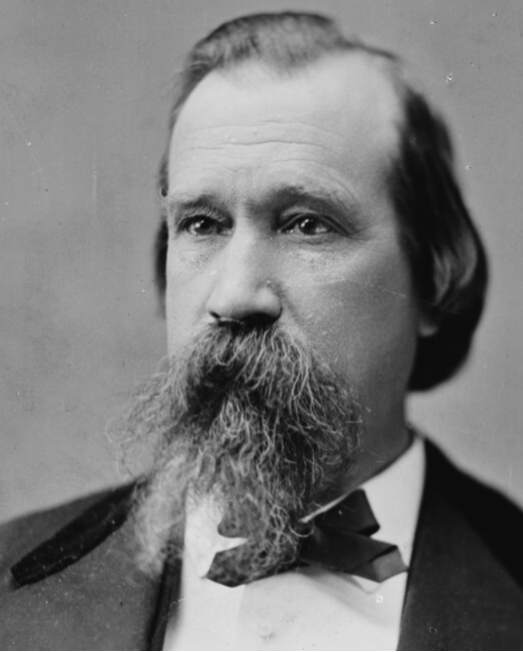
Jesse Fell (1808 — 1887) Cleveland — Stevenson Campaign Poster ca. 1885
Stevenson was proud of his connection to Lincoln through Jesse Fell, he studied Lincoln all his life, and there has probably been no politician before or since who was so thoroughly steeped in Lincoln’s words and thought. His feelings about his grandfather Adlai Stevenson I may have been ambivalent; as a young Democratic lawyer, he supported Stephen Douglas against Lincoln for the United States Senate. But Grandfather Stevenson set an example of dignity in his bearing and fairness in his dealing with others that won him the respect of members of both parties.
**********
The phrase “human dignity” occurs in crucial contexts in Adlai Stevenson’s speeches. This simple idea — that every human being possesses a dignity that others ought to consider inviolable — was the central tenet of his political philosophy.
His concern for the dignity of others explains his contempt for Joseph McCarthy — that violator of the dignity of others — and his distaste for Richard Nixon — who was always willing to surrender his own dignity to advance his political career
And it may explain why, although he was roughly handled by democracy, he never lost faith in the democratic ideals that were espoused and vindicated by his political hero, Abraham Lincoln.
**********
Shortly after Stevenson’s death, Walter Lippmann wrote:
“We must wonder whether we have buried with Adlai Stevenson some element of the promise of American life. For in this generation he stood apart — as somehow a living specimen of the kind of American that Americans themselves, and the great mass of mankind would like to think that Americans are. Shall we see his like again? Or was he the last of his noble breed? On this question hangs the American future.”
“I would like to sit in the shade with a glass of wine in hand and watch the people dance.”Honest Jack Health; or, Six Months in a Johnny
by John Breithaupt
Note: The following post is a personal essay rather than a discussion of a book. I put it here because I don’t have any other place to put it. If it makes a literary point of any sort, I assume it would be that a straightforward description of intense personal experience can make surprisingly dull reading,
But right Jack Health—honest Jack Health, true Jack Health—Banish health and banish all the world. — John Keats
In October 2024 I was hospitalized with chills, fever, and a rubbery weakness in all my limbs. Sickness in different forms had sometimes made me more miserable than I felt on this occasion. The flu, in particular, had made me question whether existence is the privilege that it is commonly supposed to be. This weakness was something that I had never experienced before. It made me helpless — unable to walk, to lift things, or to resolve on even the most ordinary courses of action, such as standing up. I had — what I would not know for sure until several days later — a urinary tract infection (UTI).
It was an illness that would almost kill me. That it didn’t kill me is owing to the efforts of a group of people of different backgrounds, training, and experience, all of whom had chosen at decisive moments in their lives to pursue careers in healing. They were spread across three hospitals and two rehabilitation centers, but they worked as a team. Our health care system is controversial; no one is happy with it as it is; everyone has a different solution of its problems. But I can witness that this system, with all its Rube Goldberg indirection, and all its wastefulness, works. And I hope that anyone who undertakes to reform it will be aware that they are operating on a living being.
To return to my story, I had fallen against our piano, holding a cup of coffee, which I spilled down my front. My wife Lorraine made phone calls, and then burly young men were strapping me onto a gurney and then lowering me perilously down our front steps, which had never before seemed so steep. Then I was abruptly lifted up and inserted into an ambulance. An ambulance ride in the Commonwealth of Massachusetts makes you aware of potholes and speed bumps in a way that you have never been before.I felt relieved when the ambulance arrived at the hospital — I don’t know which one it was but that didn’t make any difference. I was getting rid of the responsibility of taking care of myself. Hospitals are filled with people who have undergone years of rigorous training and practice in order to be able to take care of aging men with urinary tract infections.
I was wheeled into a space demarcated by a curtain that created a little privacy. I was yanked off the gurney and dragged onto a bed. This yank and drag maneuvre — which I was going to be the star of many times in the months ahead — never ceased to frighten me; I could too easily imagine myself falling to the floor in the space between the gurney and the bed. Then I was stripped of my clothing and given a johnny to put on. I would wear nothing but johnies for the next six months.
Lorraine appeared by my bedside. This was a second great relief to me. She understands what goes on in hospitals, having put herself through college working as a unit secretary at several different teaching hospitals in Boston. She had won awards for her work there and was even nicknamed “RADAR” by her hospital’s staff. She asked me whether it was a compliment to be nicknamed “RADAR. I assured her that it was. When I am bewildered by events in the hospital, she interprets them to me. When something strikes me as ominous, she tells me whether it truly is, or isn’t.
So I turned to her and said, “Where am I? What is going on?”
She explained to me that I was in the Emergency Room of the Winchester Hospital, and that I was waiting to have some blood drawn so that it can be determined what sort of infection I had — for it was assumed that I had some sort of infection.
Then nurses and nurses aids came in and asked me questions about how I felt and then someone came in to draw blood. I am what is called a “tough stick”; my veins go into hiding when a phlebotomist enters the room. The person drawing my blood this time had no trouble filling the little glass tubes with blood.
The result of this blood test determined my fate for the next six months. I had an infection that could be treated best by intravenous antibiotics. I was admitted to the hospital.
Then the doctors came in. I like doctors because they are smart. The software engineers I worked with for forty years were also smart, but in a different way; if they weren’t exactly absent minded, they were “present minded somewhere else.” Doctors are present minded where they are. They have to be. They are responsible for the well being of the patients entrusted to their care. I never wanted to be a doctor. I make mistakes. I forget things and when I do I make things up to fill in for what I forgot. You can’t be like that and be a doctor.
When I first meet a doctor, I crack jokes. It’s a technique – and a not very effectve one – for stifling anxiety. The doctors always smiled a certain recognizable smile to acknowledge that I had made a joke and then proceeded with business. I extrapolated from this many-times-repeated ritual that medical schools teach their students how to deal with The Patient Who Cracks Jokes. If they don’t teach this, they should.
I couldn’t help thinking about the sacrifices that doctors make to become doctors — the years of study and training, the hard work of developing an accurate and capacious memory, the struggle to subdue one’s thinking to a severe problem-solving discipline, the persistence to make all these mental gains part of one’s second nature, the drain on one’s energy and the hijacking of one’s time. Of course, for people with a real bent for this way of life, all the acrifices are worth it. But one young doctor — a sensitive and thoughtful one — saw a copy of Leon Edel’s biography of Henry James on my bed and asked me, “Who is Henry James?” I said “He was a novelist who wrote about rich and naive Americans who get entangled emotionally with impoverished and cynical Europeans.” “Is he any good?” ‘I like him.” “I’ll have to read him some time,” he said wistfully. He had just completed his years of schooling and training, when the medical student and fledgling doctor have little time for extra-curricular reading. Doctors do eventually find time to read books; I know a well read doctor who can recite from the works of Wendell Berry chapter and verse.
But I spent more times with nurses than with doctors. If I overcame the illnesses that kept me in johnnies for six months, it is owing in the first place to nurses, who delivered the medical care that made recovery possible. Their responsibilities are sobering, too. They can kill a patient by misplacing a decimal point, for example. My wife almost died this way. Once when she was in the hospital — one of the renowned teaching hospitals in Boston — she noticed that she was getting ten times the amount of intravenous Heparin than she was supposed to be getting. She rang for the nurse who, realizing his mistake, looked like it would have been OK with him if the Earth had opened up and swallowed him. My wife had almost died like a rat who had gorged itself on rat poison.
I spent the most time of all with nurses’ aides and orderlies. It is owing to their efforts that bed ridden old men stay clean and dry and get a change of bed sheets and johnnies every day. A very large majority of the nurses aides and orderlies who kept me clean dry and reasonably comfortable were from Haiti. Whenever I was attended by aide whom I had not known before, I started an exchange that went like this:
“Bonjour. Ça va?
The startled aide would say,
“Oui, Ça va. Parlez-vous français?”
“Un petit peu. D’où venez-vous? d’Haiti?”
“Oui, je viens d’Haiti. Mais comment se fait-il que vous parlez français?”
And then the aide would go on a tear doling out the loveliest Haitian French that ever blessed my uncomprehending ears. I could always bring the conversation back to my level by interrupting the aide with the question:
“Quelle heure est-il?”
I can understand the answers to that question. “Trois heures et demie” I thoroughly get. I can read “Un Coeur Simple” by Flaubert, too. But I haven’t the faintest idea how to say, in French, “The vending machine on the second floor has shrink-wrapped egg salad sandwiches that really aren’t half bad.”
The prolonged dullness of a day in a hospital bed is punctuated three times by the arrival of a person from “food services” carrying a covered dish on a tray: breakfast, lunch, or dinner. Hope springs eternal in the human breast as the human watches the person from food services lift the cover off the tray –dramatically, it always seems — to reveal something perhaps edible. Occasionally, it was.
My infection was serious. I was given large doses of powerful antibiotics intravenously and still developed sepsis — twice. I did not talk sense during these episodes of infection; this was hard on Lorraine, who had no way to tell whether I would ever recover my wits. Once I went on a long harangue about methadone, a subject that had never interested me. I have no memories of Thanksgiving, Christmas, or New Years Day — Lorraine celebrated tnese holidays alone. On Valentine’s Day I was in the ICU. A slum lord from Queens became president for tbe second time without my noticing. A friend of mine — a tall guy with a fine mane, native American DNA, and a personality that fills a room — visited me once or twice. I have no memories of his visits.
And then began a confused period — from October through January — when I was moved around among hospitals and rehabs and ICUs as my case required. Once I woke up at 2:00 a.m. feeling the worst pain I had ever felt, in every limb: it was the flu. I rolled my self out into the dimly lit hall and called for help; quietly, because I didn’t want to awaken the other residents. I don’t remember what happened next. In memory I’m there in the dimly lit hall, calling for help, hoping to be discovered by someone. Another time I was brisked away to a room where I found myself surrounded by cardiologists, who were arguing about something. A cardiologist older than the rest appeared, assessed my condition, and voiced his opinion, which settled the argument. One of the younger doctors produced a paddle. This I recognized from the movies. My chest was bared and the young doctor placed the paddle on it. He nodded and then WHUMP my back arched and my body rose an inch or two above the mattress and then fell back. The young doctor looked at a monitor and nodded again. Again I went WHUMP. I caught my breath and looked at the doctors and said “That was interesting but let’s not do it again, shall we?” No one smiled, from which I gathered that my heart had been misbehaving in some serious way. In fact, I have AFIB.
Eventually the doctors got ahead of all my infections and I was ready to be dischaged, but not to go home. I was heading to a rehabilitation facility.
Rehabilitation facilities are, in my experience, more depressing than hospitals. Your stay in a hospital is short; either you are cured or you leave under a blanket feet first. Rehabilitation facilities keep you until you are rehabilitated, and that term is the ignis fatuus of medical care. For example, there was a gap of about eight weeks between the date when I believed myself to be rehabilitated and the later date when I was rehabilitated officially and allowed to go home.
Granted, I needed rehabilitation because the long weeks of lying in hospital beds had so weakened my legs that I could no longer walk. My arms were strong from getting around in wheelchairs, but my legs were incapable of bearing weight. And the rehab facility was understaffed, so that I got less physical therapy than what I needed to get stronger. Even so, I got strong enough to be allowed to roam the halls with a walker, which helped.
But regaining one’s strength, when one is in one’s mid-seventies is slow. To keep going, it is necessary to learn to take pleasure in small gains, to note how one is doing as one goes along. Day-to-day progress is invisible, but month-to-month progress is often solid and apparent. It is also good to set goals. My goal is to walk — with a walker or not — from the parking lot of the Great Meadow Wildlife Refuge in Concord, Massachusetts on the causeway all the way across the marsh to the Concord River. Goals like this re-attach one to life. Detachment is what I fear most.
Toward the end of my six months in a johnny there appeared, providentially, a friend — a man from East Boston, in his eighties, who came every day to see his wife — who was never going to go home. He always came a little before the start of visiting hours to have a cup of coffee in the cafeteria, where I was always having my first cup of the day. He talked about friends in East Boston, and his time in the army, and other things. His life had been hard; he had never done more than scrape by. But he had no complaints. He had learned not to expect too much. I praised him for his faithfulness to his wedding vows but he brushed it off. He was good and decent without giving it a thought. He was all in all a very ordinary man. What he is, I hope to be.
Almost six months to the day after I was first admitted to the hospital, I exchanged my johnny for my regular clothes and Lorraine took me to the entrance of the facility in a wheelchair and helped me get into our car.
Samuel Clemens Remembered by William Dean Howells
My Mark Twain is William Dean Howells’ memoir of his forty four year friendship with Samuel Clemens, as he preferred to call the man whom he admired above all others, both as a writer and a person. Howells wrote his memoir shortly after Clemens died in 1910, to work through the grief that he felt at the loss of his incomparable friend. Unlike most of Howells’ other writing, it is vivid with emotional intensity.
Howells met Clemens in 1869, shortly after he reviewed Clemens’ book “Innocents Abroad” in the Atlantic Monthly, of which he was an editor. Howells praised Clemens’ book –- a satirical account of a group of wealthy Americans on a chartered tour of the Middle East — writing that “it is such fun as we have not had before.” Clemens was grateful for the favorable review. He was already famous and his books were selling well; what he didn’t have was respectability, and Howells, sitting atop the east coast literary establishment, could help him become respectable. Twain decided to go to Boston to thank Howells for the review in person.

But respectability, as Howell’s account of their first meeting makes clear, was something that Twain both desired and scorned. He appeared at Howells office at 124 Tremont Street wearing a sealskin coat turned inside out, to show the fur. That, and his “crest of dense red hair and magnificent mustache”, made Twain a vivid figure of a type unknown in genteel Boston. Twain was saying, in effect, accept me, yes, but accept me on my own terms, for the kind of person I am. Howells accepted Twain for the person he was, with a few reservations, and that acceptance was a foundation of their friendship.
The first meeting with Twain also revealed to Howells the youthfulness at the heart of Twain’s personality; Howells wrote that Twain was always a boy – sometimes a good boy, sometimes a bad one, but always a willfull boy.
But Twain’s love of boyish fun on one occasion betrayed him into making a social blunder that he would regret bitterly. The publisher of the Atlantic Monthly decided to throw a party to honor John Greenleaf Whittier on his seventieth birthday and invited Twain to speak at it. For the occasion, Twain wrote a skit in which three hobos in the California Gold Rush would try to get a free night’s lodging by passing themselves off as Emerson, Longfellow, and Holmes — all of whom would be at the party. Twain launched into the skit with his usual gusto and quickly reached the point at which he expected the audience to be holding its sides with laughter. Silence. He persevered on to the next sure fire gag line, and the next, hoping for a response. Nothing. Longfellow looked down at his dinner plate; Holmes stared ahead stoically; Emerson, bemused by dementia, was unaware of what was going on. Toward the end of the skit, someone in the back of the room laughed hysterically, not because the skit was funny, but because the situation was dreadful.
Twain castigated himself mercilessly for this blunder. Longfellow wrote him a gracious letter saying that he hadn’t been offended. Howells told him that no great harm had been done and that he should move on. But the truth of the matter was that Twain had offended people who had never given him offense; that he had put the organizers of the party, including Howells, in a difficult position; and that he had made an ass of himself. That was the truth of the matter and Twain would hear of of nothing else.
Once when Howells was talking with Twain about the past and how they felt about it, Twain said that he found the past to be humiliating, because it was filled with things that he had bitterly to regret. Twain was truthful about the things that he had to regret beyond any other man that he knew, Howells wrote; he was absolutely, aggressively truthful. He told Howells about how, one day, he had taken his son out for a walk and was caught in the rain. The boy came down with a cold and died two days later. “I killed my boy,” Twain told Howells. Howells tried to tell Twain that he could not know for sure that he had killed his boy; Twain wouldn’t hear any of it.
Twain would insist on the truth even when doing so jeopardized his chance of happiness. For example, when Twain asked Livia Langdon’s father for her hand in marriage, her father replied that before he could consent to that, he wanted to see five letters of reference from people who had known Twain out west. Twain thought that it would be dishonest to ask for references from people who would whitewash his character, so he asked five people who had known him at this worst. When Langdon received the letters, he asked Twain to come see him. “Mr. Clemens,” he said, “it appears that none of your friends has a good word for you.” Twain lowered his head in shame. “So I guess I will have to back you myself.”

Howell’s was with Clemens during his best times as well as his dark ones. His marriage to Livia Langdon turned out to be exceptionally happy, and he rejoiced in the children that they had. Between 1876 and 1893, he produced his Mississippi River masterpieces, Tom Sawyer, Huckleberry Finn, Life on the Mississippi, and Pudd’nhead Wilson, along with several lesser but popular works. His writing sold well, enabling him to build the extravagant mansion in Hartford, Connecticut, that would be his joy for years. He reveled in his celebrity and the opportunities that it afforded him to meet and form friendships with Ulysses Grant, Heller Keller, and other remarkable people.

But gloom seemed more and more to occupy Twain’s mind as the years passed. His later years were in fact difficult. An unwise business venture left him deep in debt, forcing him to undertake exhausting lecture tours. His wife and his daughter Jean died, griefs from which he did not recover.
And he was disturbed by what he saw happening in our country: the corruption of our democratic institutions by money, racism growing more deeply entrenched and more violent, and the gap in wealth between the rich and poor growing constantly wider.
And he was alarmed by the worldwide growth of colonialism. America had succumbed to its temptations, occupying the Philippines and toying with the idea of taking Cuba. He and Howells joined the American Anti-Imperialist League in protest. King Leopold of Belgium had instituted the savage exploitation of the inhabitants of the Congo on the rubber plantations there, provoking Clemens to write his satirical masterpiece “King Leopold’s Soliloquy”. The horrors of the Great War, which began only four years after his death, would have devastated him.

Clemens is our country’s greatest humorist; he could be funny like no one else. But his amateur sleuth Pudd’nhead Wilson spoke for him when he wrote in his calendar:
Everything human is pathetic. The secret source of Humor itself is not joy but sorrow. There is no humor in heaven.
Howells wrote about his old friend:
It is in vain that I try to give a notion of the intensity with which he pierced to the heart of life, and the breadth of vision with which he compassed the whole world, and tried for the reason of things, and then left trying:
He ended his memoir with the following words:
Next I saw him dead, lying in his coffin amid those flowers with which we garland our despair in that pitiless hour. . . I looked a moment at the face I knew so well; and it was patient with the patience I had so often seen in it: something of puzzle, a great silent dignity, an assent to what must be from the depths of a nature whose tragical seriousness broke in the laughter which the unwise took for the whole of him. Emerson, Longfellow, Lowell, Holmes—I knew them all and all the rest of our sages, poets, seers, critics, humorists; they were like one another and like other literary men; but Clemens was sole, incomparable, the Lincoln of our literature.
The Compact Muse
This post is a collection of poems that I like and that have nothing else in common except that they are short.
There was a young lady named Bright,
Whose speed was far faster than light;
She set out one day,
In a relative way,
And returned on the previous night.
— Anon.
This Humanist whom no beliefs constrained
Grew so broad-minded he was scatter-brained.
— J. V. Cunningham.
People expect old men to die,
They do not really mourn old men.
Old men are different. People look
At them with eyes that wonder when ?!
People watch with unshocked eyes;
But the old men know when an old man dies.
— Ogden Nash
Love without hope as when the young bird catcher
Swept off his tall hat to the squire’s own daughter
So let the imprisoned larks escape and fly
Singing about her head as she drove by.
–Robert Graves
Here lies the preacher, judge, and poet, Peter,
Who broke the laws of God, and man, and metre.
— Lord Jeffries
The old dog barks backward without getting up.
I can remember when he was a pup.
— Robert Frost
I stole forth dimly in the dripping pause
Between two downpours to see what there was.
And a masked moon had spread down compass rays
To a cone mountain in the midnight haze,
As if the final estimate were hers,
The mountain stood exalted in its place.
So love will take between the hands a face . .
–Robert Frost
Hi! handsome hunting man
Fire your little gun.
Bang! Now the animal is dead and dumb and done.
Nevermore to peep again, creep again, leap again,
Eat or sleep or drink again. Oh, what fun!”
— Walter de la Mare
Oh life is a glorious cycle of song
A medley of extemporanea
And I am Marie of Rumania
— Dorothea Parker —
If I pass during some nocturnal blackness, mothy and warm,
When the hedgehog travels furtively over the lawn,
One may say, “He strove that such innocent creatures should come to no harm,
But he could do little for them; and now he is gone.”
—Thomas Hardy
No dust have I to cover me,
My grave no man may show;
My tomb is this unending sea,
And I lie far below.
My fate, O stranger, was to drown;
And where it was the ship went down
Is what the sea-birds know.
— Edwin Arlington Robinson
Animula vagula blandula
Hospes comesque corporis
Quae nunc abibis in loca?
Pallidula rigida nudula
Nec ut soles dabis ioco
–Hadrian
Underneath this sable hearse
Lies the subject of all verse
Sydney’s sister, Pembroke’s mother
Death, ere thou hast slain another,
Fair and learned and good as she
Time shall throw a dart at thee.
–William Browne of Tavistock
Griefs, Not Grievances

The American poet Edwin Arlington Robinson was born in Head Tide, Maine in 1869 and died in New York City in 1935. He is known today mostly for having written a poem, “Richard Cory”, that provided the title and lyrics for a song by Simon and Garfunkel, and for three or four other poems that have been, in his words, “pickled in anthological brine”. In his lifetime he was best known for several long poems on Arthurian themes that are far from being his best work.
He discovered that he was a poet while still in high school and never tried to be anything else. Like Keats and so many other English language poets (of earlier generations), he began by translating passages of the Latin poet Vergil; the surviving examples of these translations show him already to have been a careful craftsman in verse. By his mid-twenties he had begun to write better poetry than anyone else in America at the time.
His family was gifted and troubled; you can find the details in Scott Donaldson’s meticulously researched Edwin Arlington Robinson: A Poet’s Life. What matters, if you are a lover of poetry, is not that he found life hard, but that he succeeded in doing what he set out to do.
From time to time, a poet or critic writes an essay deploring the reading public’s neglect of this distinguished artist, for acquaintance with his work can lead to no other estimation. The poets Robert Mezey, Donald Hall, and several other poets and critics have published good selections of his works. The Library of America, however, has denied him entrance into the American canon, instead conferring the honor of a dedicated volume on Gary Snyder and other, in my opinion, lesser lights.

So what is going on with Edwin Arlington Robinson?
Readers of his book The Children of the Night (1897) would have found in it poems such as “The Mill”:
The miller’s wife had waited long,
The tea was cold, the fire was dead;
And there might yet be nothing wrong
In how he went and what he said:
“There are no millers any more,”
Was all that she had heard him say;
And he had lingered at the door
So long that it seemed yesterday.
Sick with a fear that had no form
She knew that she was there at last;
And in the mill there was a warm
And mealy fragrance of the past.
What else there was would only seem
To say again what he had meant;
And what was hanging from a beam
Would not have heeded where she went.
And if she thought it followed her,
She may have reasoned in the dark
That one way of the few there were
Would hide her and would leave no mark:
Black water, smooth above the weir
Like starry velvet in the night,
Though ruffled once, would soon appear
The same as ever to the sight.
Charitable readers would have allowed Robinson his right to think an occasional bleak thought, and turned to other poems, such as “The Clerks”:
I did not think that I should find them there
When I came back again; but there they stood,
As in the days they dreamed of when young blood
Was in their cheeks and women called them fair.
Be sure, they met me with an ancient air,—
And yes, there was a shop-worn brotherhood
About them; but the men were just as good,
And just as human as they ever were.
And you that ache so much to be sublime,
And you that feed yourselves with your descent,
What comes of all your visions and your fears?
Poets and kings are but the clerks of Time,
Tiering the same dull webs of discontent,
Clipping the same sad alnage of the years.
Other poems in the book would reveal the nature and subject matter of Robinson’s work as a whole. His subject matter is ordinary people and their trials and misfortunes; the treatment of this subject matter is detailed, restrained, and classical; for example, the poem “Reuben Bright”:
Because he was a butcher and thereby
Did earn an honest living (and did right),
I would not have you think that Reuben Bright
Was any more a brute than you or I;
For when they told him that his wife must die,
He stared at them, and shook with grief and fright,
And cried like a great baby half that night,
And made the women cry to see him cry.
The singers and the sexton and the rest,
He packed a lot of things that she had made
Most mournfully away in an old chest
Of hers, and put some chopped-up cedar boughs
In with them, and tore down the slaughter-house.
Robinson would have known Wordsworth’s poem “Michael”, about a shepherd whose son leaves home to make his fortune in some far away place, and disgraces himself there in such a way that it is impossible that he should ever return home. Upon learning of his son’s disgrace, Michael went to a stone enclosure for his sheep that he had been building with his son, and sat down in it, “and never lifted up a single stone.” Reuben Bright’s grief is similarly objectified in a single act, that of tearing down his slaughter house, but how different in effect the two poems are. Robinson’s poem has the brutal reality of a headline, which distances it from the moving pathos of Wordsworth’s idyll. Mankind cannot stand very much reality, wrote T. S. Eliot, and Robinson’s poems are full of reality unpalliated.
No poem has more of it than “Eros Tyrannos” (Love the Tyrant), which elevates into tragedy the familiar story of a woman who married in haste, or for wrong reasons, with all the rest of her life for regrets. Aristotle said that every tragedy is centered on a “reversal of fortune”, in which not only the protagonist but all his household (family, slaves, dependents) are brought to ruin. In “Eros Tyrannos”, the reversal of fortune has already occurred. A young woman, fearing never to find a man, has married a scoundrel, and her life, and the honor of her family and perhaps even of her town, have been brought to ruin:
She fears him, and will always ask
What fated her to choose him;
She meets in his engaging mask
All reasons to refuse him;
But what she meets and what she fears
Are less than are the downward years,
Drawn slowly to the foamless weirs
Of age, were she to lose him.
Between a blurred sagacity
That once had power to sound him,
And Love, that will not let him be
The Judas that she found him,
Her pride assuages her almost,
As if it were alone the cost.—
He sees that he will not be lost,
And waits and looks around him.
A sense of ocean and old trees
Envelops and allures him;
Tradition, touching all he sees
Beguiles and reassures him;
And all her doubts of what he says
Are dimmed with what she knows of days —
Till even prejudice delays
And fades, and she secures him.
The falling leaf inaugurates
The reign of her confusion;
The pounding wave reverberates
The dirge of her illusion;
And home, where passion lived and died,
Becomes a place where she can hide,
While all the town and harbor side
Vibrate with her seclusion.
We tell you, tapping on our brows,
The story as it should be,—
As if the story of a house
Were told, or ever could be;
We’ll have no kindly veil between
Her visions and those we have seen,—
As if we guessed what hers have been,
Or what they are or would be.
Meanwhile we do no harm; for they
That with a god have striven,
Not hearing much of what we say,
Take what the god has given;
Though like waves breaking it may be,
Or like a changed familiar tree,
Or like a stairway to the sea
Where down the blind are driven.
Robert Frost said that Robinson was the “prince of heartachers”, that he gave us the poetry of griefs, and left the grievances for others. This may account for his non-acceptance by the academies, who require of all artists that they shoulder arms against the world’s injustices. Robinson instead asserted the immemorial privilege of poets to do nothing but sing their dolefullest.
As Edwin Arlington Robinson lay dying of cancer in a New York Hospital at the age of 65, he said that he had no regrets, that he had had a good life. He had been a success, on his own terms, having written a few poems that will be remembered anywhere and everywhere there are people for whom poetry is one of the ordinary and indispensible pleasures of life.

Playing the Music
I am writing this post not as a music critic but as a music listener. I am writing to recommend a recording that moves me like none other that I have ever heard. It is a recording of Beethoven’s Kreutzer Sonata by the violinist Josef Szigeti and the composer Bela Bartok at the piano. The recording was made April 13, 1940, at the Library of Congress in Washington D.C.
Both Szigeti and Bartok were refugees from their native Hungary. Szigeti had come to the United States first. Bartok had arrived two days before this recording was made. They were grieving for their country, which they deeply loved.
People with a proper musical education can detect imperfection in this performance — mostly departures from the apparent intentions of the composer. I find it hard to imagine that Beethoven would have objected to anything in this performance. He was beginning to go deaf when he composed this sonata, and was unsure of his ability to test the transcription of the music in his head with actual performance. If only he could have heard this.
What some people might object to, I love. Szigeti and Bartok were playing the music, not the notes. It is, the critics say, a very emotional, romantic, Eastern European way of playing the music. The passionate nature of the performance no doubt owes something to what was happening in the world at the time, but it has lost nothing with the passage of time. And something is always happening in the world anyway.
What I Think About Some of the Books in My Life
Here’s my attempt to get in touch with my literary feelings. I like all of these books and am grateful to their authors for having gone to the trouble of writing them. At the moment, I can’t imagine moving any of these books to a different category, but I may as I keep re-reading them.
Great but Too Long
Paradise Lost, by John Milton (Majestic organ tones numb the ear after a while.)
The Decline and Fall of the Roman Empire, by Edward Gibbon
A La Recherche du Temps Perdus, by Marcel Proust
Great, Except for the Ending
Kim, by Rudyard Kipling (In the end, the little Irish kid goes to work for British intelligence in Afghanistan, thereby forsaking not only his Holy Man, but also siding with the historic oppressors of his own people.)
Huckleberry Finn, by Mark Twain (Huck sees through conventional society, it hypocrisies, its cruelty, but instead of staying to do something about it, turns his back to it and lights out for the territories.)
Paradise Lost, by John Milton (Our grandparents the orchard thieves had to go and get kicked out of a good thing.)
Great, but Marred by an Eccentricity of Manner
Travels in Arabia Deserta, by Charles Doughty
Leaves of Grass, by Walt Whitman
The American Scene, by Henry James
(Let me rethink this. The eccentricities of these wonderful books are what makes them wonderful.)
Kept Rooting for It to Be Good
The Grapes of Wrath, by John Steinbeck.
Ivanhoe, by Sir Walter Scott
Almost Too Painful to Read
Othello, by William Shakespeare
Great Expectations, by Charles Dickens
Perfect!
\Walden, by Henry David Thoreau (Proust wanted to learn Englisb well enough to translate Walden in French, but then learned that someone was already doing it.)
The Country of the Pointed Firs, by Sarah Orne Jewett
The Pilgrim’s Progress, by John Bunyan
The Memory of Old Jack, by Wendell Berry
My Life and Hard Times, by James Thurber
The Wind in the Willows, by Kenneth Graham
Plays by Moliere, translated by Richard Wilbur
Tom Sawyer, by Mark Twain (Not a great book like Huckleberry Finn but not marred by an ending that you want to tear out of the book, either.)
History of the Administrations of Jefferson and Madison, by Henry Adams
Nero Wolfe Mysteries, by Rex Stout
Bertie Wooster Stories, by P. G. Woodhouse
The Varieties of Religious Experience, by William James
Too Much Like Life Itself to Characterize
Don Quixote, by Cervantes
Plays, by Shakespeare
The Iliad and the Odyssey, by Homer (William Cullen Bryant trans.)
Essays by Montaigne
Over One Hundred Years Ago, Oliver Wendell Holmes Jr. Wrote an Eloquent Justification of Freedom of Speech. Is it valid today?
In this post, I will examine the life of Justice Oliver Wendell Holmes, Jr., and speculate about how he came to formulate the justification of freedom of speech that he wrote in his great dissent from the Supreme Court’s decision in Abrams v. the United States (1919). I believe that if Holmes’ justification of freedom of speech were more widely known and better appreciated, there would be fewer self appointed censors of speech on the right and left. And if it were commonly understood what free speech is, it would be more difficult to hand a manila envelope stuffed with cash to a Congressman with power to make or break a particular piece of legislation, and claim that one was only exercising one’s First Amendment rights.
What Sort of Hero Is Oliver Wendell Holmes Jr?
When I was a kid, I had a hunch that turned out to be — pretty good for a kid’s. This was, that Oliver Wendell Holmes Jr. (1841 – 1935) was someone whom I could make my hero. When I saw The Mind and Faith of Justice’ Holmes, a hefty Modern Library Giant edited by Max Lerner, on sale at Gelsanliter’s Office Equipment Store, in Mount Vernon, Ohio, I bought it. I laid it aside not long after, though. I was fifteen years old and Oliver Wendell Holmes was a grade or two above my reading level. My belief that Holmes was a hero of some sort nevertheless persisted in my mind, maybe because of his flamboyant mustache, which seemed to say “Here I am and to hell with you.”

My interest in Justice Holmes was later revived by Edmund Wilson. In his book Patriotic Gore (1962), Wilson made the case for Holmes as an important figure in American intellectual and cultural history. But Wilson also pointed out that although Holmes as a judge had sometimes ruled in favor of liberal causes — and I considered myself a liberal by now — he wasn’t a liberal himself. He had little sympathy with most progressive efforts to improve the lot of working men and women — liberalism, abolitionism, Fourierism, anarchism, conservatism — because of how they can lead to violent conflict and death, as in the Civil War.
Then, as I learned more, I began to see that Holmes could not be easily categorized.
Bad Holmes, Good Holmes
Holmes’s legacy, I found, consists both of decisions that history has judged to be valuable and correct and of bad decisions that reflect a curious lack of empathy that was common among the members of the educated classes of his time.
What is bad in his legacy comes from this bleaker, less kind and less empathetic side — a side, some biographers say, that was brought forth by his brutal suffering in the Civil War. “Three generations of imbeciles are enough,” he wrote in a 1927 opinion denying a mentally retarded woman’s plea not to be sterilized by the state of Virginia. Coming so late in Holmes’ life, this heartless dictum could not be dismissed as an aberration. In letters to friends he confided an interest in eugenics, which, if this may be counted in his defense, was of widespread interest among the educated classes in his time.
The good side of his legacy consists mostly of dissents that affirm the constitutionality of social legislation, and that affirm the principle of free speech. For example, his influential dissent in Lochner v. New York (1905) argued for the constitutionality of New York state laws regulating the hours and working conditions of workers in a bakery — which in themselves did not concern him. But it is with his great dissent in Abrams v. United States that this post is concerned.
Holmes’ Life and Views
Oliver Wendell Holmes, Jr. was born in Boston, Massachusetts in 1841 and died in Washington, D. C. in 1935. His life touched points in the entire history of his country — something that is no longer possible. As a child, he witnessed veterans of the Revolutionary War being honored in a parade down Tremont Street in Boston, and he remembered his grandmother telling how her family fled Boston when the British army came to occupy it. At the age of 92, he received a courtesy call from the newly inaugurated President Franklin D. Roosevelt, who in a few years would authorize development of the atomic bomb. (Holmes had this advice for the new president: “Form your battalions and fight!”)
His father, Dr. Oliver Wendell Holmes Sr., was a pioneering medical reformer. In this capacity, he is best remembered for discovering, in 1843, how puerperal fever — an often lethal infection affecting women who have just given birth — is passed from patient to patient by physicians and nurses who do not wash their hands or change their smocks between patients. Naturally, the article outraged doctors and nurses who were spreading the disease by not washing their hands or changing their smocks. Dr. Holmes was unmoved by their outrage. The importance of his discovery was quickly recognized, however, and honors followed; he was eventually made Dean of Harvard Medical School.

He was also a witty lecturer, the author of the popular book of essays, The Autocrat of the Breakfast Table, and a much-in-demand writer of occasional verse. His poem “The Deacon’s Masterpiece or, the One Hoss Shay” is a satirical commentary on the collapse of the Calvinist Church in America. I find another of his poems, “The Last Leaf”, to be quite touchng. Dr. Holmes was a genuine poet, although a minor one. His essays and verse were published in The Atlantic Monthly, a magazine which he co-founded and named.
The Holmeses were “Boston Brahmins”. In fact, it was Holmes Sr. who coined the term, to refer to members of families who had maintained a high level of intellectual distinction for at least several generations. Brahmins were scholars, poets, clergymen, college professors, doctors, judges, and philosophers; but never merchants, soldiers, artisans, laborers, or politicians.
Holmes Jr. was conscious of being a Brahmin through his descent from a long line of learned clergymen, originally Calvinist but turning to Unitarianism in recent generations. He would describe himself as a Unitarian whenever he needed to say what church he belonged to, but he had lost his belief in God early in life, never regained it, and did not attend the services of any church.
Holmes, Sr. was a friend of Ralph Waldo Emerson, who became an occasional guest at the Holmes household. Holmes Jr. revered Emerson, both for the wise things that he said, and for his ability to remain silent when he had nothing to say — an uncommon ability in the loquacious Holmes household. Holmes Jr. once gave Emerson an essay that he had written to criticize Plato’s theory of ideas. Emerson returned the essay to him with only the one comment, “When you strike at a king, you must kill him”. Holmes showed this comment to friends proudly, as an intellectual battle scar. Toward the end of Emerson’s life, Holmes mailed him a copy of an essay that he had written on primitive notions in modern law; along with the essay he enclosed the following note: “Accept this little piece as a slight mark of the gratitude and respect I feel for you who more than anyone else first started the philosophical ferment in my mind.”

Emerson may also have provided Holmes Jr. with validation for the scorn that he was beginning to feel for the masses of men. In his book The Conduct of Life (1860), Emerson wrote:
Leave this hypocritical prating about the masses.. I wish not to concede anything to them, but to tame, drill, divide, and break them up, and draw individuals out of them. The worst of charity is that the lives you are asked to preserve are not worth preserving. Masses! The calamity is the masses. I do not wish any mass at all, but honest men only, lovely, sweet, accomplished women only, and no shovel-handed, narrow-brained, gin-drinking million stockingers or lazzaroni at all.
Holmes would later refer to working men and women en masse as “thick-fingered clowns” But his reactions were never predictable. He had contempt for plebeians en masse, but when he went on his daily walks in Beverly Farms, Massachusetts, he always stopped to talk with the railroad crossing guard. During the Civil War, he grew to detest abolitionism, but once when he saw a concert of whites singing in blackface, he became so indignant at this disrespect for the members of black race that he walked out on the performance.
When he was growing up, his friends included Henry Adams, the future historian and the grandson and great-grandson of presidents; Henry James, the future fiction writer; and his brother William James, who would achieve distinction both as a psychologist and a philosopher. Holmes and William would sometimes sit up all night talking philosophy — or “twisting the tail of the Kosmos” as Holmes called it. They gradually became less close as the differences between their aims and temperaments became more obvious. William wrote to his brother Henry that “Holmes was formed like a planing machine to gouge a deep self-beneficial groove through life.” Holmes was aware that he was being judged.

Holmes attended Harvard where he became an abolitionist. After he was graduated he enlisted in the Twentieth Regiment of Massachusetts Volunteer Infantry. This so called “Harvard Regiment” would suffer the highest number of casualties of all Massachusetts regiments and would rank fifth in casualties of all Union regiments.

He was wounded three times in the course of his military service: at Balls Bluff, Fredericksburg, and Antietam. The wounds he received at Balls Bluff and Antietam almost killed him, as did a later bout of dysentery. He did not re-enlist when his original three year enlistment ended. Nearly all the Harvard men with whom he had enlisted were dead.
He sometimes talked about his experiences in the Civil War in a large philosophical manner, but although he observed the anniversaries of the major battles in which he had fought, he could not bear to revisit the war in detail. When someone gave him a copy of Lord Charnwood’s distinguished biography of Lincoln, he read it without pleasure. In old age, he decided to reread Thucydides’s History of the Peloponnesian War, one of the books that had most impressed him when he was a young man. He couldn’t bear to read it now, even when decades separated him from war.
Holmes enrolled in Harvard Law School in 1864 and upon graduation began to practice law in Boston. He quickly became well regarded as a lawyer and a long career of respectability and affluence opened up before him.
Still, he craved work in which he could achieve intellectual distinction. He found it when he was chosen to edit the twelfth edition of Kent’s Commentaries on American Law, a standard and influential reference work. He was beginning to make his mark.
In 1872 he married his childhood girlfriend Fanny Bowditch Dixwell. Shortly after their wedding she developed rheumatic fever and was graavely ill for weeks. She was reclusive for the rest of her life, and is remembered for her devotion to her husband and her sardonic wit; she once said “Washington is filled with great men and the women they married when they were young.”
At the same time, he was reflecting on the philosophical basis of law; the chief fruit of his reflection was his conclusion that natural law could not be referenced as a sanction of positive law. The principles by which men were ruled could no longer be read in the face of nature or be found engraved on the human heart. There were no unvarying eternal rules, no self-evident truths. In an article on natural law that he later published in the Harvard Law Review, he wrote:
It is not enough for the knight of romance that you agree that his lady is a very nice girl—if you do not admit that she is the best that God ever made or will make, you must fight. There is in all men a demand for the superlative, so much so that the poor devil who has no other way of reaching it attains it by getting drunk. It seems to me that this demand is at the bottom of the philosopher’s effort to prove that truth is absolute and of the jurist’s search for criteria of universal validity which he collects under the head of natural law.
His rejection of natural law informed the most famous paragraph of his most famous book, The Common Law:
The life of the law has not been logic: it has been experience. The felt necessities of the time, the prevalent moral and political theories, intuitions of public policy, avowed or unconscious, even the prejudices which judges share with their fellow-men, have had a good deal more to do than the syllogism in determining the rules by which men should be governed.
By the age of 40, he had thus achieved greatness in legal scholarship, the first of the two fields to which he would devote his life. The second field became open to him in 1882, when he was appointed an associate justice of the Massachusetts Supreme Judicial Court. He would serve on this court for twenty years, the last two years as chief justice. He applied himself to his work as a judge with his usual assiduity, and in twenty years wrote over a thousand opinions for the court. But he found that his work on the Massachusetts court provided little opportunity for the original work that he longed to do.
It was, however, as a justice on the Massachusetts Supreme Judicial Court that he perfected a way to make judicial opinions and dissents something like works of art. His opinions and dissents were much shorter than those of other judges, and the language that he used in them was pithy, colloquial, and free of legal terms except where these were unavoidable. “I don’t believe in the long opinions which have been almost the rule here I think that to state the case shortly and the ground of decision as concisely and delicately as you can is the real way.” His style was said by some to be easy to read but hard to understand. It was the style that he would use for his great opinions and dissents on the United States Supreme Court.
It was also during his time on the Massachusetts Supreme Judicial Court that Holmes wrote an influential and controversial paper for the Harvard Law Review, The Path of the Law. (1897). In this paper, Holmes described the job of a lawyer as predicting, for the benefit of his client, the probable costs of breaking the law as well as of the benefits of obeying it. The client is free to weigh costs against benefits and make the choice that better furthers his aims. Holmes wrote:
You can see very plainly that a bad man has as much reason as a good one for wishing to avoid an encounter with the public force, and therefore you can see the practical importance of the distinction between morality and law. A man who cares nothing for an ethical rule which is believed and practised by his neighbors is likely nevertheless to care a good deal to avoid being made to pay money, and will want to keep out of jail if he can.
This point of view has been vigorously, if not in my opinion, convincingly, debunked by Albert Alschuler in Law Without Value: The Life, Work, and Legacy of Justice Holmes. 2000.
Similarly for contracts, which merely specify promises that one is free to keep or not to keep, with the contract specifying the penalties for not keeping them. Holmes thus originated the practice of viewing the law as a “bad man” would view it — as a matter of benefits versus costs, with no accounting for morals or ethics. The bad man doctrine of legal analysis became both controversial and influential almost immediately.
Holmes stayed on the Massachusetts court until President Theodore Roosevelt appointed him to the United States Supreme Court in 1902. He was 62 years old when he was sworn as an associate justice. He would serve on the court with distinction for 30 years.

Shortly after his appointment to the Supreme Court, he wrote: “Since I have been here, the novelty solemnity and augustness of the work has made my past labors seem a closed volume locked up in a distant safe.”. The Holmes’s social life was transformed, too. He and his wife Fanny became frequent dinner guests of President Teddy Roosevelt at the White House.
It was clear to all that Roosevelt expected Holmes to support his trust-busting and other progressive legislation should it ever be challenged before the court. Holmes enjoyed his White House dinners but felt quite comfortable ruling against Roosevelt when the law as he saw it wasn’t on Roosevelt’s side. Roosevelt, however, was surprised and outraged by what he regarded as Holmes’s betrayals, not having realized that a Boston Brahmin cannot be bought, not even with White House dinners.
[It should be noted that it was Theodore Roosevelt, not Franklin Delano, whom Holmes, some think, described as “a first rate temperament and a second rate intellect”, although there is no evidence either that Holmes used anything like these words to express that thought.]
As a justice of the Supreme Court, Holmes could not, of course, seek out cases that raised interesting or profound questions of law. He did not, as it turned out, have any need. As a young man, Holmes had chosen the materials that enabled him to become a great legal scholar; now, in the final years of his life, he was being chosen by the issues that enabled him to become a great judge.
In the new century the demand for progressive reform was growing as the nation’s major corporations, chiefly based in coal, oil, and railroads, grew in wealth, political power, and influence over the lives of the country’s workers. These changes raised novel legal issues that necessarily landed before the Supreme Court. And in the years after 1917, when the United States entered World War One, the Supreme Court was called upon to define the government’s power to regulate the exercise of free speech.
As if these challenges were not enough to occupy Holmes’s mind, one of his fundamental legal tenets, his rejection of natural law, was attacked in the Illinois Law Journal as “heresy”. The legal scholar making this charge took issue with a judgement that Holmes had made some years before, that an individual cannot sue a state government for recovery of land. “ There can be no legal right as against the authority that makes the law on which the right depends,” Holmes had written.
Another strong conviction that Holmes formed while he was a judge was the wisdom of allowing the people considerable freedom to legislate solutions for their own needs and problems. This meant that judges should be restrained in their exercise of the power of judicial review — the power to invalidate laws or provisions of laws when the courts found them to be in conflict with the Constitution.
In Lochner v. New York (1905), Holmes dissented from the court’s majority opinion, which held that a New York statute regulating the hours and working conditions of bakery workers was an unconstitutional infringement of the bakery owner’s freedom to contract with his employees as he saw fit. It may surprise some to find Holmes dissenting in favor of the sweaty masses for whom he had expressed, on occasion, such Emersonian contempt. But Holmes’s regard for the law was stronger than his disdain for the masses of men or his doubts about the practical wisdom of legislation meant to make long hours among bakery ovens a little more tolerable for the bakers. “If my fellow citizens want to go to Hell, I will help them. It’s my job”, he said. His disinterested respect for the law is one important aspect of his greatness as a judge.
His detachment was further shown in his dissent from the Court’s majority opinion in U. S. Schwimmer, 1928. Rosika Schwimmer, a Hungarian Jew, had applied for U. S. citizenship and been turned down because, as an avowed pacifist, she had said that she would not bear arms in defense of the United States. The fact that as a 50 year old woman she could not bear arms in any case was considered immaterial by the lower courts.
Holmes scorned pacifism but believed that the issue involved in this case was not the soundness of pacifism as a philosophy, but the principle of free speech:
Some of her answers [to questions that she had had to answer about her beliefs in her application for citizenship] might excite popular prejudice, but, if there is any principle of the Constitution that more imperatively calls for attachment than any other, it is the principle of free thought — not free thought for those who agree with us, but freedom for the thought that we hate. I think that we should adhere to that principle with regard to admission into, as well as to life within, this country. And recurring to the opinion that bars this applicant’s way, I would suggest that the Quakers have done their share to make the country what it is, that many citizens agree with the applicant’s belief, and that I had not supposed hitherto that we regretted our inability to expel them because they believed more than some of us do in the teachings of the Sermon on the Mount
This was the last dissent that Holmes would write in a free speech case.
Holmes As a Person
He was as remarkable as a man as he was as a legal scholar. According to Dean Acheson, at that time Judge Brandeis’s legal secretary, Holmes was “possessed of a grandeur and beauty rarely met among men. His presence entered a room with him as of a pervading force.” He stood six feet two inches tall, with a soldier’s posture and a theatrically oversized moustache. One acquaintance, however, said that the dominant feature of his face was not the moustache but his “gently menacing” blue grey eyes. He was affable, witty, and and a conversationalist without a peer in his time. He had many brilliant friends, among them Judge Learned Hand, Harold Laski, Walter Lippmann, Frederick Pollock, and Felix Frankfurter. The friends who worked in Washington found Holmes’s townhouse to be a welcome retreat from the atmosphere of “cigar smoke suspended in steam heat” (Lippmann’s words) in which the work of the great city was done; Holmes’s book-lined study was the scene of many exhilarating discussions of matters mundane and metaphysical. To be a party to these discussions was a cherished privilege in Washington in Holmes’s day.

Holmes was vastly well read in law, philosophy, and literature. He knew a great deal about art, collected prints, and enjoyed going to art museums. His judgement of books was independent, as befitted an admirer of Emerson; he didn’t hesitate to say, for example, that he thought Othello “a rotten and repulsive” play. He never read newspapers.
He retired from the court at the age of 90, after acknowledging, reluctantly, that he had become physically incapable of doing his job. Age brought him little mental impairment, however, and he now systematically read through what he called his “Judgement Day books” — the books that he would be ashamed never to have read when the final bugle blows. These books included, among others, Spengler’s Decline of the West, Martin Chuzzlewit, Vanity Fair, the stories of P. G. Wodehouse (“He makes me roar.”), Willa Cather’s My Antonia (“really great”), and Proust in French. He read selections from Emerson. (“The only firebrand of my youth that burns to me as brightly as ever.”).
He outlived his wife by several years. When he died, it was found that he had left most of the value of his estate to the Treasury of the United States, the nation whose existence he had fought to preserve as a soldier, and whose laws he had helped reduce to system and clarity first as a scholar and then for fifty years as a judge. He was mourned by a nation that sensed that he had embodied faithfulness to one’s task and one’s country.
The Path to Abrams
In this section I will try to describe the historical background of Abrams v. United States and to account for Holmes’s famous “change of mind” about the protections owed to speech — a change that took place over a period of almost two years, culminating in his great dissent in Abrams vs the United States.
I rely heavily on Thomas Healy’s excellent book, The Great Dissent: How Oliver Wendell Holmes Chznged his Mind — and Changed the History of Free Speech in America.
Holmes once wrote in a letter to William James that he preferred to keep developments in his thinking to himself. His dissent in Abrams certainly surprised and dismayed the colleagues on the court who were most in sympathy with his views, while it delighted his progressive friends who had long been frustrated by Holmes’s refusal to give speech greater protection.
Before Holmes’ time, the federal courts had seldom been called upon to declare what protections were owed to speech under the First Amendment. The infamous Alien and Sedition Acts (1798), by which the Federalist party hoped to silence its critics, was allowed to expire by Jefferson when he became President in 1801; and Jefferson pardoned those who had been convicted under the acts. This attempt to squelch free speech inspired no efforts to establish protections for speech, however.
Until Holmes wrote his dissent in the Abrams case, the principal protection enjoyed by freedom of speech was derived from Sir William Blackstone’s Commentaries on the Laws of England (1765 – 1769):
The liberty of the press is indeed essential to the nature of a free state; but this consists in laying no previous restraints upon publications, and not in freedom from censure for criminal matter when published. Every freeman has an undoubted right to lay what sentiments he pleases before the public; to forbid this, is to destroy the freedom of the press; but if he publishes what is improper, mischievous or illegal, he must take the consequence of his own temerity. (4 Bl. Com. 151, 152.)
In other words, the government cannot prevent a citizen from speaking, but it can hold him liable for what he says. The drafters of our Constitution appear to have accepted Blackstone’s doctrine without discussion. There is no evidence that Holmes felt that speech needed greater protection than protection from what came to be called prior restraint. The First Amendment had seldom been appealed to in cases involving freedom of speech.
Adding to the element of surprise surrounding the Abrams dissent, perhaps, is the fact that the Supreme Court had reviewed only a handful of cases dealing with the protections owed to speech. The data on which to base speculation about the movements of Holmes’s mind are not plentiful. By reviewing some of the cases that do deal with the protections owed to speech, I hope at any rate to glimpse the movement of his thought.
However, events soon pressured the Court to consider the question of free speech. The country’s entrance into the Great War created a powerful public demand that Congress take action against spies and saboteurs, even though there was little evidence that the country was seriously threateed by either. The Espionage Act of 1917 and the Sedition Act of 1918 were Congress’s response to the demand. Together, the acts put a chill on freedom of speech by specifying jail terms of up to 20 years for actions tending to hamper or impede the war effort — all such actions being forms of speech. The language of the Espionage Act and the Sedition Act was vague; deliberately so, some thought, so as to give the government wider scope for prosecution.
Holmes’ supporters were aghast at these acts, and it did not reassure them that the acts would expire when the war ended. A precedent had been established. The government could, when it deemed it necessary, do exactly the thing that the First Amendment said that it could not do: set limits to freedom of speech. In desperation, Holmes’s supporters looked to him to take a stand for First Amendment rights.
Instead, he shocked his supporters by siding with the court in upholding the Constitutionality of the Espionage and Sedition Acts in three separate challenges; Schenck v. the United States, Frohwerke v. the United States, and Debs v. the United States. In each case, the Court upheld the convictions of the defendants, each of whom had spoken out against the government’s war efforts. Worse, in each case Holmes was chosen to write the majority opinion for the Court! “The question in every case is whether the words are used in such circumstances and are of such a nature as to create a clear and present danger that they will bring about substantive evils that Congress has a right to prevent,” he wrote. Holmes’s powers of reasoning, his profound legal learning, his marvelous gift of expression all would be enlisted in the government’s bid to weaken First Amendment protections.
A Chance Encounter
At the start of the summer recess for the federal bench in 1917, Judge Learned Hand by chance encountered Holmes on the train that both were taking from Washington D. C. to New England. Hand was grateful for this opportunity to speak to Holmes.

Sitting as a federal district judge in the case Masses Publishing Company v. Patten, Hand had just ruled that criticism of the U. S government’s war effort that appeared in a magazine published by the Masses Publishing Company did not violate the terms of the Espionage Act of 1917. Hand had ruled that speech did not violate the act as long as it “stops short of urging upon others that it is their duty or in their interest to resist the law,” and that the criticisms in the magazine had so stopped short. Hand’s ruling was overturned on appeal and the Masses Publishing Company was blocked from distributing its magazine through the U. S. Post Office as stipulated by the act. Since the company relied on subscriptions by mail for almost all its revenue, it had gone out of business shortly after Hand’s ruling had been overturned. Hand said to Holmes that something of value had been lost; the magazine was of real distinction. Hand made clear to Holmes his belief that freedom of speech was becoming dangerously restricted and that something needed to be done to correct this state of affairs.
Holmes listened to Hand courteously, but committed himself to nothing. It is hard not to believe that Holmes was influenced by Hand’s passionate advocacy. He admired Hand for the brilliant jurist that he was, and the two judges were in agreement on most points of law. But Hand had come up against something austere and immovable in Holmes’ nature, and was obliged to wait and hope.
Abrams v. the United States
Holmes soon had an opportunity to revise his stand on freedom of speech — its nature, its importance, and the protections owed to it on account of its nature and importance. His revision would make one of the great documents in the history of the doctrine of freedom of speech.
In 1918, a group of Russian immigrants in New York City, led by a man named Jacob Abrams, printed hundreds of copies of two pamphlets denouncing the invasion of Russia by the United States and other allied powers. The allies had invaded Russia after the Russian revolution had overthrown the Tsar. The original purpose of the invasion was to prevent a large cache of munitions from falling into the hands of the German Empire. After the armistice, the invaders remained in Russia to support the Whites in the Russian civil war.

Abrams and his fellow immigrants had distributed the pamphlets by throwing them out the window of a loft in the garment district. The immigrants were found guilty of violating the Espionage Act and sentenced to twenty years in prison. In Abrams v. the United States they asked the Supreme Court to overturn their convictions.

The Supreme Court upheld their convictions, with the majority opinion being written by Justice John C. Clarke, who wrote in part:
… while the immediate occasion for this particular outbreak of lawlessness on the part of the defendant alien anarchists may have been resentment caused by our Government’s sending troops into Russia as a strategic operation against the Germans on the eastern battle front, yet the plain purpose of their propaganda was to excite, at the supreme crisis of the war, disaffection, sedition, riots, and, as they hoped, revolution, in this country for the purpose of embarrassing, and, if possible, defeating the military plans of the Government in Europe.
Justices Holmes and Brandeis voted to overturn the convictions. Holmes’ dissent was concise and rigorously reasoned — a good example of the style which one critic had criticized as easy to read and hard to understand.
The case turned on the question of “intent”: had the defendants distributed the pamphlets with the intention of hampering the U. S. war effort? The Court had held that men can be assumed to intend the usual consequences of their actions, and that the usual consequences of actions such as the defendants’ would present a clear and present danger that the government has a duty to prevent.
Holmes argued that whatever the intentions of the defendants, their actions did not in fact present immediate dangers that the government had a duty to prevent:
Now nobody can suppose that the surreptitious publishing of a silly leaflet by an unknown man, without more, would present any immediate danger that its opinions would hinder the success of the government arms or have any appreciable tendency to do so.
If, as Holmes believed, the court was not really punishing the defendants for their actions — which were innocuous — but for their creed, the issue before the court was nothing less than the rights of speech itself, and thus, of the right to think one’s thoughts:
Persecution for the expression of opinions seems to me perfectly logical. If you have no doubt of your premises or your power, and want a certain result with all your heart, you naturally express your wishes in law, and sweep away all opposition. To allow opposition by speech seems to indicate that you think the speech impotent, as when a man says that he has squared the circle, or that you do not care wholeheartedly for the result, or that you doubt either your power or your premises. But when men have realized that time has upset many fighting faiths, they may come to believe even more than they believe the very foundations of their own conduct that the ultimate good desired is better reached by free trade in ideas — that the best test of truth is the power of the thought to get itself accepted in the competition of the market, and that truth is the only ground upon which their wishes safely can be carried out. That, at any rate, is the theory of our Constitution. It is an experiment, as all life is an experiment. Every year, if not every day, we have to wager our salvation upon some prophecy based upon imperfect knowledge. While that experiment is part of our system, I think that we should be eternally vigilant against attempts to check the expression of opinions that we loathe and believe to be fraught with death, unless they so imminently threaten immediate interference with the lawful and pressing purposes of the law that an immediate check is required to save the country. I wholly disagree with the argument of the Government that the First Amendment left the common law as to seditious libel in force. History seems to me against the notion.
Here at last was a justification of freedom of speech that did not rely on authority –not even on so venerable an authority as the First Amendment –but referred to the real needs of men – that there be an agreed upon working version of the truth which can alone serve as the basis of policy or other common undertakings.
Holmes concluded his dissent with the words “I regret that I cannot put into more impressive words my belief that, in their conviction upon this indictment, the defendants were deprived of their rights under the Constitution of the United States.” My own belief is that the paper on which Holmes wrote this dissent should be prominently displayed in the U. S. Capitol in a glass case filled with inert gases.
The Marketplace of Ideas — Can It Rescue Freedom of Speech?
Holmes’ justification of freedom of speech supposes a degree of civic virtue that is not likely to be found in many communities. It requires people to be well informed, rational, and motivated by a disinterested concern for the common good. We do not see many such communities today — certainly our nation as a whole is not such a community.
The public today is not well informed, but variously informed. In his book Public Opinion (1922), Walter Lippmann wrote that each person carries in this head a unique picture of the world, even though all people are children of the same objective world. Because they carry different pictures of the world in their heads, they are bound to judge ideas differently. For example, one man says that the dam on the slope above the town is weak and needs to be drained and repaired immediately. Another man says, let’s wait and see. A third says that the whole idea is silly. Each man’s idea is reasonable, given the picture of the world that he carries in his head. And people are loathe to alter or give up the picture of the world that they carry in their heads. They find it hard to conceive that there might be any difference between their pictures and the objective world.
And there are people who, to enrich themselves, hope to confirm other people in their attachment to their pictures of the world. The owner of a dredging company wants to confirm people in their belief that the dam is in need of immediate repair. The owner of a seismic survey company wants people to believe that the dam could be damaged by an Earth tremor. The developer who wants to build a dozen houses in the meadow below the dam want people to regard the dam as sound.
People are not hopelessly irredeemably bound to their pictures of the world. People change their minds. But to judge among pictures of the world in order to decide which best corresponds to observable facts requires a power of rational judgement. It is an instinct of rationality that prompts a person who thinks the dam sound to go to the dam himself to verify his idea.
And then, the competition of ideas in the marketplace will sometimes require people to endorse ideas that benefit others more than themselves. It will require, in other words, that people have a disinterested concern for the welfare of their community.
And then there are the qualities of the ideas that are brought to marketplace, and the criteria for judging among them. In a corrupt community, only corrupt ideas will be brought to the marketplace, and the criteria for choosing the best (or rather, the worst) among them will be corrupt.
It would appear then that Holmes’ justification of freedom of speech is operative only in a community of saints of which there are none.
Even so, unattainable ideals have their value, even in this fallen Earth. They can instill in us a bias toward truthfulness, justice, and mercy. And even if we have not attained civic sainthood, we still may find it within our power “to be eternally vigilant against attempts to check the expression of opinions that we loathe.”