In this article, I will give my reasons why I do not believe that the ‘’Letter to Mrs. Bixby’’, supposedly written by Abraham Lincoln, can in fact be his. See the end of this article for a list of the references that I consulted to write this artcle.
On November 21, 1864, Mrs. Lydia Bixby, a widow living in Boston, received a hand-delivered letter from William Schouler, the Adjutant General of Massachusetts. The letter read as follows:
Dear Madam, I have been shown in the files of the War Department a statement of the Adjutant General of Massachusetts that you are the mother of five sons who have died gloriously on the field of battle. I feel how weak and fruitless must be any word of mine which should attempt to beguile you from the grief loss so overwhelming. But I cannot refrain from tendering you the consolation that may be found in the thanks of the Republic they died to save. I pray that our Heavenly Father may assuage the anguish of your bereavement, and leave you only the cherished memory of the loved and lost, and the solemn pride that must be yours to have laid so costly a sacrifice upon the altar of freedom.
Yours, very sincerely and respectfully, A. Lincoln
Schouler later send copies of the letter to the Boston Evening Transcript and other newspapers, which printed it immediately. Ever since, the letter has been regarded by many people as one of Lincoln’s most eloquent writings. It achieved a sort of consecration as national myth in 1998 when it was featured in Steven Spielberg’s movie Saving Private Ryan; in the opening scene of the movie, General George C. Marshall reads the letter to a group of staff officers to justify his decision to send a rescue mission after the private, who has gone missing behind enemy lines – Private Ryan had lost all three of his brothers in the war, and General Marshall wanted to spare his family further loss.

Three years after Saving Private Ryan appeared in the theaters, George W. Bush could read the letter at Ground Zero in New York City, as part of a ceremony to commemorate the tenth anniversary of the 9/11 attack. The letter, having achieved full status as national myth, could now be invoked to produce a stock response, even in a context where logic might suggest that the myth had no application.
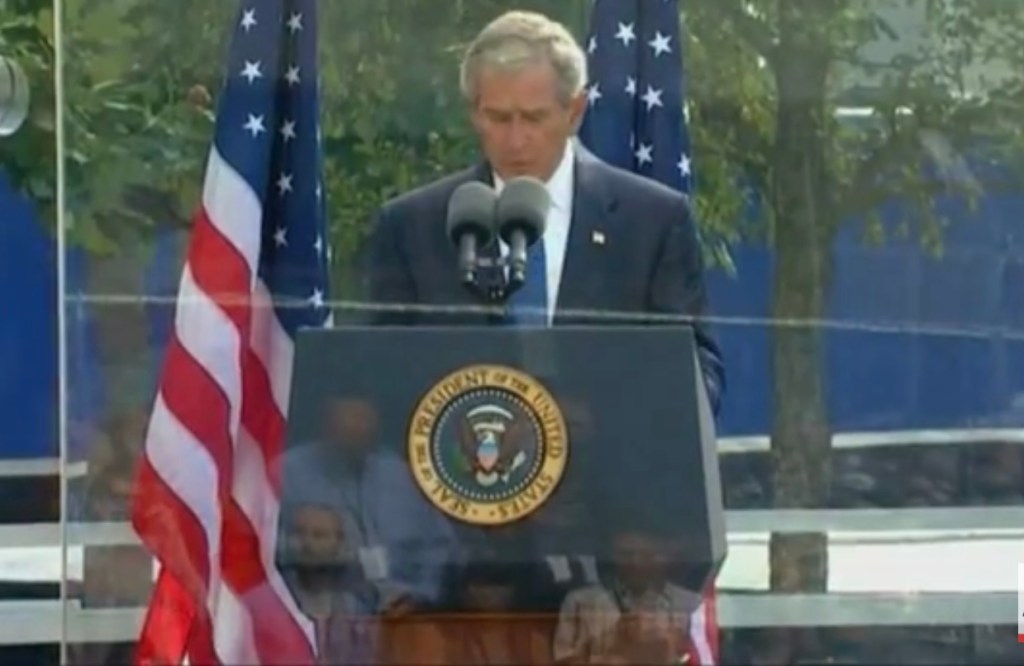
But some scholars have always questioned whether Lincoln himself wrote the letter. They point first of all to the circumstance that no copy of the letter in Lincoln’s handwriting has ever been known to exist. Mrs. Bixby’s copy of the letter, in particular, has never been seen.
The circumstances of the letter’s composition may explain why it disappeared.
Mrs. Bixby had seen Schouler on one occasion before he brought her the famous letter. She had shown him documents from five different company commanders in the union army, each stating that a son of hers had been killed in battle. Schouler had shown the documents to John Andrews, the Governor of Massachusetts. Andrews, in turn, had told officials in Washington that “I really wish a letter might be written her [Mrs. Bixby] by the President of the United States, taking notice of a noble mother of five dead heroes so well deserved.” And a letter was duly written and delivered.
Mrs. Bixby then either lost or destroyed the letter. If she destroyed it, it may simply have been because she disliked Lincoln. She was a native of Richmond, Virginia, and, according to her grand-daughter, she secretly favored the South.
Or, she may have destroyed the letter out of the disgust with edifying talk about noble causes that a mother feels whose sons have been killed in the name of those causes.
But she may also have been driven to destroy the letter by fear. Only two of her sons had been killed, and her claim to have lost all five was a scam to enable her to receive a larger survivor’s benefit from the government. She had already scammed Governor Andrew for $40 to visit a wounded son at Antietam, where she never went, because none of her sons had fought there. The last thing she wanted now was for her scams to attract notice – least of all the notice of the President of the United States — so she yielded to the perfectly natural impulse to destroy whatever part of the paper trail was in her possession. It was bad enough to be as well known to the Boston police as she was; a wealthy Bostonian named Sarah Cabot Wheelwright had considered hiring Mrs. Bixby as a servant until the police told her (in Wheelwright’s words) that Mrs. Bixby “kept a house of ill-fame, was perfectly untrustworthy and as bad as she could be.”P
At any rate, the absence of an autograph copy of the letter has kept the controversy about its authorship alive.
Scholars who doubt that Lincoln wrote the letter himself point to evidence that it was written by his secretary, John Hay. Lincoln is known to have disliked writing letters, and Hay and Lincoln’s chief secretary, John Nicolay, wrote large numbers of them for his signature. Toward the end of the war, Hay and Nicolay were writing nearly all of Lincoln’s correspondence.
In November, 1864, Hay wrote to an acquaintance that Lincoln had little time for tasks such as writing letters because “the crush here just now is enormous”. In 1866, Hay told Lincoln’s former law partner William Herndon, that Lincoln “wrote very few letters. He did not read one in fifty that he received. At first we tried to bring them to his notice, but at last he gave the whole thing over to me, and signed without reading them the letters I wrote in his name.”
These historians further note that Hay was himself a talented writer who had been elected class poet in his senior year at Brown University and was said by some to have had a gift for literary mimicry. During the war, Hay and Lincoln often talked long into the evening about English grammar, usage, and composition – topics in which they shared an intense interest. These discussions would have given Hay insight into the nature of Lincoln’s prose – and made him better able to imitate it.
And several people claimed that Hay told them that he himself had written the letter. These confidants include the journalist and critic W.C. Brownell, the editorial writer of the New York Times Walter Hines Page, and the liberal British statesman John Morley. Spencer Eddy, Hay’s personal secretary after the war, told his sister that Hay had written the letter; Eddy’s sister believed that her brother’s source of information was either Henry Cabot Lodge, a close friend of Hay, or Hay himself.
Also telling are two scrapbooks that Hay compiled of his own poems and essays. In each scrapbook, Hay had pasted a copy of the Bixby letter. Why would Hay have included the letter in a scrapbook of his own writings that he created for his private use, unless the letter were his own?
Historians who believe the letter to be Lincoln’s point to a letter that Lincoln’s son Robert Todd Lincoln wrote in 1917 to an historian who had asked him about the Bixby letter. Robert wrote that he once heard John Hay disclaim any knowledge of the circumstances of the Bixby letter’s composition.
And for many historians, questions about the authorship of the letter were laid to rest officially and finally in 1953, when Roy P. Basler decided to include the letter in the definitive nine-volume Collected Works of Abraham Lincoln, which he was then editing. The letter has been accepted as Lincoln’s by well-known scholars such as James G. Randall, Richard N. Current, Carl Sandburg, Benjamin Thomas, Donald E. Fehrenbacher, and David Herbert Donald.
The letter and other writings by Lincoln provide clues about the authorship of the Bixby letter.
- The Letter to Mrs. Bixby
Several words in the letter have always struck me as not the kind that Lincoln would likely have used: in particular, “assuage” and “beguile”. These words savor of the parlor; Lincoln’s vocabulary savors of the frontier and the law office.
The letter also contains genteel clichés that, in my opinion, Lincoln would not likely have used: “died gloriously”, “field of battle”, “cherished memory”, “loved and lost”, “solemn pride”, and “altar of freedom”. He had little taste for stale and ready-made expressions. George Templeton Strong identified important qualities of Lincoln’s writing when he remarked that his First Inaugural Address was “characterized by strong individuality and the absence of conventionalism of thought or diction.” Lincoln in fact followed the rule that George Orwell would formulate in his 1946 essay on politics and the English language: “Never use a metaphor, simile, or other figure of speech which you are used to seeing in print.” Instead, Lincoln’s literary blunders were usually lapses into frontier extravagance, as when he described the U.S. Navy as “Uncle Sam’s web-feet”.
Finally, the close of the letter, “yours very sincerely and respectfully”, seems too verbose to be Lincoln’s.
Fortunately, it is now possible to determine the frequency with which certain words and phrases were actually used by Lincoln. The Abraham Lincoln Association has put online the entire text of the nine-volume Collected Works and made it possible to search the text for occurrences of particular words and phrases.
So, I searched the Collected Works for “assuage”, “beguile”, “cherished memory”, “loved and lost”, “solemn pride”, “altar of freedom” and “yours very sincerely and respectfully”, and found that each of these words or phrases occurs only once – in the “Letter to Mrs. Bixby”. In addition, Lincoln used the phrases “heavenly Father” and “I cannot refrain from” only twice in compositions other than the Bixby letter.
- John Hay and the Word “Beguile”
Lincoln may not have liked the word “beguile”, but John Hay loved it. The Lincoln scholar Michael Burlingame found that Hay used it at least 30 times in his correspondence during the 1860s.
- Lincoln Consoles a Girl by Appealing to Her Reason
Lincoln isn’t in the letter to Mrs. Bixby, as he is in almost everything that he wrote. The writer of the letter holds his own emotion at arm’s length while attempting to elicit an emotional response from another person. Manipulating people’s emotions was not Lincoln’s usual procedure. The letter of consolation that he wrote to Fanny McCullough, a child who had lost her father in the war, provides an instructive contrast to the Bixby letter. In this letter, Lincoln is neither manipulative nor detached. He tries to give a young girl something that a child could understand and believe – that her frightening and overwhelming sensations of grief will not last forever. He tells her that he knows from personal experience that this will indeed happen to her.
- Lincoln’s “Controlled Impetuosity”
In the best essay about Lincoln as a writer that I am aware of, the poet Marianne Moore called attention to the quality of “controlled impetuosity” in his language – his impetuosity of feeling being controlled by his determination always to be clear and succinct. The distinguishing mark of this style is its union of thought and feeling, making Lincoln, in Moore’s words, a “Euclid of the heart.” The letter to Mrs. Bixby is not markedly Euclidean.
- Lincoln and Euclid
Lincoln absorbed the rigors of Euclidean geometry as deeply as he absorbed the music of Shakespeare’s English. He seems always to have known what sort of mental nourishment he would need in order to become the kind of writer that he had it in himself to become.
- Lincoln’s Art of Incantation in Words
Powerful feeling caused Lincoln to tighten up his language, to it make it compact and sinewy, rather than relax it into the kind of expansive phrases found in the Bixby letter. The tightening could, on occasion, produce the effect of “incantation” that the critic Edmund Wilson found in Lincoln’s farewell speech at Springfield, and that is absent from the smoothly flowing letter to Mrs. Bixby.
- Abraham Lincoln, Copy Editor
The final paragraphs of Lincoln’s First Inaugural Address were based on a draft written by William Seward, which Lincoln rewrote and improved immensely.
- Is there a Second Lost Letter to Mrs. Bixby?
The Bixby letter it is an expert piece of writing, even if we cannot call it Lincoln’s. Is it possible that Hay wrote a first draft that Lincoln revised, converting it into his peculiar kind of verbal music, just as he had done to Seward’s paragraphs? Such a draft would be a “second lost letter to Mrs. Bixby.”
Some scholars have supposed that the letter to Mrs. Bixby is a fine imitation of Lincoln by Hay. Might it not be a fine imitation of Hay by Lincoln? That is my best guess.
References,,km.
The Collected Works of Abraham Lincoln, vol. 8, pp. 116-117, ed. Roy P. Basler, 1953
Barzun, Jacques, Lincoln the Literary Genius, The Schori Private Press, 1960
Burlingame, Michael, Abraham Lincoln: A Life, 2008; “The Trouble With the Bixby Letter,”
American Heritage Magazine, Volume 50, Issue 4 (1999)
Moore, Marianne, “Abraham Lincoln and the Art of the Word,” in The Complete Prose of
Marianne Moore, ed. Patricia Willis

 Books Matter
You’ve convinced me by your literary analysis that John Hay had a large if not the sole part of the production of that letter. Nice job. People need to be reminded that authenticity is a member of the family of Truth, and that Reality won’t be mocked forever.
The other aspect of this affair is interesting. I think that Mrs. Bixby’s fear of the scam’s exposure is the likeliest explanation for the disappearance of the letter but, of course, I’ve nothing factual to back that up. I say that because one of the lasting effects of the rebellion upon the North was the elevation and acceptance of crookery. The loss of life was so great, the societal dislocation so huge, the government’s desperation so profound that a new American ethos of sharp practices sprang up. The rich bought their way out of the draft, speculators in currency and precious metals proliferated, suppliers fleeced the quartermaster, and fortunes were made by those who moved people and contraband across the lines of combat. Everyone else was getting theirs; Mrs. Bixby was just getting hers. (Just a thought.)
LikeLike