Henry David Thoreau is probably the least popular of our classic American writers. For many, he is too cocky or cranky or preachy. He seems to mock people for doing only what they have to do to get by in an unforgiving world. A very intelligent and well read young woman of my acquaintance said, after reading Walden on school assignment, “Thoreau is a jerk.”
I would reply to my acquaintance that I understand why you say that, but still I must disagree. He was not a jerk.
True, his manners could be forbidding, and he was, on occasion, cocky: literally, for he likened himself to chanticleer, crowing to wake up his slumbering fellow townsmen. “No way of thinking or doing, however ancient, can be trusted without proof,” he writes. Like Socrates, he believes that the unexamined life is not worth living. Like Socrates, he becomes unpopular by goading people into examining their lives.
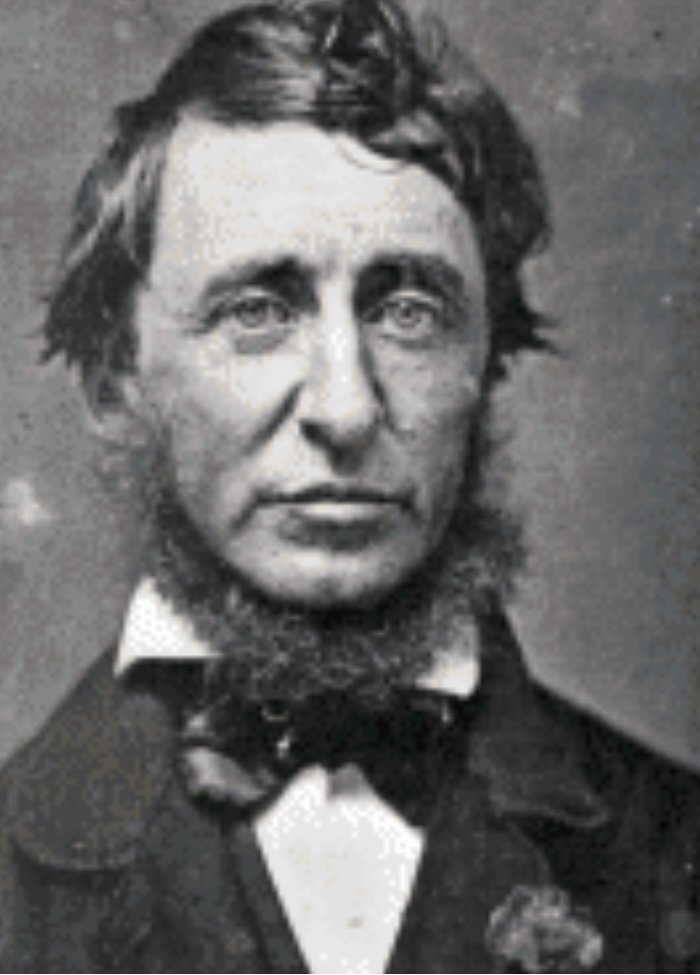
But he was often kind and generous; he was true to his word in all his dealings with others; of all the transcendentalists, he alone had a sense of humor; for years he worked to support his family; he loved his brother John and was bedridden with grief when John died of tetanus poisoning; he quit a teaching job, which he badly needed, rather than cane his pupils; he risked a prison sentence helping a fugitive slave escape to Canada.
He was, in addition to all that, a beautiful prose stylist, our greatest nature writer, a courageous fighter for social justice, and a philosopher in the sense that Socrates understood the term, someone who lives philosophy rather than preaching it.
He was still other things, too: a reader of the literatures of Latin, Greek, German, Italian, French, and of Old, Middle, and modern English, a surveyor whose services were sought after because of his accuracy, and the inventor of a superior kind of pencil.
And I would add what I find especially admirable: he alone of the transcendentalists could do things. There was a reason Emerson’s wife liked having him around the house. He could make almost any needed household repairs.
I believe, no, I know, that most people would abandon their dislike of Thoreau on better acquaintance. Making a better acquaintance with Thoreau has become much easier in recent years with the publication of new editions of his works and books about him.
Walden, his masterpiece, is available in numerous paperback editions, with introductions by distinguished writers such as John Updike and Joyce Carol Oates. A fully annotated edition has been produced by Jeffrey Cramer.
Jeffrey Cramer also produced an annotated edition of The Maine Woods.
The Journal of Henry David Thoreau, 1837-1861, selections by Damion Searls, is a treasury of patient and loving observations of nature.
A single volume edition of Thoreau’s essays and occasional writings has been published in the Library of America series. This volume is somewhat expensive but look for change behind the cushions of your couch — it is well worth it to have his great essays all in one volume.
Henry Thoreau: A Life of the Mind, by Robert Richardson, is a brilliant, beautifully written intellectual biography.
Henry David Thoreau: A Life, by Laura Dassow Walls, is another brilliant biography.
But what was the point of the millions of words that he left us in books, essays, and journals? It is, I believe, that mankind cannot truly flourish when estranged from nature. This is, of course, a commonplace that has enabled outfitters of weekend outdoor enthusiasts such as L. L. Bean to create commercial empires. But for Thoreau, this was no commonplace. “In wildness is the preservation of the world,” he wrote. His beautiful words brace us to our task, which is to preserve wildness itself from the effects of our radically disrespectful spoliation of nature — that nature of which we are, like it or not, inescapably a part.

 Books Matter
John,Another cogent, refreshing, and illuminating essay. “Thoreau is a jerk”is also a great lead in. I’m enjoying your work, as ever. How may I contributewithout giving away my CC#? Cheers,Peter
LikeLike
Yes! I admit it’s been a while since I dug into Walden, but I was visiting a friend a few years ago who had a complete set of the journals. As I leafed through some of the volumes, pausing to read more carefully in several places, I was struck with how absolutely modern his mind was, how all the observations he recorded were much in keeping with what late 20th century Americans of sense were also writing.
LikeLike
Nice appreciation
LikeLike
His journals are amazing. Hope you guys are having a good 4th.
LikeLike
I’ve come to think that the desire to have high schoolers read “Walden” as a compulsory assignment is well-intentioned but screwy. There will always be a few adolescents able to understand that Thoreau’s literary manner in this book is not mere preachiness and self-satisfaction, but not many. And that reaction turns them from Thoreau. I think that “Walden”, as with Henry James’s later works, is more perceptively received by adults. I wonder whether an introduction to Thoreau would be better served with “Civil Disobedience”? Just a thought.
LikeLike
I think “civil Disobedience” would be a hit with high school students. Also his essay “walking”.
Yes, you are right — if so many adults don’t get Walden, it’s unreasonable to expect high school student to get it.
I don’t expect Walden to fare well with readers in the coming years. You need to read a lot and widely to be able to pick up the tone of good books. (Best sellers are toneless.). As peoplevread less and less, the skills required to read good books become uncommon.
LikeLike