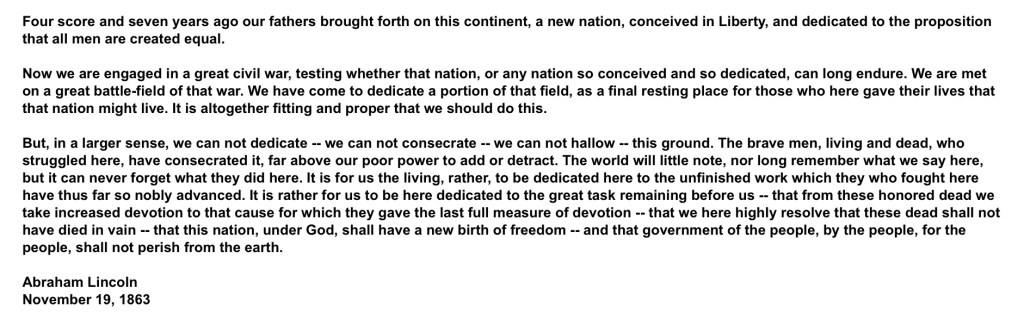
As every school child used to know, Lincoln’s three minute speech at the dedication of the Union cemetery at Gettysburg, on November 19, 1863, was better than the two hour speech delivered by Edward Everett on the same occasion. The irony of the situation was easily grasped: Lincoln’s few words said more than Everett’s prolixity, and said it better.
Note: In case you haven’t read it in a while, here’s the best of the several versions of Lincoln’s remarks:
Everett himself was one of the first to be aware of the irony. On the day after the dedication, he wrote the following in a letter to Lincoln:
Permit me . . . to express my great admiration of the thoughts expressed by you, with such eloquent sensibility & appropriateness, at the consecration of the Cemetery. I should be glad, if I could flatter myself, that I came as near to the central idea of the occasion in two hours, as you did in two minutes. My son, who parted from me at Baltimore & my daughter concur in this sentiment.
Lincoln replied graciously:
Your kind note of to-day is received. In our respective parts yesterday, you could not have been excused $to make a short address, nor I a long one. I am pleased to know that, in your judgment, the little I did say was not entirely a failure.
Lincoln’s reply refers to the fact that Everett had been invited by the organizers of the ceremony to be the principal speaker and in that role was expected to speak at some length. Lincoln, however, had been asked only to deliver “a few brief remarks”, simply to provide official sanction for the new cemetery.
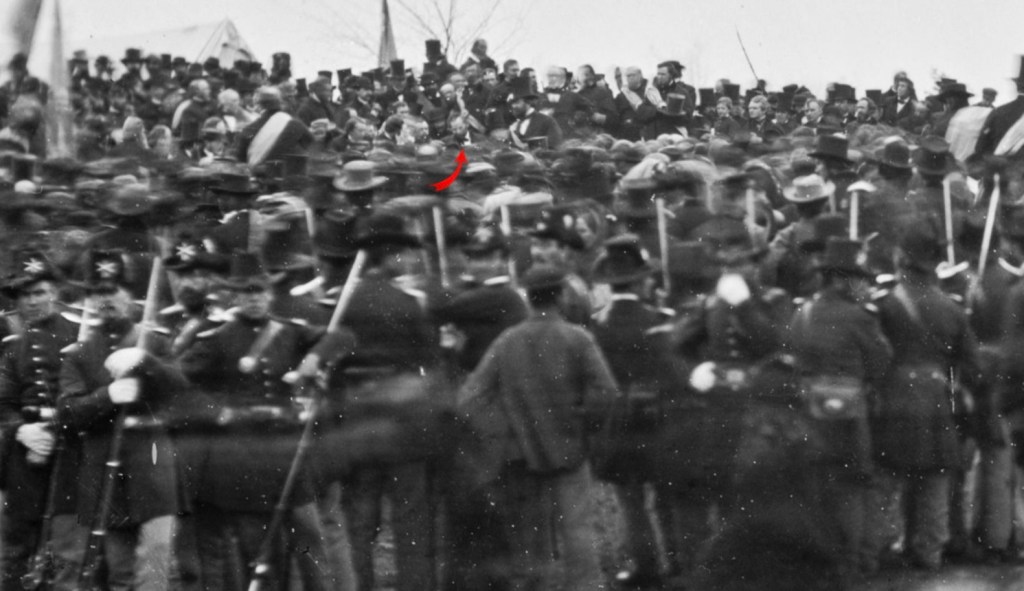
A second irony becomes evident upon closer inspection of the context of the two speeches. The irony involves the degree of risk that each speaker was willing to take in shaping his remarks.
In giving the kind of speech that he gave, Everett was taking little risk with his reputation as the nation’s leading orator. His speech was exactly what his audience wanted and expected: long and replete with references to ancient Greek and Roman history as well as with patriotic exhortation to see the war through to victory. It also included a detailed and accurate review of what had happened when Meade’s army fought Lee’s over this ground on July 1, 2, and 3 earlier that year — the sort of information that was hard to come by back then, in the darkness of our nation’s pre-electronic era.
But Lincoln, who had immensely more at stake than the maintenance of his reputation as an orator, chose not to play it safe in shaping his speech. He had been invited to make “a few brief remarks”. It is not known exactly what the organizing committee meant by “brief”. We know what Lincoln meant by it. The speech that he gave was radical in its brevity. At 275 words, Lincoln’s remarks were a tiny fraction in length of Everett’s oration of 13, 607 words. Such a speech risked being dismissed as hardly any speech at all by an audience that was accustomed to long speeches. It risked creating the impression that Lincoln couldn’t think of anything to say. And the brevity of the speech would require Lincoln to neglect the orator’s rule that, to make sure that you get a point across with your audience, you must say it at least three times. Lincoln was limiting himself to saying things of the greatest importance only once.
The thing of greatest importance that Lincoln had to keep in mind was his own chance of being re-elected to the presidency the following year. This was a matter of more than personal ambition. On Lincoln’s re-election depended the survival of the Union, for his chief political rival, General George McClellan, had pledged that if elected he would seek to end the war by negotiation — in other words, by allowing the Union to be divided into a slave half and a free half. And the Union’s survival was essential to demonstrate to the world that democracy was a viable form of government.
To improve his chance of being re-elected, Lincoln had clearly to state his administration’s war aims, to make clear why those war aims were worth the suffering that the war was inflicting on the nation, and to rally the nation behind those war aims. All this in 275 words.
Everett, then, played it safe having comparatively little at stake. Lincoln, having everything at stake, risked all on extreme brevity. A second kind of irony.
At this point in my reflections on the Gettysburg Address, it occurred to me that the significance of Lincoln’s speech might best be apprehended through other ironies. I sensed that there were more, went hunting for them, and found some.
I found irony in the contrasting educational backgrounds of Everett and Lincoln, and the degree to which each man’s background contributed to his grasp of the significances of the tragic events that had engrossed both men’s lives.
A broader, more cosmopolitan background than Everett’s is hard to imagine. He was the first American to be awarded a PhD degree, which he earned at Göttingen, one of Europe‘s most distinguished Universities. Jacob and Wilhelm Grimm taught there while preparing their great collection of fairy tales; Otto von Bismarck would later study law there; and Bernhardt Riemann while at the university would propose the extensions to classical geometry that would form the basis of Einstein’s general theory of relativity. Everett’s education could also be said to include impressive life experience, such as meeting Goethe and Byron, teaching ancient Greek literature at Harvard, serving as president of Harvard, representing Massachusetts in the U. S. House of Representatives and the U.S. Senate, serving as Governor of Massachusetts, and being the United States Ambassador to the Court of Saint James.
Lincoln had had only a few months of formal education, and his life experience, before he was elected president, would in itself have made him known to history as nothing more than a provincial celebrity. He had run a general store that failed, had been a moderately successful politician, and had made a comfortable middle class living as a lawyer, known for his way with juries. His educational opportunities have often been underplayed by biographers, to exaggerate the improbability of his amounting to anything. He did have access to books and read widely, mostly in classics of English literature. Michael Burlingame, Lincoln’s most recent biographer, discovered that Lincoln liked Alexander Pope’s Essay on Man, and it seems likely that this poem was an influence on Lincoln’s Second Inaugural Address.
Still, he lacked what are called “advantages,” the principal advantage being a mentor to take his education in hand. Lacking a mentor, he ran the risks run by all autodidacts, such as becoming over-confident, or developing a pompous, eccentric style of self expression. His great contemporary Walt Whitman, another autodidact, did not altogether escape these risks. But Lincoln did, through his remarkable power of standing apart from himself, and judging himself and his works with a terrible objectivity.
One advantage that he appears to have had was genetic; although almost nothing is known of his mother Nancy Hanks, friends and neighbors described her as “intellectual” and “brilliant.”. But it is impossible to estimate the importance of this advantage to Lincoln’s development.
And yet it was Lincoln, the man without educational advantages, and not Everett, who displayed the more comprehensive grasp of the significance of the battle of Gettysburg. Lincoln saw and stated more clearly than Everett, that in a world dominated by regimes hostile to democracy, it was up to America to demonstrate that a nation could flourish under democratic government. A third irony.
A fourth irony inclines to the technical side. Everett was a classical scholar; Lincoln had “small Latin and less Greek.”. But, as Gary Wills notes in his book Lincoln at Gettysburg, Everett’s own written style owed more to English romantic prose writers than to any Greek writer, while Lincoln’s style resembles that of the ancient Greeks orators and historians on several points.
For example, the thinking of the ancient Greek orators and historians tended to resolve itself into antitheses, expressed in paired clauses. The clauses were marked by short words known as particles, the particle men (μεν) being used in the first clause and the particle de (δε) used in the second clause. The particles are no more translatable than the “eh?” at the end of a Canadian sentence, but they had a specific and well-understood function — like “eh?”, which asks the auditor for confirmation of what the sentence says.
The particle men raises the expectation that the clause in which it occurs will be followed by a second clause that completes or provides a contrast to the first clause. The second clause is marked by de. Lincoln thought naturally in μεν … δε contrasts:
“The world μεν will little note nor long remember what we say here,
“but δε it can never forget what they did here.”
This sentence exactly illustrates the principle stated by the English classical scholar J. D. Denniston in his authoritative study The Greek Particles:
Often . . . the antithesis carries an idea of strong contrast, so that in English we should make one of the clauses concessively dependent on the other. In such cases the weight is far more frequently on the δε clause. Denniston p. 370
(An unmarried daughter of one of Professor Denniston’s colleagues was once urged by her mother to try to get to know Denniston, who wasn’t married either. “He’s a very good man. He knows more about men and de than anyone else,” said the mother. “Well, I know something about men,” sniffed the daughter. Among classicists, that’s a real knee-slapper.)
Lincoln was also a natural master of a more complex device used by ancient Greek orators and historians: the tricolon abundans. This device consists of three clauses (tri-cola) constructed in parallel, with the first two of roughly equal weight or duration, and third of noticeably greater weight or duration (abundans). Conspicuous among ancient Greek writers using this device was Gorgias (438 – 375 B. C), a sophist and teacher of rhetoric. In his charming and erudite book Golden Latin Artistry, the British classicist L. P . Wilkinson refers to Lincoln as particularly “Gorgianic”, citing as an example the phrases
we cannot dedicate,
we cannot consecrate,
we cannot hallow this ground.
which form a textbook example of tricolon abundans. Lincoln made this device even more effective by using two more devices known to classical rhetoricians: anaphora, the repetition or a word or words at the beginning of a phrase (“we cannot”); and asyndeton, the omission of a connective word (in this example, “and”), to indicate vehemence.
Lincoln, of course, had never read Gorgias. (Very little of the writing of Gorgias survives, anyway). He undoubtedly learned about tricolon abundans from the King James Bible and John Bunyan, with which he was thoroughly familiar. The English Bible itself was stylistically influenced by the Latin liturgy, where tricolon abundans is used frequently; for example:
Te Deum laudamus,
Te Deum confitemur,
Te aeternum Patrem omnis terra veneratur;
In the King James Bible, Lincoln undoubtedly read the follow tricola:
Except I shall
see in his hands the print of the nails, and
put my finger into the print of the nails, and
thrust my hand into his side,
I will not believe.
And in The Pilgrim’sProgress, Lincoln read how Christian’s relatives, having discovered that he is troubled by thoughts of damnation, tried to bring him back to his right mind:
sometimes they would deride,
sometimes they would chide,
and sometimes they would quite neglect him:
Rhetorical devices by themselves do not make one a great orator or writer. Anyone can write a tricolon abundans: here’s one that I wrote for this occasion:
I don’t want to clean up my study,
I don’t want to do my laundry,
I don’t want to do these things but I will sometime soon.
What is hard is to use these rhetorical devices without making them seem adventitious. To be effective, they must seem to be the inevitable and necessary vehicles of the thought that they express. This Lincoln was able to do, because he was a skilled artist in words.
This reflection led me to the fifth irony suggested by the speakers at the Gettysburg dedication ceremonies. Everett, with all his training and exposure to the best models of prose, did not become an artist in that medium. Lincoln did.
As a classicist, Everett was familiar with what German scholars call Kunstprosa, or “art prose”, as exemplified in the extreme urbanity of Plato and the almost superhuman eloquence of Demosthenes. At Harvard, he would have taken his students — including Ralph Waldo Emerson — through these masterpieces clause by clause in search of the secrets of their magic. He did not learn to make use of what he found there in his own writing, however.
Lincoln did learn to make use of what he found in the classics — the English classics. In his essay “Lincoln the Literary Genius”, Jacques Barzun wrote of Lincoln as a “literary artist, the maker of a style that is unique in English prose and doubly astonishing in the history of American literature, for nothing led up to it.”
I’m not sure I agree with Barzun that “nothing led up to” Lincoln’s style, at least in the American practice of public speaking. Lincoln admired the speeches of Daniel Webster, and the little I’ve read of Webster suggests that he was an influence on Lincoln’s way of writing. Like Lincoln, Webster was a pleader before juries and a solid reasoner. And Lincoln undoubtedly admired Webster’s famous tricolon, “Liberty and union, one and inseparable, now and forever.”
There was in Lincoln’s prose a unique kind of music, the nature and source of which are elusive. In his book on the Declaration of Independence, Carl L Becker — himself a distinguished writer — tries to define why Jefferson’s prose, for all its felicity, fails to move us the way Lincoln’s does. Edmund Wilson, in his study of the literature of the Civil War, Patriotic Gore, wrote that the prose of Ulysses Grant, rightly admired for its strength and lucidity, lacks music — Lincoln’s music.
One source of Lincoln’s music may have been identified by the poet Marianne Moore, in her 1959 essay “Abraham Lincoln and the Art of the Word” — still the best thing ever written about Lincoln’s prose, in my opinion. Moore lays great emphasis on Lincoln’s study of Euclidean geometry, and how, when Lincoln was most deeply moved by what he was writing about, his writing became more austere, and rational, and Euclidean. Moore calls the writing that results “a Euclid of the heart”.
The best example of what Moore calls Lincoln’s “restrained impetuosity” may be found, in my opinion, in Lincoln’s farewell address to the citizens of Springfield — a short speech that in its artistic perfection deserves to be set beside the short speech that he would make at Gettysburg three years later:
My friends, no one, not in my situation, can appreciate my feeling of sadness at this parting. To this place, and the kindness of these people, I owe everything. Here I have lived a quarter of a century, and have passed from a young to an old man. Here my children have been born, and one is buried. I now leave, not knowing when, or whether ever, I may return, with a task before me greater than that which rested upon Washington. Without the assistance of the Divine Being who ever attended him, I cannot succeed. With that assistance I cannot fail. Trusting in Him who can go with me, and remain with you, and be everywhere for good, let us confidently hope that all will yet be well. To His care commending you, as I hope in your prayers you will commend me, I bid you an affectionate farewell.

 Books Matter
I believe that some of this material appeared in an earlier post. Bear with me. I’m still trying to do justice to the subject.
LikeLike
Perhaps my favorite of the series so far, both because I have long been an admirer of Lincoln’s way with words and because of your clear explicati
LikeLike
Glad you liked it.
If you like Lincoln, I would recommend Michael Burlingame’s biography. It’s long, but it’s full of stuff you never read or heard before. This is because Burlingame did a huge amount of original research. He doesn’t change the story or our picture of Lincoln — just makes it much more real.
The Library of America came out with a volume titled A Lincoln Anthology:Great Writers Write About Lincoln, ed. by Harold Holzer. This contains Marianne Moore’s essay about Lincoln, and a lot of what Jacques Barzun wrote about him. Also Bram Stoker’s celebratory essay about Lincoln!
LikeLike
I consider this essay your best yet in this forum. Between your analysis of the embedded ironies and your examination of the rhetorical devices and general prose style used by Abraham Lincoln, a great deal has been laid out here for the reader, and I’ll have to read it several times in an attempt to absorb it all. I especially liked your thoughts on Lincoln the autodidact, who appears in my thoughts more and more these days as my dissatisfaction with the deficiencies of a grossly expensive regime of higher education here in the United States grows more acute.
LikeLike
Glad you liked it. Lincoln is an inexhaustible subject. I mean, how did he get to bevwhat he was, starting out from where he began?
LikeLike