My Mark Twain is William Dean Howells’ memoir of his forty four year friendship with Samuel Clemens, as he preferred to call the man whom he admired above all others, both as a writer and a person. Howells wrote his memoir shortly after Clemens died in 1910, to work through the grief that he felt at the loss of his incomparable friend. Unlike most of Howells’ other writing, it is vivid with emotional intensity.
Howells met Clemens in 1869, shortly after he reviewed Clemens’ book “Innocents Abroad” in the Atlantic Monthly, of which he was an editor. Howells praised Clemens’ book –- a satirical account of a group of wealthy Americans on a chartered tour of the Middle East — writing that “it is such fun as we have not had before.” Clemens was grateful for the favorable review. He was already famous and his books were selling well; what he didn’t have was respectability, and Howells, sitting atop the east coast literary establishment, could help him become respectable. Twain decided to go to Boston to thank Howells for the review in person.
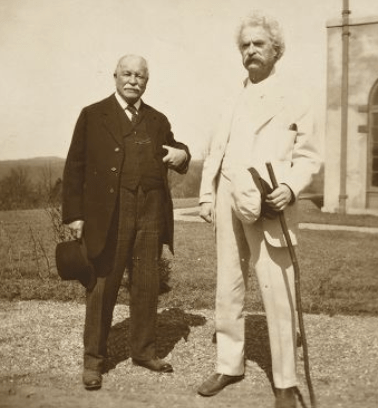
But respectability, as Howell’s account of their first meeting makes clear, was something that Twain both desired and scorned. He appeared at Howells office at 124 Tremont Street wearing a sealskin coat turned inside out, to show the fur. That, and his “crest of dense red hair and magnificent mustache”, made Twain a vivid figure of a type unknown in genteel Boston. Twain was saying, in effect, accept me, yes, but accept me on my own terms, for the kind of person I am. Howells accepted Twain for the person he was, with a few reservations, and that acceptance was a foundation of their friendship.
The first meeting with Twain also revealed to Howells the youthfulness at the heart of Twain’s personality; Howells wrote that Twain was always a boy – sometimes a good boy, sometimes a bad one, but always a willfull boy.
But Twain’s love of boyish fun on one occasion betrayed him into making a social blunder that he would regret bitterly. The publisher of the Atlantic Monthly decided to throw a party to honor John Greenleaf Whittier on his seventieth birthday and invited Twain to speak at it. For the occasion, Twain wrote a skit in which three hobos in the California Gold Rush would try to get a free night’s lodging by passing themselves off as Emerson, Longfellow, and Holmes — all of whom would be at the party. Twain launched into the skit with his usual gusto and quickly reached the point at which he expected the audience to be holding its sides with laughter. Silence. He persevered on to the next sure fire gag line, and the next, hoping for a response. Nothing. Longfellow looked down at his dinner plate; Holmes stared ahead stoically; Emerson, bemused by dementia, was unaware of what was going on. Toward the end of the skit, someone in the back of the room laughed hysterically, not because the skit was funny, but because the situation was dreadful.
Twain castigated himself mercilessly for this blunder. Longfellow wrote him a gracious letter saying that he hadn’t been offended. Howells told him that no great harm had been done and that he should move on. But the truth of the matter was that Twain had offended people who had never given him offense; that he had put the organizers of the party, including Howells, in a difficult position; and that he had made an ass of himself. That was the truth of the matter and Twain would hear of of nothing else.
Once when Howells was talking with Twain about the past and how they felt about it, Twain said that he found the past to be humiliating, because it was filled with things that he had bitterly to regret. Twain was truthful about the things that he had to regret beyond any other man that he knew, Howells wrote; he was absolutely, aggressively truthful. He told Howells about how, one day, he had taken his son out for a walk and was caught in the rain. The boy came down with a cold and died two days later. “I killed my boy,” Twain told Howells. Howells tried to tell Twain that he could not know for sure that he had killed his boy; Twain wouldn’t hear any of it.
Twain would insist on the truth even when doing so jeopardized his chance of happiness. For example, when Twain asked Livia Langdon’s father for her hand in marriage, her father replied that before he could consent to that, he wanted to see five letters of reference from people who had known Twain out west. Twain thought that it would be dishonest to ask for references from people who would whitewash his character, so he asked five people who had known him at this worst. When Langdon received the letters, he asked Twain to come see him. “Mr. Clemens,” he said, “it appears that none of your friends has a good word for you.” Twain lowered his head in shame. “So I guess I will have to back you myself.”
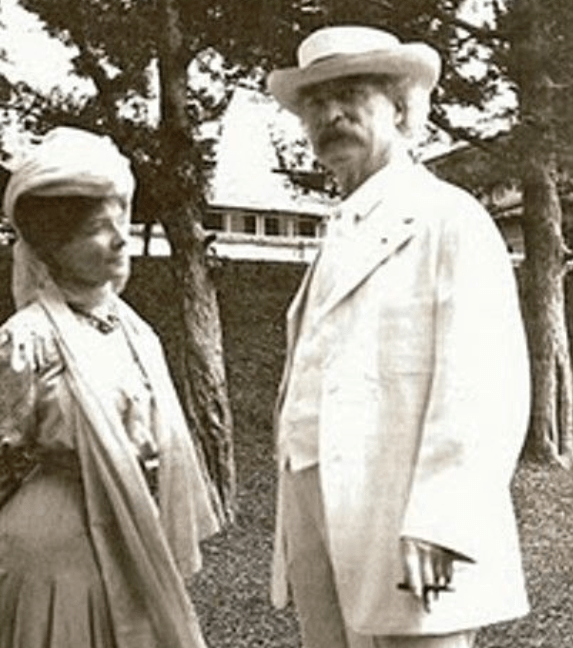
Howell’s was with Clemens during his best times as well as his dark ones. His marriage to Livia Langdon turned out to be exceptionally happy, and he rejoiced in the children that they had. Between 1876 and 1893, he produced his Mississippi River masterpieces, Tom Sawyer, Huckleberry Finn, Life on the Mississippi, and Pudd’nhead Wilson, along with several lesser but popular works. His writing sold well, enabling him to build the extravagant mansion in Hartford, Connecticut, that would be his joy for years. He reveled in his celebrity and the opportunities that it afforded him to meet and form friendships with Ulysses Grant, Heller Keller, and other remarkable people.
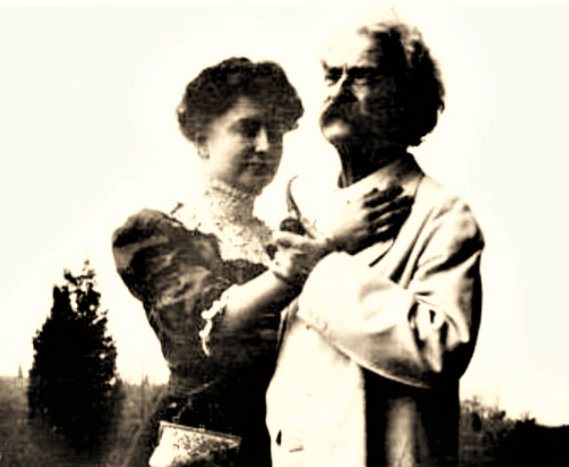
But gloom seemed more and more to occupy Twain’s mind as the years passed. His later years were in fact difficult. An unwise business venture left him deep in debt, forcing him to undertake exhausting lecture tours. His wife and his daughter Jean died, griefs from which he did not recover.
And he was disturbed by what he saw happening in our country: the corruption of our democratic institutions by money, racism growing more deeply entrenched and more violent, and the gap in wealth between the rich and poor growing constantly wider.
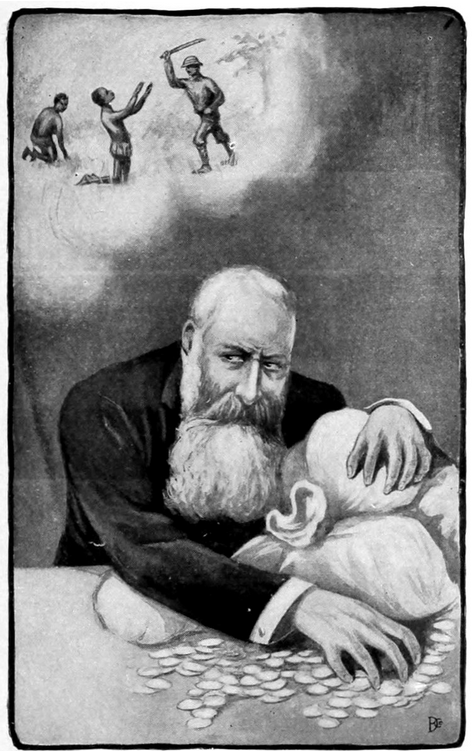
And he was alarmed by the worldwide growth of colonialism. America had succumbed to its temptations, occupying the Philippines and toying with the idea of taking Cuba. He and Howells joined the American Anti-Imperialist League in protest. King Leopold of Belgium had instituted the savage exploitation of the inhabitants of the Congo on the rubber plantations there, provoking Clemens to write his satirical masterpiece “King Leopold’s Soliloquy”. The horrors of the Great War, which began only four years after his death, would have devastated him.
Clemens is our country’s greatest humorist; he could be funny like no one else. But his amateur sleuth Pudd’nhead Wilson spoke for him when he wrote in his calendar:
Everything human is pathetic. The secret source of Humor itself is not joy but sorrow. There is no humor in heaven.
Howells wrote about his old friend:
It is in vain that I try to give a notion of the intensity with which he pierced to the heart of life, and the breadth of vision with which he compassed the whole world, and tried for the reason of things, and then left trying:
He ended his memoir with the following words:
Next I saw him dead, lying in his coffin amid those flowers with which we garland our despair in that pitiless hour. . . I looked a moment at the face I knew so well; and it was patient with the patience I had so often seen in it: something of puzzle, a great silent dignity, an assent to what must be from the depths of a nature whose tragical seriousness broke in the laughter which the unwise took for the whole of him. Emerson, Longfellow, Lowell, Holmes—I knew them all and all the rest of our sages, poets, seers, critics, humorists; they were like one another and like other literary men; but Clemens was sole, incomparable, the Lincoln of our literature.

 Books Matter
Mark Twain is one of my favorite writers, and you’ve done him, and Howells, remarkable justice in relatively few words. Thanks very much for this. I wish to heaven that we could have the benefit of Mark Twain’s mind — and pen — here in our own corrupt, violent, plutocratic age.
LikeLike
He would have a lot to say — if he weren’t struck dumb by the enormity of the mess that we are in.
LikeLike