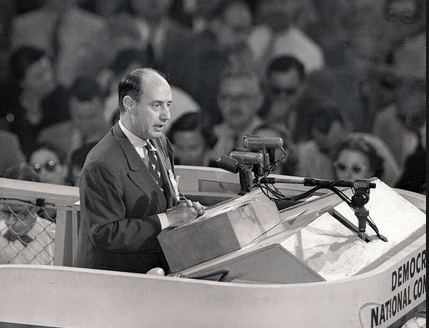
On July 25, 1952, Governor Adlai Stevenson of Illinois was drafted by the the Democratic National Convention in Chicago to be the party’s candidate for President of the United States. It was the improbable beginning of a political campaign that is still remembered, by older Democrats at least, as a model for what political campaigns can and should be. Stevenson began his campaign by urging his fellow Democrats to talk sense to the American people, to tell them the truth — and he then proceeded to follow his own advice, to the best of his remarkable abilities. That he lost the election, by one of the widest margins in modern American history, seemed only to add luster to his foredoomed campaign.
For no one believed that Stevenson, or any other Democrat, could be elected President in 1952. President Truman was deeply unpopular, largely because of his inability to end the Korean War; Democrats had occupied the White House for twenty years, and the voters were quite reasonably wondering if it weren’t time for a change; and the Republican candidate for President was Dwight David Eisenhower, an authentic war hero who was liked and admired by people in both parties. Stevenson himself would later say that running against Eisenhower was like running against the ketsup on the kitchen table.
And in fact, Stevenson lost by a landslide. Eisenhower carried 39 of the 48 states, and received 55% of the popular vote. Stevenson carried only 9 states, all of them southern or border states where voting for a candidate of the party of Lincoln was still unthinkable. He even lost liberal, elitist Massachusetts — by over 100,000 votes. In addition, the Republicans won control of both houses of Congress, although by small margins.
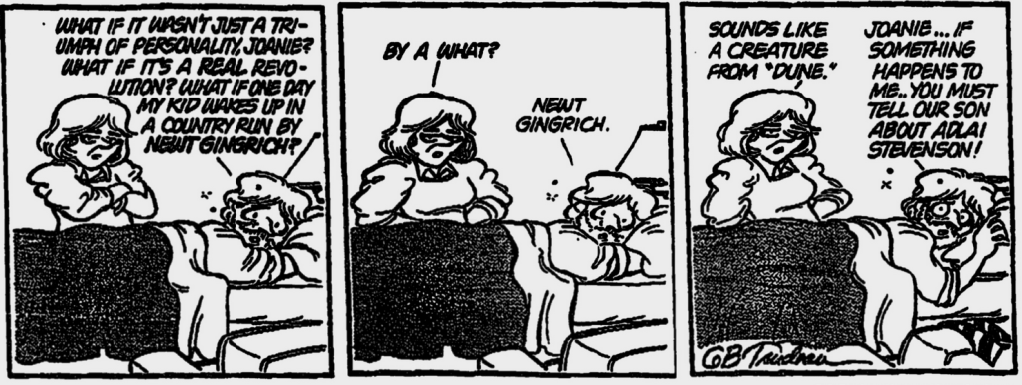
But in spite of having led his party into electoral catastrophe, Stevenson developed a stubbornly loyal following within the party, and he would be the party’s voice and conscience for the remainder of the decade. His influence would extend far beyond the era of his political activity and would cross party lines. Political figures as diverse as Ted Kennedy, Donald Rumsfeld, and Henry Kissinger claimed to have been inspired to enter public life by Stevenson’s example. And the cartoon character Mike Doonesbury would take to bed wondering what would happen to our country if it were no longer inspired by Stevenson’s example.
Shortly after Stevenson’s death in 1965, the journalist Eric Severeid, who knew him well, wrote, ““All I know as a political reporter is that Adlai Stevenson injected humor and happiness and sophistication into American political life, and you have to have spent half your life listening to the normal run of American politicians to really understand what a fantastic accomplishment that was.”
In this post I will try to describe the qualities of Stevenson’s 1952 campaign for the presidency that made it so memorable.
**********
Stevenson’s nomination was owing to a set of unusual circumstances. President Truman had decided not to seek re-election after losing the New Hampshire primary to Senator Estes Kefauver of Tennessee. Going into the convention, Kefauver had more delegates pledged to him than any other contender for the nomination, but was still short of the number that he needed to be nominated. None of the other contenders for the nomination had a significant amount of support outside of their home states.
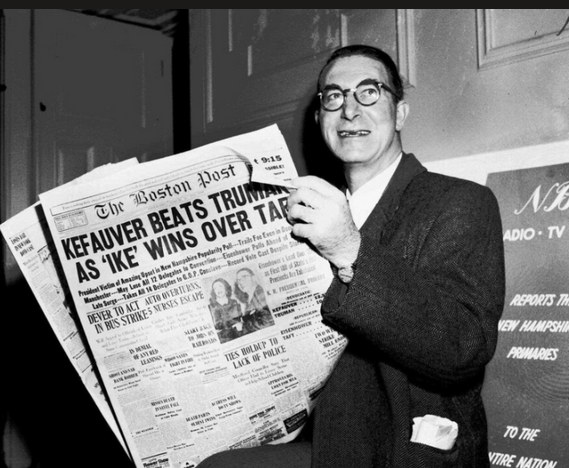
Truman detested Kefauver, who, to be fair to Truman, was widely disliked within the party for his sanctimonious manner. He and other party bosses began to look for someone other than Kefauver to be the party’s nominee, and they settled on Stevenson, who had been elected Governor of Illinois by the largest margin in state history. During the war, he had worked in the Department of the Navy and the State Department and had been a member of the original American delegation to the United Nations. But Stevenson had already announced that he would seek a second term as governor, and felt honor-bound to follow through on that commitment. Besides, his work as governor was well respected, he and his dalmation dog “King Arthur” were beloved figures in the streets of Springfield, and he was almost certain to be re-elected.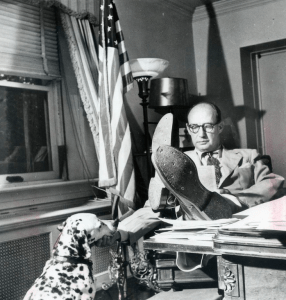
In the absence of a strong contender for the nomination, the Democrats were facing the prospect of a long convention, requiring many ballots to settle on a candidate. Although party officials had far more influence over conventions than they do today, Truman was powerless to avert this outcome.
This was the situation when Stevenson, as governor of the state hosting the convention, was invited to deliver a welcoming address. He told the delegates:
Here on the prairies of Illinois and the Middle West we can see a long way in all directions. We look to east, to west, to north and to south. Our commerce, our ideas, come and go in all directions. Here there are no barriers, no defenses, to ideas and aspirations. We want none; we want no shackles on the mind or the spirit, no rigid patterns of thought, no iron conformity. We want only the faith and conviction that triumph in free and fair contest.
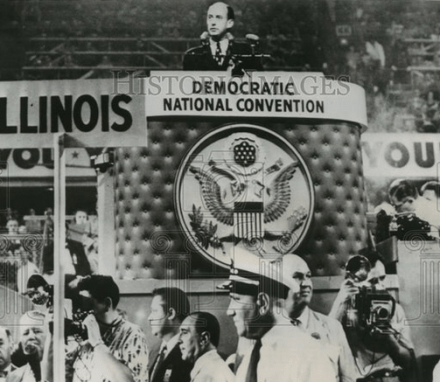
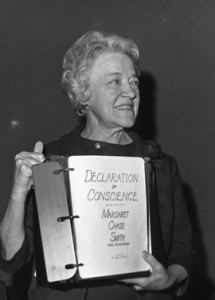
Stevenson’s eloquence impressed the delegates, and even the least attentive among them must have realized that Stevenson was here criticizing Senator Joseph McCarthy and the spirit of fear and suspicion that McCarthy had introduced into American life two years earlier, when he began his campaign to expose alleged Communists and Communist sympathizers in the State Department and other branches of the government. Stevenson, it was clear to the delegates, had courage; among national political leaders, only Senator Margaret Chase Smith had previously dared to criticize McCarthy, in a speech before the Senate that she titled her “Declaration of Conscience.”
A draft Stevenson movement took shape among the delegates; one of the originators of the movement later recalled, “We started with a bicycle and suddenly we had a bandwagon.” Jacob Arvey, the Democratic boss of Chicago, finally got Stevenson to allow his name to be placed in nomination. Adlai Ewing Stevenson became the Democratic Party’s candidate for President of the United States on the third ballot.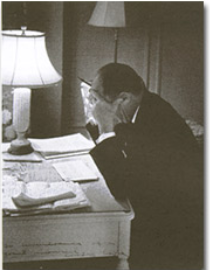
Stevenson had twenty four hours to produce an acceptance speech. He had never used speech writers, and did not do so now, although he asked several friends and advisors for comments on his first draft.
The speech that he wrote would be one of the best that he wrote for the campaign, and one of the most famous speeches in American political history. Stevenson began by explaining why he had not sought the nomination that he now accepted:
I would not seek your nomination for the Presidency, because the burdens of that office stagger the imagination. Its potential for good or evil, now and in the years of our lives, smothers exultation and converts vanity to prayer.
This explanation proved controversial. Some people welcomed it as a sign that at last someone asking to be made president understood how much harm a president — a mere mortal — might do with the godlike powers of the office. Other people thought it showed that Stevenson was altogether too sensitive to be president.
He moved on to the most famous passage in the speech:
The ordeal of the twentieth century, the bloodiest, most turbulent era of the whole Christian age, is far from over. Sacrifice, patience, understanding, and implacable purpose may be our lot of years to come. Let’s face it. Let’s talk sense to the American people. Let’s tell them the truth, that there are no gains without pains, that there — that we are now on the eve of great decisions, not easy decisions, like resistance when you’re attacked, but a long, patient, costly struggle which alone can assure triumph over the great enemies of man — war, poverty, and tyranny — and the assaults upon human dignity which are the most grievous consequences of each.
One might admire Stevenson’s eloquence and still wonder whether it was good politics to warn the public that it would be having to undertake “a long patient costly struggle” of any sort; this was the public that had just engaged in a long patient costly struggle against depression and war. Stevenson understood this but felt that the public needed to be prepared for what the country might have to face in the years ahead.
When Stevenson came to the end of his speech, Eric Sevareid, who was covering the convention for CBS News, turned to a colleague and asked, “How are we going to report on a candidate who writes better than we do?” In fact, some people found the speech excessively literary.
Other people found it a refreshing change from the usual political cant and rhodomontade. Many of the country’s writers, artists, and scholars embraced Stevenson’s candidacy enthusiastically; John Steinbeck wrote an admiring preface for a paperback volume of Stevenson’s writings; celebrities such as Lauren Bacall and Judy Garland began to show up at Stevenson rallies.
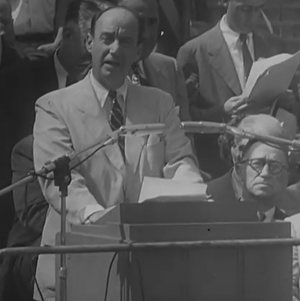
During the subsequent campaign, Stevenson spoke often about employment, taxation, inflation and the other bread-and-butter issues that decide elections. But McCarthyism — and the hyper-patriotism that it was fostering — was never far from his thoughts, and he criticized it often, if seldom mentioning McCarthy by name.
On August 27, he made his most pointed criticism of McCarthyism in front of an audience that he did not expect to hear gladly what he had to say, the annual convention of the American Legion, in New York City. McCarthy had questioned the loyalty of General George C. Marshall. He told the legionnaires:
“We talk a great deal about patriotism. What do we mean by patriotism in the context of our times? I venture to suggest that what we mean is a sense of national responsibility which will enable America to remain master of her power — to walk with it in serenity and wisdom, with self-respect and the respect of all mankind; a patriotism that puts country ahead of self; a patriotism which is not short, frenzied outbursts of emotion, but the tranquil and steady dedication of a lifetime. The dedication of a lifetime — these are words that are easy to utter, but this is a mighty assignment. For it is often easier to fight for principles than to live up to them. . .
“There are men among use who use “patriotism” as a club for attacking other Americans.
“What can we say for the self-styled patriot who thinks that a Negro, a Jew, a Catholic, or a Japanese-American is less an American than he? That betrays the deepest article of our faith, the belief in individual liberty and equality which has always been the heart and soul of the American idea.
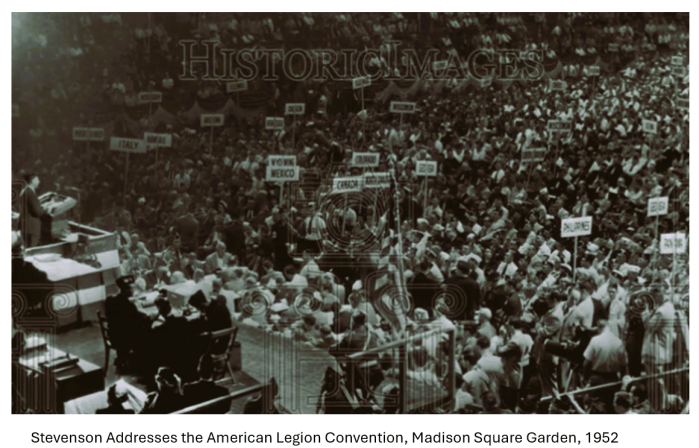
“What can we say for the man who proclaims himself a patriot—and then for political or personal reasons attacks the patriotism of faithful public servants? I give you, as a shocking example, the attacks which have been made on the loyalty and the motives of our great wartime Chief of Staff, General Marshall. To me this is the type of “patriotism” which is, in Dr. Johnson’s phrase, “the last refuge of scoundrels.”
Stevenson also accused the Republicans of tolerating McCarthyism to promote their own political fortunes. He was in fact nearly alone in his criticisms of McCarthy at this time.
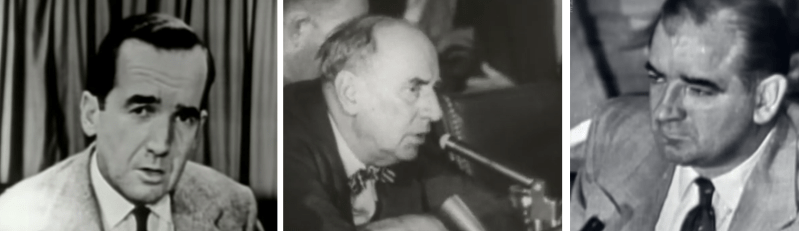
Among national political leaders, only Senator Margaret Chase Smith of Maine had spoken out against McCarthy; it was two years before Edward R. Murrow would broadcast his famous editorial denouncing McCarthy, and two years before the venerable Boston lawyer Joseph Welch would ask McCarthy “Have you no sense of decency sir, at long last?” during the nationally televised Army-McCarthy hearings.
On the day before the election, he addressed a group of supporters with these elegant but prescient words:
Looking back, I am content. Win or lose, I have told you the truth as I see it. I have said what I meant and meant what I said. I have not done as well as I should have liked to have done, but I have done my best, frankly and forthrightly. No man can do more, and you are entitled to no less.
No one was really surprised when, on election day, Eisenhower was victorious, although the size of his victory seemed to Stevenson like a gratuitous rebuke. When the official results had bee n reported, Stevenson told a group of supporters in Springfield, Illinois:
Someone asked me, as I came in down on the street, how I felt. I was reminded of a story that a fellow townsman of ours used to tell Abraham Lincoln. They asked him how he felt once after an unsuccessful election. He said he said he felt like a little boy who had stubbed his toe in the dark. That he was too old to cry, but it hurt too much to laugh.
**********
Then something happened that defied the political laws of gravity. After leading his party to electoral catastrophe, Stevenson was embraced by it and would remain its recognized leader and voice for the rest of the decade. He was constantly in demand as speaker or writer about the issues of the day; he sought and easily won his party’s 1956 presidential nomination.
In his run at the presidency in 1956, Stevenson questioned the new practice of using paid advertising in political campaigns. It degraded the political process to market candidates or platforms as if they were soap, Stevenson objected. And where were candidates to get the money to pay for the advertising, if not from wealthy donors with an interest in legislation that the candidates might be able to stop or shape? Stevenson foresaw the establishment of our current system of legalized bribery conducted under the aegis of the First Amendment’s protection of freedom of speech.
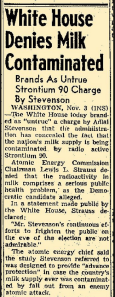
He also proposed that the United States place a moratorium on its testing of nuclear weapons in the atmosphere, until the United Stated and the Soviet Union could agree upon a treaty that permanently banned atmospheric testing by either country. Vice-president Nixon called the proposal “catastrophic nonsense”. But growing public concern over increasing amount of strontium-90 in the air, the water, and the food chain kept the idea alive in government circles, and in 1963 President Kennedy signed a Partial Test Ban Treaty with the Soviet Union that incoporated the main points of Stevenson’s proposal. It may be that the main tangible legacy of the wittiest, most eloquent politician of the twentieth century is that our breakfast cereal is less radioactive than it would have been, had he not spoken out against radioactive breakfast cereal.
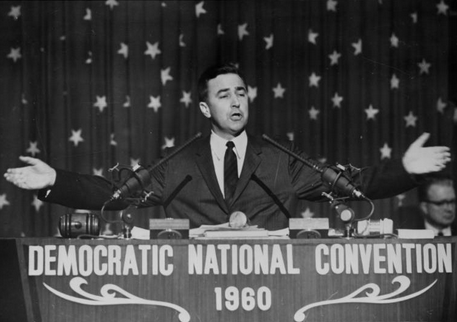
At the 1960 Democratic Convention in Los Angeles, Stevenson was nominated for president by Senator Eugene McCarthy, who eight years later would become one of the principle opponents of the Vietnam War. “Let us not reject this man who made us all proud to be Democrats!” McCarthy implored the convention. Stevenson supporters immediately flooded the convention floor and brought proceedings to a halt. The convention managers let the vociferous demonstration run its course. It was the Democratic Party’s farewell to the man who had been the voice and inspiration of the party for eight years. John F. Kennedy of Massachusetts was nominated on the first ballot.
**********
Stevenson hoped to be asked to be Secretary of State in the Kennedy administration, but Kennedy offered him the choice of Attorney General, Ambassador to England, or Ambassador to the United Nations. Stevenson chose the latter.
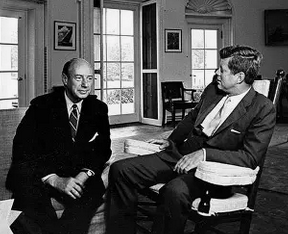
Stevenson’s tenure as Ambassador to the United Nations got off to a difficult start. One of Kennedy’s first decisions as president was to go ahead with a plan — inherited from the Eisenhower administration — to remove Fidel Castro from power by backing an invasion of the island by a group of anti-Castro exiles. When rumors about the plan began to appear in the press, Kennedy told Stevenson that the rumors were not true, and Stevenson repeated the lie at the United Nations. When the invasion occurred, and failed disastrously, Stevenson was made to look like a liar, and he thought of resigning. He decided against doing so; the new administration did not need any more bad press.
Stevenson found that he had not forfeited the respect of the international community and went on to serve in his post with distinction. He continually urged the wealthiest nations of the world to do more to help the poorest nations, he spoke up for human rights, and he became an outstanding advocate for disarmament — he is said to have had nightmares about nuclear war.
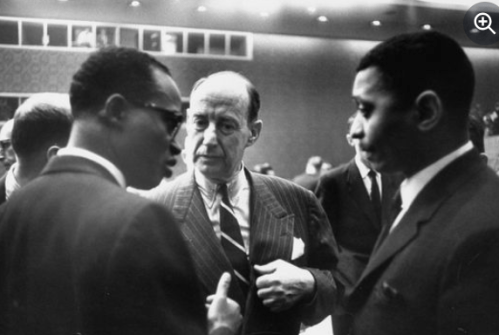
And he would play an important part in a drama that brought the world closer to nuclear war than it has ever been before or since. During the Cuban missile crisis, he urged Kennedy to offer to scrap our “Jupiter” missiles in Turkey if Russia would withdraw its missiles from Cuba. Most of Kennedy’s other advisors thought that this proposal was too “soft”; that it savored of Munich and Neville Chamberlain. While Kennedy was considering what choice of action to take, Stevenson forced Russia to admit that it had missiles in Cuba by showing photographs of the missiles, taken by a U-2 aircraft. Kennedy then made Russia the offer that Stevenson had proposed: to withdraw our Jupiter missiles from Turkey if Russia withdrew its missiles from Cuba. Russia agree to the proposal, ending the crisis. It did not immediately become public that Kennedy had made any concession to Russia; the public was made to believe that it was Kennedy’s unyielding toughness alone that had brought an end to the crisis.
**********
One of the compensations of his last years was his friendship with Eleanor Roosevelt, who became his supporter, advisor, and confidant. He shared with her many convictions, most importantly a belief in the supreme importance of human rights. When she died in 1962, he spoke at a memorial service for her at the United Nations; he said:
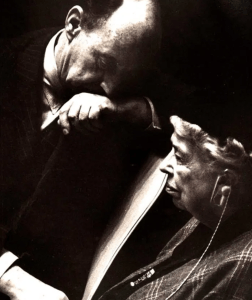
The United States, the United Nations, the world has lost one of its great citizens. Mrs. Eleanor Roosevelt is dead; and a cherished friend of all mankind is gone. Yesterday, I said that I had lost more than a friend — I had lost an inspiration: for she would rather light candles than curse the darkness and her glow had warmed the world.
Adlai Stevenson died of a heart attack in London, England on July 14, 1965. His death surprised most people who knew him, and some believed that he was killed by the stress of having to sit on his growing doubts about the wisdom of President Johnson’s escalation of the war in Vietnam. Eric Severeid, who had a long talk with him two days before he died, believed that he died of exhaustion/.
Several days before he died, he spoke the following words avt a conference in Geneva; his concern for the environment, going back to his call for a ban on atmospheric testing of nuclear weapons, here finds its fullest expression:
We travel together, passengers on a little space ship, dependent on its vulnerable reserves of air and soil; all committed for our safety to its security and peace; preserved from annihilation only by the care, the work, and I will say, the love we give our fragile craft. We cannot maintain it half fortunate, half miserable, half confident, half despairing, half slave to the ancient enemies of man half free in a liberation of resources undreamed of until this day. No craft, no crew can travel with such vast contradictions. On their resolution depends the survival of us all.
**********
Seventy-four years after Stevenson’s first run at the presidency, it may not be immediately apparent why he became a hero to the Democrats. His support of the New Deal traditions of the Democratic party was genuine, but somewhat perfunctory. He wasn’t a champion of liberal causes such as civil rights for African Americans or the rights of other abused groups. Unlike his friend Eleanor Roosevelt, he never sought direct acquaintance with the poor in order to understand their suffering. He wasn’t at all what today is called a “progressive.”
And in some ways, he set a bad example for following generations of Democrats — indulging in wit tainted with snobbery. Reflecting on his loss to Eisenhower in 1952, he said, “The people have spoken. As for their wisdom, well, Coca Cola still outsells champagne.” When Eisenhower became president in 1953, Stevenson said “The New Dealers have been replaced by the car dealers.” When asked whether it bothered him that the popular preacher Norman Vincent Peale had endorsed Eisenhower for president, he said “Not at all. I find the Apostle Paul appealing but Peale appalling.” Great wit, but bad politics.
And he never became reconciled to the corny side of politics. For example, once when he was campaigning in Florida, a supporter handed a stuffed alligator as a gift. Instead of holding it up in the air for the benefit of the press photographers, he looked at stuffed alligator and said “For Christ’s sake what’s this?”
And yet he became a hero -to the Democrats — because he was what many of them wanted to be and wanted their fellow Americans to be. He was deeply rooted in an America that was simpler, more idealistic, more sure of itself and therefore less self-righteous than America found itself to be at mid-twentieth century.
**********
More than most politicians, he looked to the past for guidance and support — in particular, to the role his family had played in our country’s history. His grandfather Adlai Stevenson I served as vice-president of the United States during Grover Cleveland’s first administration — which historians regard as an oasis of good government in the almost bottomless miasma of the Gilded Age. And on his mother’s side of the family was a great-grandfather, Jesse Fell, who was both a close friend and political advisor of Abraham Lincoln — the one of Lincoln’s advisors, it is said, who never asked Lincoln for anything in return for his services.
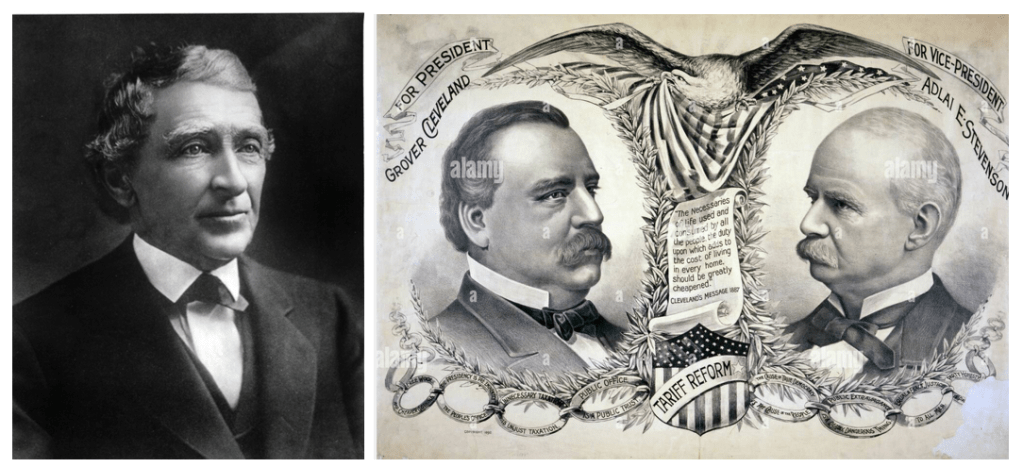
Jesse Fell (1808 — 1887) Cleveland — Stevenson Campaign Poster ca. 1885
Stevenson was proud of his connection to Lincoln through Jesse Fell, he studied Lincoln all his life, and there has probably been no politician before or since who was so thoroughly steeped in Lincoln’s words and thought. His feelings about his grandfather Adlai Stevenson I may have been ambivalent; as a young Democratic lawyer, he supported Stephen Douglas against Lincoln for the United States Senate. But Grandfather Stevenson set an example of dignity in his bearing and fairness in his dealing with others that won him the respect of members of both parties.
**********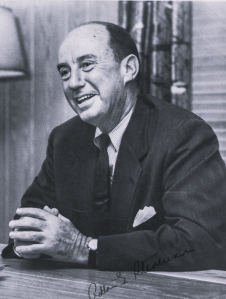
The phrase “human dignity” occurs in crucial contexts in Adlai Stevenson’s speeches. This simple idea — that every human being possesses a dignity that others ought to consider inviolable — was the central tenet of his political philosophy.
His concern for the dignity of others explains his contempt for Joseph McCarthy — that violator of the dignity of others — and his distaste for Richard Nixon — who was always willing to surrender his own dignity to advance his political career
And it may explain why, although he was roughly handled by democracy, he never lost faith in the democratic ideals that were espoused and vindicated by his political hero, Abraham Lincoln.
**********
Shortly after Stevenson’s death, Walter Lippmann wrote:
“We must wonder whether we have buried with Adlai Stevenson some element of the promise of American life. For in this generation he stood apart — as somehow a living specimen of the kind of American that Americans themselves, and the great mass of mankind would like to think that Americans are. Shall we see his like again? Or was he the last of his noble breed? On this question hangs the American future.”
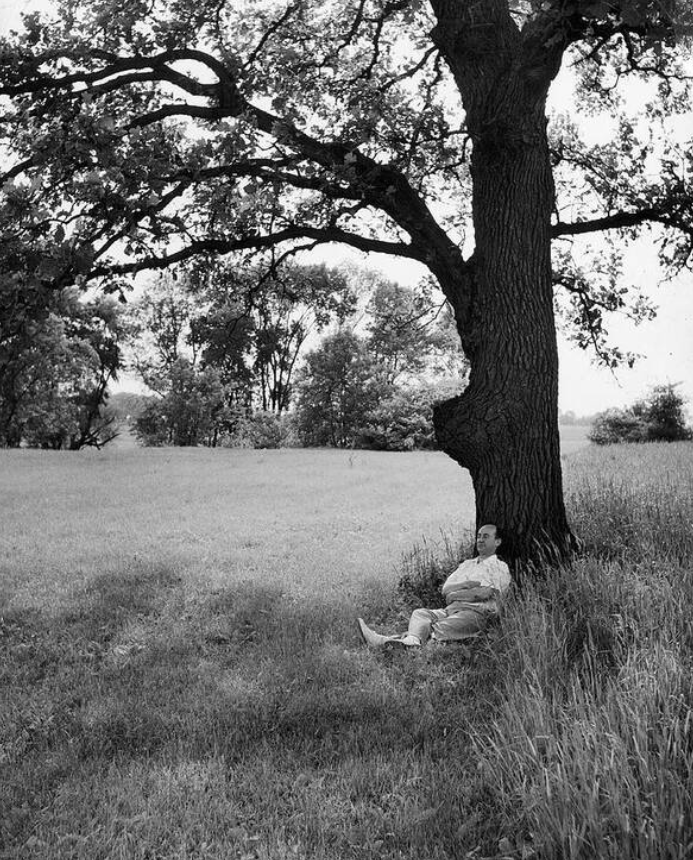 “I would like to sit in the shade with a glass of wine in hand and watch the people dance.”


I heard years after the fact that my parents and their friends, who liked Stevenson very much, wondered about his mettle — whether he had, in essence, the grit to be the leader of the free world. To ask the question is to answer it; they as Democrats voted for Eisenhower that year, as did many other Democrats. As I grew older I came to understand that Stevenson did, in fact, have that quality. In fact his courage was even greater in scope because he more than anyone else knew that his ‘52 campaign had no chance of success. He ran anyway, for his party and for his country, which he saw turning away from its stated principles. The Democrats had held the White House for twenty years, the banner was tattered, the two largest countries in the world were controlled by regimes genuinely hostile to the United States, and the Republicans were running the greatest war hero since Ulysses S. Grant. Stevenson never stood a chance, but he handled the situation with wit and style. (One of my favorites: “Newspaper editors are men who separate the wheat from the chaff, and then print the chaff.”) Thanks for this appreciation of a great American.
LikeLike
Nice review of interesting times. My mother, a lifelong Democrat, wouldn’t let herself vote for him as a Catholic woman of the time, though I think my father did, because he had divorced and remarried. Such a quaint idea today.
LikeLike