by John Breithaupt
About 25 years ago, my Uncle Bob — my mother’s oldest brother — gave me several boxes filled with genealogical material relating to my mother’s family. My uncle had received this material many years before from his grandfather, who had received it from his uncle. This chain of custody appears to extend back to the 1860s or 1850s, when someone first began to gather information about the family.
My uncle didn’t suggest that I do anything with this material other than keep it until I felt that it was time for me to pass it on to a younger member of the family. But I wanted to do something more, maybe adding genealogical information to the collection or clarifying what was already in it. So I started going through the material to see what I might be able to do.
What I found was mostly letters, and the letters were mostly about the things of ordinary life: weddings, births, deaths, and recipes — nothing that required my brilliant editorial intervention.
But one day I came across two remarkable letters, written during the Civil War, that gave me something to work on — a mystery! Both letters were addressed to a 17-year old Quaker woman named Lydia Good, who lived in a small town north of Cincinnati. Both letters began with the salutation “Dear Friend”, which was standard Quaker usage in those days. Lydia was the unmarried sister of Martha Ellen Good Conard, my great great grandmother. The letters were written by a soldier in the Union army named William something— he signed his last name illegibly on both letters.
Here then was something for me to work on — finding out who William was. That information would enable me to answer a number of questions raised by the letters.
William wrote his first letter to Lydia, dated August 11, 1864, from Kelton Barracks in Cincinnati, Ohio, where he was serving a 100 day enlistment with the Ohio state militia. Some of the most brutal fighting of the war was occurring then or was still to come. Nevertheless, the tone of William’s letter is light and cheerful; perhaps he chose not to burden a young woman with a soldier’s dark thoughts. He wrote about details of camp life and his hope that the war would be short.
William wrote his second letter to Lydia, dated April 18, 1865, from Camp Fisk in Vicksburg, Mississippi. He was waiting for the completion of the formalities of prisoner exchange and parole; that completed, he could return home to Ohio. He wrote:
After a long silence, I again take the liberty to address you, under quite different circumstances from when we last met . . . During my imprisonment, I was helped by a kind and merciful Providence with good health. I suffered frequently from cold, not having sufficient clothing & more particularly from hunger. At one time while on march I gathered up by the road side some turnip tops & rinds that had been thrown away and fed upon it greedily. We also stole corn from the mule troughs & and ate it raw or parched. But I will shock you no more by a relation of the horrors we suffered . . . When we received the news and the order for our exchange on 18th March you never saw a happier set of men in your life than we were. Some expressed their joy in one way and some in another. Some shouted aloud. Some at very top of voices sung national songs. Others laughed & others sat down and cried for joy. Yes men, strong men. Men that had stood firm on many a battlefield wept at this time like children. All felt that it was deliverance from death. . . Since I camed here I have been very sick. About ten or twelve days ago I was attacked with fever, was very bad three or four days. Am well now. . . There is the greatest contrast between yesterday and today in camp. Yesterday all was life and animation. National and other songs were heard all over camp. Not so today. This morning we received the sad mournful news of the murder of President Lincoln and Secretry Seward. Not a song is heard. All are sad. Some are swearing vengenance. The rebel commissioners were sent to the other side of the river before the news was made public in camp. Well may the nation mourn. In Abraham Lincoln we have lost the most honest public man in America. . . I hope to get out soon as I am getting tired of this place . . .
These remarkable letters raise several questions:
- What was William’s last name? Without an answer to this question, it would be difficult to answer the other questions:
- What happened to William between the time when he wrote the first letter to Lydia and the time when he wrote the second?
- What happened to him after the war?
- What was the nature of his relationship with Lydia?
I stared at the squiggle of a signature for hours, I showed it to friends, I showed it to people who had studied history — no one was able to decipher William’s last name.
Then one day, in 2018, a friend of ours named Joanie mentioned that she had just finished a course in the techniques of genealogical research that was offered by the adult education department at Boston University, and that several people who had taken the course had agreed to meet once a month to work on genealogical projects of the group’s choosing. I told her about the mystery of William. She said she thought that her genealogist friends would like to take on that project — and she was right.
Several months later, Joanie invited me to the next monthly meeting of her group of genealogists. They wanted to report to me about what they had learned. Joanie said that I might not like all that I heard.
First of all, they told me what William’s last name had turned out to be:
Barrere
Of course — their training included the decipherment of bad handwriting.
William Barrere, they found, was a member of one of the more well to do families in Highland County, where Lydia lived. An autograph album included in the material that Uncle Bob gave me contains the signature of a George Barerre, so it appears that the Barrere and Good families were close in some way. William’s letters to Lydia suggest that he knew her fairly well. She may also have been one of his pupils at the Papaw Seminary, where he taught and she was a student. For whatever reason, he felt an obligation to inform her about his life in the Union army. It is unlikely that there was a romantic relationship between the two: William married Araminta Van Winkle on April 13, 1864, four months before he wrote his first letter to Lydia.
On September 28, 1864 William enlisted in the 175th Regiment of the Ohio Volunteer Infantry. This regiment was mustered in October 1864 for one year to support Union forces in the western theatre near Nashville. When Confederate General John Bell Hood’s army advanced toward Nashville, it skirmished with the 175th and captured several of its members, William among them. He was sent to Cahaba Prison in Alabama; situated on low ground at the confluence of the Cahaba and Alabama Rivers, the prison was plagued by mosquito borne diseases such as yellow fever and malaria.
Even so, being captured was no doubt a stroke of luck for William; he missed fighting in the battle of Franklin, Tennessee — a battle so horrible and pointless that it is often dealt with in summary fashion by historians who relish their chance to describe the human catastrophes that took place at Gettysburg and Antietam; for example, J. G. Randall’s classic Civil War and Reconstruction devotes five pages to the battle of Antietam, nine pages to the battle of Gettysburg, but only two sentences to the battle of Franklin — even though roughly 8,000 men lost their lives in that battle.
On March 1865, William and other prisoners from Cahaba were transferred for prisoner exchange to Camp Fisk in Vicksburg, Mississippi, where he wrote his second letter to Lydia.
Camp Fisk also received former prisoners from the notorious Andersonville prison camp, and was soon struggling to provide for all the former prisoners, many of whom needed medical care. The authorities at Camp Fisk began to look for a commercial ship to take prisoners north to Camp Chase in Ohio, where their processing could be completed and their medical needs attended to. The federal government was offfering to pay ship owners $2.75 for each person they took north.
Just as the crisis at Camp Fisk was becoming acute, a large side-wheeled wooden steamship named Sultana arrived at Vicksburg. Powered by four large boilers, it had been designed to carry cotton to market. It was currently carrying passengers but no cargo.
One of the Camp Fisk officials told the ship’s owner that he would allow 1,000 former prisoners to board the ship, in exchange for a kickback. The ship was designed to carry, at most, 375 passengers and 85 crew. With the addition of the former prisoners to the passengers already on board, the ship would be carrying roughly 2,100 passengers. But the ship owner and the camp official coveted federal dollars, and a deal was stuck. Seven days after he arrived at Camp Fisk, William boarded the Sultana for his journey home.
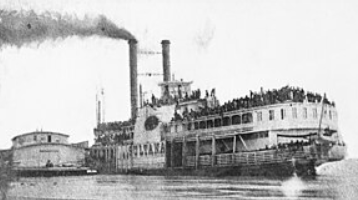
The Sultana began to make its way north slowly, against the current and straining under the weight of its human cargo. The ship was seen to list from side to side; this is thought to have drained water away from sides of the boilers, causing them to overheat and weaken. On April 27, 1865, shortly after the ship had passed Memphis, one boiler exploded, quickly followed by two others. The ship was blown to pieces, and most of its passengers were either killed by the force of the explosion, or were burned or scalded to death. Some passengers jumped overboard; most of these either drowned or died of hypothermia. Roughly 1,700 people died in the disaster, making it the worst maritime disaster in U. S. History, worse even than the sinking of the Titanic, which resulted in the loss of 1,500 lives.
Among those lost in the Sultana disaster was William Barrere of Highland County, Ohio — patriot, soldier, husband, teacher, and correspondent of Lydia Good.
Lydia Good died in 1915, surviving William Barrere by half a century.

 Yes Books Matter