I just watched Casablanca again — I don’t know how many times I’ve watched it. It’s an excellent movie of its kind — well plotted, well paced, full of suspence and wit and romance. It is not profound. Plumb its depths and you will come up with nothing. It is entertainment, and that is all.
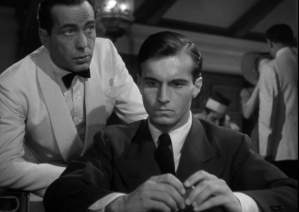
But I could enjoy it without having to deny my nature, which is that of a 76 year old man. I am an adult. “Casablanca” was made for adults. And it came toward the end of the times when mass entertainment was made for adults.
I believe that popular entertainment, by and large, stopped being suited for adults shortly after World War II. It began to be suited for adolescents, the reason being that people that age now had money to spend on entertainment. In the newly prosperous America, there were jobs for teenagers — part time, poorly paid, but enough make adolescents the arbiters of taste in mass entertainment. And it is an unhealthy taste.
In the preface to his long poem “Endymion”, John Keats wrote:
The imagination of a boy is healthy, and the mature imagination of a man is healthy; but there is a space of life between, in which the soul is in a ferment, the character undecided, the way of life uncertain, the ambition thick-sighted: thence proceeds mawkishness, and all the thousand bitters which those men I speak of must necessarily taste in going over the following pages.
Mawkishness and bitters, indeed. It’s the way our world is and will be for who knows how long. I feel like reading ‘The Spoils of Poynton.”

 Yes Books Matter
I understand your argument about the film, I think. But to me, first and last, this is a wartime propaganda film. As such, I’ve always looked at “Casablanca” from a different angle, as being among the best, perhaps the best, of the propaganda films during World War II because it avoided the usual crude manipulation of that genre and contained real brilliance. This film instead was witty as well as serious, and had actors, screenwriting, and directing that were as good as Hollywood could produce then. It was not a profound movie, as you say (few are), but it was among the best ever at its purpose.
As to the other point about adolescents’ entertainment, I’ll have to think about that more. Teenagers did have movies aimed at them before the war (Garland/Rooney, Tom Swift, Nancy Drew, Andy Hardy, etc.) and did attend them, just not as often for the reason you cite — disposable income. Five cents was a lot of money then. After the war (excluding film noir and select others) the movie entertainment industry dropped more and decidedly bigger idiot bombs not just on teenagers who had more money to spend on movies, but also on adults, and had the world had never seen screen gems such as “Pillow Talk”, “The Nutty Professor”, and “Boeing, Boeing”), it would be a better place today. That’s as far as I can generalize, but my point is that coopting imagination runs right across the demographic board because it’s all about the money. But, as I say, I’ll give your thought more thought.
LikeLike