My interest in the Battle of Shiloh is a personal one. In this battle, my great-great-grandfather, George R. Conard, received a wound in his ankle bone (then known as the “astragalus”) that withdrew him from the war and very likely saved his life, for his company suffered almost 100% casualties before the fighting ended. Thus, I owe my existence and my identity to a Confederate marksman who took aim at my grandfather, intending to kill him, but only crippling him for life.
Note: The information in this post comes from two sources: genealogical records handed down to me by my Uncle Bob over 25 years ago, and a letter, written by 1st Lieutenant F. M. Posegate, now online, describing the first hours of the battle. Because I am not writing for scholarly publication, I have not foot noted any of my statements. The source for any particular statement should be obvious, however.
Early in the morning of April 6, 1862, Corporal George R. Conard and the other soldiers of Company A of the 48th Regiment of Ohio Volunteer Infantry, were sitting down to breakfast and looking forward to a quiet Sabbath. The 48th Regiment was part of the Army of the Tennessee, commanded by General Ulysses Grant. A Confederate army, commanded by General Albert Sidney Johnston, was only several miles away. There had been skirmishes between the two armies, but Grant did not believe that there would be a battle that day.
Suddenly, the men of Company A heard the Long-Roll off to the right, followed by the sound of muskets being fired rapidly. They ran to get their weapons and after several minutes their regiment was ready to fight.
It was the beginning of a battle that horrified the nation, very nearly ended Grant’s military career, and in its scale and savagery prefigured some of the major battles of the First World War.
Company A began to suffer casualties almost immediately. Lieutenant Posegate wrote: “Just at this time David Morgan, [Corp.] George Conard, and David Woosley, all of our Company, came limping past, all wounded. Morgan thro’ the bowels, and the two latter in the feet. Geo is pretty seriously wounded, and it will be some time before he will be able to use his foot.” David Morgan died the next day. Ten soldiers from Company A were wounded, “Geo. Conard and myself the most seriously”, the Lieutenant added.
Some time later — it is not clear when — George Conard was loaded into an ambulance with two other men and taken to a remote location where the men’s medical needs could be attended.
The likelihood of infection made George Conard’s wound life-threatening. A Confederate minny ball had shattered the astragalus bone in his left foot. Known today as the “ankle bone”, the astragalus bone distributes weight from above to the other bones in the foot. Without an astragalus bone, the affected foot cannot bear weight. George walked with a cane for the rest of his life.
When news of George’s wounding reached his father, Benjamin Conard, in Cincinnati, he immediately boarded ship for Tennessee, found George, and brought him home. George was now desperately ill, suffering from both “camp dysentery” and a gangrenous infection in his wounded foot.
I do not know what Benjamin did to treat George for these diseases; he must have been an exceptional caregiver to have saved not only his son’s life, but also his foot.
When George had recovered enough strength to move around, Benjamin had him enrolled in Miami University, Oxford, Ohio (where my father would enroll eighty years later), and then in the local medical school.
By the war’s end, he was an army doctor, preparing sick and wounded Union soldiers to go home. The horror of war that he had missed seeing by being removed from the fighting on the morning of first day of battle, he now saw up close; and he not only saw it, but was responsible for alleviating and curing it. The war could never afterwards have been far from his thoughts.
Nor could the war ever be far from him physically. My Uncle Bob, who visited him several times when he was a child, told me that he moved slowly and stiffly, with the help of a cane, and that his ankle made a crunching noise whenever he flexed it. His disability did not, however, prevent him from marching in the annual Grand Army of the Republic parade on the Fourth of July.
In a nation that celebrates youth and endows it with attributes of invulnerability, he knew otherwise. He had once stepped forward to save his country; late in life, he stepped forward to save his country’s youth. He petitioned the legislature of the state of Ohio to outlaw football as a collegiate sport, testifying that it exposed the young men who played it to too great a risk of suffering catastrophic brain injury.
On our honeymoon in Maine, in July, 1982, my wife Lorraine and I noticed a large building on Route 1 in Wells, with a sign out front that said Douglas N. Harding Books Maps Prints. We stopped and made the acquaintance of Mr. Harding, and explored his collection of used books, which was large and of the highest quality. We left after about an hour, each with an armload of good things to read. Over the next 40 years, we stopped at Douglas N. Harding Books Maps Prints at least twice a year, when we were in Maine on day trips or vacationing in Kennebunkport. That would make around 80 visits. Sounds about right.
Douglas N. Harding died on June 11, 2026. He was 88 years old.
I don’t know how much of a reader he was himself, but he could distinguish good books from bad. There was little of the junk on his shelves that takes up so much space on the shelves in other second hand bookstores.
His demeanor was gruff and that scared some customers away. He was not all gruffness. I remember making my way through a crowd of mourners to talk to him at the memorial service for one of his former employees — a young woman whose job it had been to ensure that the books were in proper order on the shelves and that everything in the store was neat. She was charming but she was not the most reliable of employees; her periodic life crises led her to move out of state, and then to move back, and to ask Doug if she could have her old job back. He always took her on again. Anyway when I approached him at the memorial service, he made no sign of recognizing me. He was staring straight ahead. His eyes were filled with tears.
He traveled to find books, often driving across the country, stopping at estate sales, library book sales, and other spots where good second hand books were to be found. He knew where to look. He mailed the books back to Maine as he went along. His quest for books even took him to Newfoundland several times, where occasionally a professor at the university in St. John’s would die leaving a house full of books.
Running a second hand bookstore is hard work and the rewards — other than that of uniting readers with books — are uncertain. It is certain that people have been buying fewer books as the Age of the Internet wears on, and Douglas N. Harding Books Maps Prints became less profitable every year. It made for a sad end of a useful and honorable career, uniting people with the books that will delight, instruct, and inform them, for untold years to come. Requiescas in pace, Douglas N. Harding. You did well.
P.S. The bookstore’s website says that it is closed permanently.
palinode, n: 1. An ode or poem that recants or retracts something said in an earlier poem, 2. a recantation
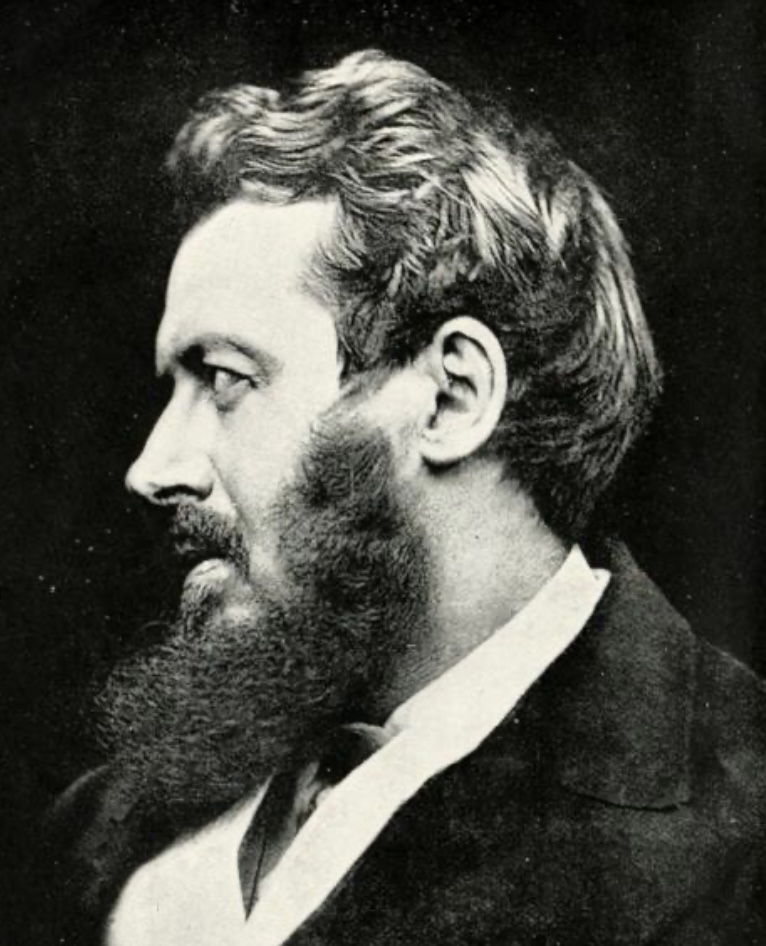
By a stroke of good luck for students of the Civil War, Walter Bagehot, one of Victorian England’s most brilliant economists, essayists, and political thinkers, became editor of the London business journal The Economist in the autumn of 1860, not long before Abraham Lincoln became President of the United States. As editor of the Economist, Bagehot would freqently need to comment on American affairs; even then the English and Americans were deeply involved with each other both politically and economically. The twenty commentaries on American affairs that Bagehot eventually wrote provide a valuable historical record of the evolution of the views of a first rate mind on the momentous events in America and on the statesmanship of the chief actor in those events, Abraham Lincoln.
Walter Bagehot was born in 1826, into a wealthy family of merchants and bankers. After completing his education at University College, London, with first class honors in economics and moral philosophy, he studied law and worked as manager of the Bristol branch of Stuckey’s bank. At the same time he began publishing articles on history and economics in England’s leading academic and literary journals. The original content and elegant style of these articles were admired by James Wilson, a member of the Palmerston government, who had founded The Economist is 1843. Wilson died in 1860, and Bagehot by pre-arangement became editor of the Economist. Several years after becoming editor, Bagehot married Wilson’s daughter Eliza; the marriage was by all accounts exceptionally happy.Walter Bagehot died in 1873, of complications from pneumonia.
Bagehot also found time to write books — remember, he was a Victorian — two of which were of enduring importance. One is “The English Constitution” a brief overview of the subject that is said to be required reading for the Princes of Wales. The other is “Lombard Street”, about the Bank of England and central banking generally; in this book, he expounds the rule, known as “Bagehot’s dictum”, that in times of financial crisis following the collapse of speculative investments, the central banks should provide unlimited amounts of credit to solvent institutions in order to quell panic and prevent a disastrous contraction of the economy. During the financial crisis of 2008, officials at the United State Federal Reserve Bank frequently referred to Bagehot’s dictum and claimed to be following it in practice.
Walter Bagehot, 1826 – 1877
In his articles about American affairs, Bagehot often wrote about the difficulty of learning what was happening in America and of understanding why. But however baffling and obscure American affairs may have been to Bagehot and his readers, they were of too much consequence to England to be ignored.
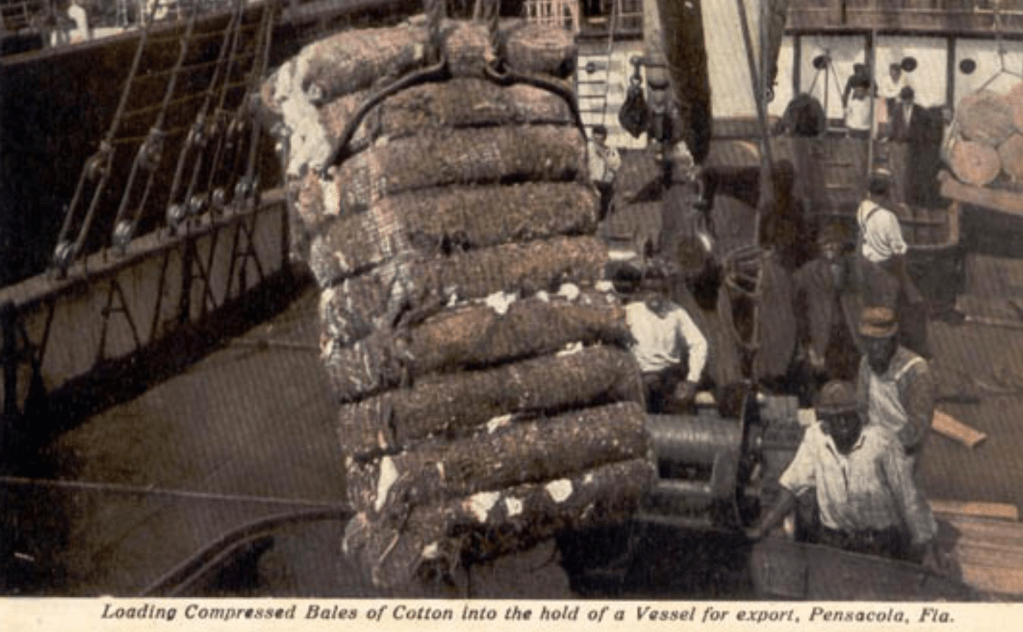
For example, Lancashire depended for its prosperity on American cotton, and the north’s embargo on the export of cotton was causing great hardship there.
And for Bagehot in particular — a keen student of forms of government, the functioning of the United States Constitution in this moment of crisis provided almost endless matter for reflection.
Thus, Bagehot’s thoughts were drawn to America willy-nilly, and he formed strong convictions on several fundamental matters:
The south was responsible for the crisis. The election of Lincoln was not the cause of the war, but the long awaited pretext for seccession.
The war would be immensely destructive, and for this reason, he frequently called for a quick end to it through negotiation.
The North in any case would be better off if it were free to go its own way, without the south. It would no longer have a share in the moral shame of slavery. It would be better able to attend to its own business. It would be less feared, but more respected by the countries of Europe, and it would still be destined to become the wealthiest and most powerful nation on earth.
If the south could be prevented from extending slavery into the territories, the continued cultivation of cotton in the current slave states would eventually exhaust the soil there, making cotton unprofitable to grow and so leading to a gradual and voluntary abolition of slavery. On this point Bagehot seems less impressive than when touching on other points. For the South, slavery was more than a means to an economic end; it was above all, the South’s sole bulwark against an insurrection of blacks against whites. Take that bulwark away, and nothing could prevent the white Southerner’s nightware vision of race war from becoming a reality. But Bagehot can hardly be blamed fo failing to understand Amerian race relations in all their complexity.
The north in any case had little chance of bringing the south back into the union. “The Americans have never faced any great difficulties”, he wrote. They had won their independence from England, not by strength or courage, but only due to the “imbecility” of the Lord North government. Northerners prized the union only because it bolstered their sense of prosperity and power, which “swelled so flatulently and disturbingly in the breast of every citizen of the Atlantic Republic.” Of the northerners’ deep attachment to the union as the realization of the ideals of the founders, Bagehot appears to have had little appreciation.
Adding to the difficulties of the north, Bagehot believed, was its lack of capable leadership. Here the south had the advantage of being led by so capable and experienced men as Jefferson Davis and Robert E. Lee. On the other hand, the government of the federal states, Bagehot wrote, “has fallen into the hands of the smallest weakest and meanest set of men who ever presided over the policy of a great nation at the critical epic of its affairs. The president means well, but he does nothing else well. The inexplicable caprice of a forgotten caucus selected Mr. Lincoln as a candidate because no one knew much about him, and therefore scarce anyone could object to him.”
Bagehot further deplored the “ungrammatical prolixity” of Lincoln’s writing style, saying “There is no greater misfortune than for a great nation to be exclusively represented at a crisis far beyond previous example by a person whose words are mean even as his actions are important.”
The blame for the rise of such a person as Lincoln belongs to the constitution’s “gift of unchecked influence to obscure political caucuses and the uninstructed outdoor multitudes”. Bagehot wrote:
“The constitution of the United States was framed upon a vicious principle . . . under the growing influence of democracy, the electoral college had lost its power of independent choice, and now simply ratified the choice of the people,” and this was frequently a “bombastic vulgarian”.
An Infinitesimal Chance?
But Bagehot was a student of the actual who never tried to explain away what he saw happening, however unexpected and inexplicable that might be. In the third year of America’s terrible war, the North looked more and more like it might win; the American people unexpectedly showed powers of endurance and a gift for mastering difficulties; and Lincoln appeared more and more to be the leader that the crisis demanded. Bagehot changed his views accordingly.
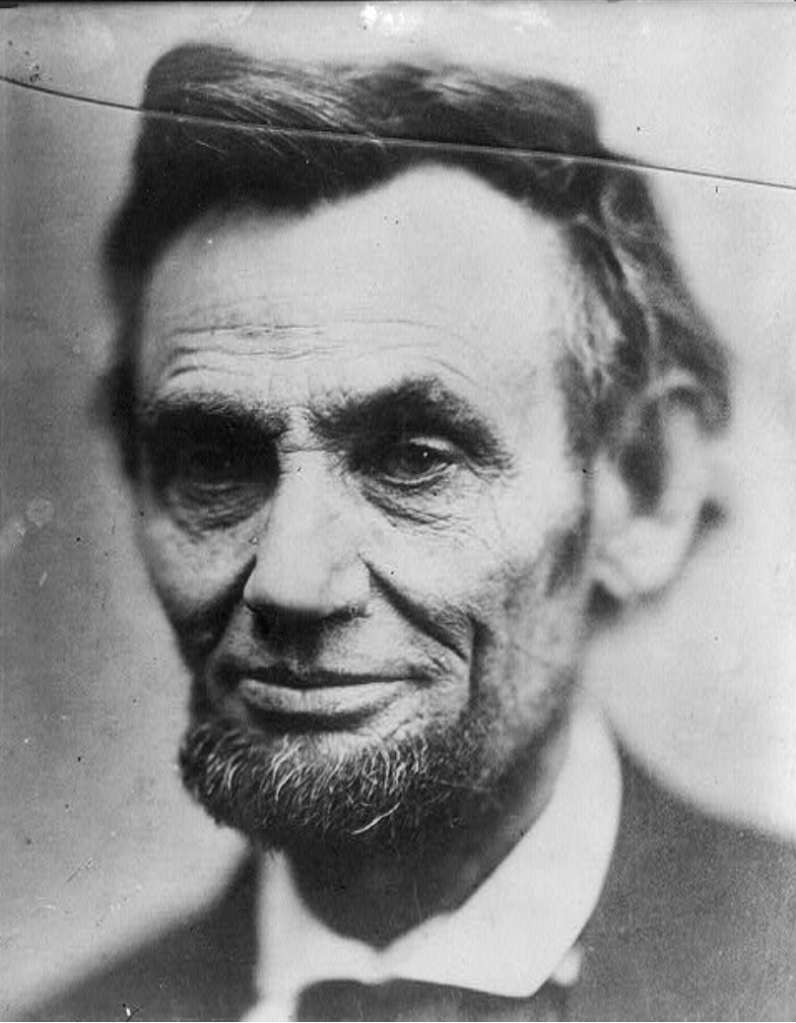
His exceptionally eloquent editorial of April 29, 1865, “The Assassination of Mr. Lincoln”, was his palinode from everything he had written on Lincoln. Bagehot wrote that under the American system of government,
“the head of the Executive may, by an infinitesimal chance, be a man so exactly representative of the people, that his acts always represent their thoughts, so shrewd that he can steer his way amidst the legal difficulties piled deliberately in his path, and so good that he desires power only for the national ends. The chance of obtaining such a man was, as we say, infinitesimal; but the United States, by a good fortune, of which they will one day be cruelly sensible, had obtained him. Mr. Lincoln, by a rare combination of qualities—patience, sagacity, and honesty—by a still more rare sympathy, not with the best of his nation but the best average of his nation, and by a moderation rarest of all, had attained such vast moral authority that he could make all the hundred wheels of the Constitution move in one direction without exerting any physical force. . . .
“. . . The President had, in fact, attained to the very position — the dictatorship — required by revolutionary times. At the same time, this vast authority, not having been seized illegally, and being wielded by a man radically good—who for example really reverenced civil liberty and could tolerate venomous opposition—could never bedirected to ends wholly disapproved by the ways of those who conferred it.”
“. . . We do not know in history such an example of the growth of a ruler in wisdom as was exhibited by Mr. Lincoln. Power and responsibility visibly widened his mind and elevated his character. Difficulties, instead of irritating him as they do most men, only increased his reliance on patience; opposition, instead of ulcerating, only made him more tolerant and determined. The very style of his public papers altered, till the very man who had written in an official despatch about “Uncle Sam’s web feet,” drew up his final inaugural in a style which extorted from critics so hostile as the Saturday Reviewers, a burst of involuntary admiration. A good but benevolent temporary despotism, wielded by a wise man, was the very instrument the wisest would have desired for the United States; and in losing Mr. Lincoln, the Union has lost it. The great authority attached by law to the President’s office reverts to Mr. Johnson, but the far greater moral authority belonging to Mr. Lincoln disappears.”
Bagehot was wrong in supposing that Lincoln’s eloquence was drawn out of him by the pressures he felt as President — the Presidency does not turn inarticulate men into literary artists, as the long dismal turgid flow of presidential speech in our time so clearly demonstrates! But Bagehot’s palinode says more about Lincoln’s greatness than many whole books on the subject have managed to say, and it remains a classic of political commentary.
At the end of the war, the nation was in fact exhausted — physically, emotionally, morally. It did not want to hear about the rights of man, or justice, or freedom. For another 80 years, black Americans would be oppressed and abused in ways barely preferable to what they had experienced as slaves. But Lincoln’s words and his example of faithfulness to the principles of the Declaration of Independence, if they did not make us just, lingered in our minds, keeping us from being even more unjust than we were.
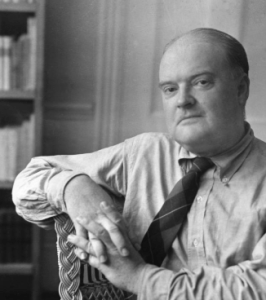
The Library of America is a non-profit foundation that prints well-edited uniformly bound editions of major American writers. The first volumes in the series (works by Melville, Hawthorn, and Whitman) went on sale in 1982, ten years after the death of the critic Edmund Wilson, who had long been agitating for the creation of a foundation such as this — one that would do for American literature what the Bibliothèque de la Pléiade had long since done for French literature: make the works of the country’s best writers available in not-too-expensive editions that are sturdy and legibly printed, and can easily fit in a suitcase or handbag.
Edmund Wilson (1895 – 1972)
Most of titles printed by the Library of America are reprints, but a number of original titles have been brought out recently. One of the most valuable of these titles is, in my opinion, The Lincoln Anthology: Great Writers on His Life and Legacy from 1860 to Now, edited by Harold Holzer, and published in 1989.
The Lincoln Anthology contains 129 entries, none longer than seven or eight pages. Some entries are by forgotten writers such as James Sloan Gibbons (1810 -1892), author of the patriotic poem “We Are Coming, Father Abraham, 300,000 Strong” and Honoré Willsie Morrow (1880 – 1940), author of a trilogy of historical novels about Lincoln’s life.
Other entries are by some of the great ones of the Earth: Karl Marx, Henrik Ibsen, Victor Hugo, and Leo Tolstoy (who thought Lincoln the greatest leader in human history.)
One entry is itself a masterpiece: Walt Whitman’s superb “When Lilacs Last in the Dooryard Bloomed.” In general though, poets do not make a good showing here; for example, Edwin Arlington Robinson’s “The Master” is far from the level of this wonderful poet’s best.
Ralph Waldo Emerson’s remarks at a memorial gathering in Concord several days after Lincoln’s assassination, and Nathanial Hawthorne’s account of his meeting with Lincoln in the White House, are magnanimous and just. Here are two princes of Yankeedom acknowledging that the finest fruits of the nation’s character may bloom not in New England, but out in the uncouth hinterland. Their remarks do them credit.
Governor Adlai E. Stevenson of Illinois, speaking at Gettysburg on the the eighty-eighth anniversary of Lincoln’s address, said that “it is for us, the living, to rekindle the hot, indignanr fires of faith in the free man, free in body, free in mind, free in spirit, free to hold any opinion, free to search and find the truth for himself; the old faith that is ever new — that burned so brightly here at Gettysburg long ago.”
I’m far from having read all the entries in “The Lincoln Anthology.” But among those that I have read, three stand out for their penetration and their ability to bring Lincoln into focus. These essays are Jacques Barzun’s “Lincoln the Writer” (1959), Reinhold Niebuhr’s “The Religion of Abraham Lincoln” (1965), and Marianne Moore’s “Abraham Lincoln and the Art of the Word.” (1961)
Reinhold Niebuhr (1982 – 1971) was a reformed Lutheran pastor and theologian whose writings on public affairs have had a profound influence on historians, political scientists, reformers (including Martin Luther King) and politicians (including Barack Obama). By temperament a crusader for social justice, he criticized modern liberal movements for their utopianism, arguing that “original sin is one Christian dogma that is empirically verifiable.” His aphorisms (“Man’s capacity for justice makes democracy possible; his inclination to injustice makes it necessary.”) are legendary, and he is thought to be the author of an early form of the “Serenity Prayer”.
Niebuhr admired Lincoln for his grasp of what modern theologians (Karl Barth?) have called the “otherness” of God. In the view of these theologians, men may be instruments of God’s will, but not necessarily in ways they would have guessed or found flattering. In his Second Inaugural Address, delivered at the moment of victory in a terrible war that even friendly observers gave Lincoln’s side little chance of winning, he refused to take victory lap or claim that the North won because it was doing God’s will. Instead, Lincoln said the war may have been a punishment meted out to both sides for their joint complicity in the crime of slavery. That the leader of a great nation should renounce the mantle of righteousness when all the world would have forgiven him for assuming it, Niebhuhr found to be astounding; his call for charity for all, Niebuhr thought, showed that Lincoln’s religion, unorthodox as it may have been, was grounded in profound religious insight.
Jacques Barzun (1907 – 2012), a native of France, was for many years a professor of cultural history at Columbia University. In “Lincoln the Writer”, Barzun said that Lincoln was for him first of all artist, “the maker of a style that is unique in English prose and doubly astonishing in the history of American literature, for nothing led up to it.” I don’t entirely agree that “nothing led up to it”; Daniel Webster, when he was not upholstering his speeches with verbal velvet, at times achieved something like the sinewy argumentative strength that is so characteristic of Lincoln’s best prose. And Lincoln borrowed phrases from the Boston abolitionist, preacher, and scholar, Theodore Parker (1810 — 1860), whose writings he admired. Even so, Barzun is certainly right that there is something unique about Lincoln’s prose — a cadence, an impetuosity of thought, a striving for clarity that make almost every sentence he wrote proclaim its author.
“Abraham Lincoln and the Art of the Word” by the poet Marianne Moore, seems to me the best account of Lincoln’s style ever written. “The largeness of the life,” she wrote, “entered into the writing, as with a passion he strove to persuade his hearers of what he believed, his adroit ingenious mentality framing an art which, if it is not to be designated poetry, we may call a grasp of eternal grace — in both senses, figurative and literal.”
Marianne Moore (1887 – 1972)
I’ve often wondered why the knickname “Honest Abe” was affixed to Lincoln so early, and stayed with him to the end. Salmon P. Chase was an honest man; never a breath of scandal about him. But it was Lincoln who was “honest” Abe, and Marianne Moore helps us understand why this was so. Lincoln’s intellectual honesty was evident in everything he wrote. He tried to make what he thought, as well as why he thought it, as clear as possible, in the hope that his hearers would thereby be persuaded. The American people understood that Lincoln was treating them with respect and to their credit repaid him with a fierce devotion.
Reviewing the list of books that Lincoln read, and made part of himself, she found Euclid’s “Elements of Geometry” to be crucial.
In a Euclidean mood, he wrote to James Conkling, “You desire peace, and you blame me that we do not have it. But how can we attain it? There are but three conceivable ways. First, force of arms. . . . Are you for it? A second way is to give up the Union. Are you for it? If you are, you should say so plainly. If not for force, not yet for dissolution of the Union, Compromise. I am against that. I do not believe any compromise is now possible.”
“An architect of justice,” she wrote, “determined and destined to win his ‘case’, he did not cease until he had demonstrated the mightiness of his ‘proposition’. It is a Euclid of the heart.”
This anthology would have done well to include two more items that I can think of:
The discussion of Jefferson’s language in Carl Becker’s beautifully written book, “The Declaration of Independence” (1922). Jefferson’s language, wrote Becker, is felicitous, and his gifts as a phrase maker are obvious. But it all lacks warmth; it is too entirely of the head. Lincoln’s language, in contrast, appeals to the heart as well as the mind, very much as Marianne Moore would point out.
Walter Bagehot’s editorial “The Assassination of Mr. Lincoln”, in the April 29, 1865 issue of the Economist is the most profound estimate of Lincoln’s historical achievement that I have ever read. “We do not know in history such an example of the growth of a ruler in wisdom as was exhibited by Mr. Lincoln,” wrote Bagehot. The editorial is particularly gratifying to Yankee sensibilities when read in the light of Bagehot’s previous editorials on American affairs, in which he deplored the “smallness and meanness” of the leadership of the North. I will discuss the evolution of Bagehot’s views on Lincoln and the Civil War in a soon to be published post, titled “Walter Bagehot’s Palinode.”
……..
Will this country ever again see such a leader as Lincoln? We cannot know. But by studying the qualities of heart and mind that made Lincoln so extraordinary a leader, we can become better able to recognize such qualities in the people who emerge from the American political machine to solicit our favor. It’s a forlorn hope, that there will ever be much to recognize or reward, but then democracy was never anything more than an experiment.
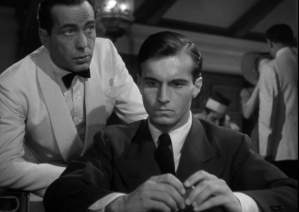
I just watched Casablanca again — I don’t know how many times I’ve watched it. It’s an excellent movie of its kind — well plotted, well paced, full of suspence and wit and romance. It is not profound. Plumb its depths and you will come up with nothing. It is entertainment, and that is all.
But I could enjoy it without having to deny my nature, which is that of a 76 year old man. I am an adult. “Casablanca” was made for adults. And it came toward the end of the times when mass entertainment was made for adults.
I believe that popular entertainment, by and large, stopped being suited for adults shortly after World War II. It began to be suited for adolescents, the reason being that people that age now had money to spend on entertainment. In the newly prosperous America, there were jobs for teenagers — part time, poorly paid, but enough make adolescents the arbiters of taste in mass entertainment. And it is an unhealthy taste.
In the preface to his long poem “Endymion”, John Keats wrote:
The imagination of a boy is healthy, and the mature imagination of a man is healthy; but there is a space of life between, in which the soul is in a ferment, the character undecided, the way of life uncertain, the ambition thick-sighted: thence proceeds mawkishness, and all the thousand bitters which those men I speak of must necessarily taste in going over the following pages.
Mawkishness and bitters, indeed. It’s the way our world is and will be for who knows how long. I feel like reading ‘The Spoils of Poynton.”
Good English prose continues to be written by people in all walks of life, for all purposes. Even so, only an incurable optimist will say that all is well with the English language. Within the lifetime of the author of these sentences, and of most of his readers, two changes have happened that have lowered the general standard of English prose:
Being able to write well is more and more becoming a personal achievement. Schools no longer require students to go through the exercises that helped past generations learn how to write clearly and simply: diagramming sentences, memorizing poetry, copying passages of distinguished prose into notebooks, and so on. Exercises such as these are not creative, say the educational experts — forgetting that such exercises teach students fundamental skills that they will need when they begin to do creative work. Somehow, a few people are finding their way to the discipline that they need to bring order out of the chaos of their thoughts. These are the people who are going to end up writing well however little guidance or encouragement they receive. What we are losing are the reasonably good writers who would never have learned to write well on their own.
Not being able to write well is no longer a cause for shame, most people feel. In fact, being inarticulate may be to one’s advantage in some areas of life, such as politics; politicians who speak too well are thought to lack the common touch. And in fact, prose whose clarity expresses the logic of an argument places a burden on the reader that bad prose does not; the muddiness of bad prose hides the logic of arguments, thereby relieving the reader and listener of the need to think anything through. In bad prose, the arguments, such as they are, are made through vague, suggestive, manipulative language that is meant to make certain impressions on passive minds, not to awaken anyone’s critical faculties.
For example, it is hard to imagine a public figure of a generation or two ago replying to a journalist’s question in as slipshod a manner as Secretary of the Interior Doug Burgum did, when asked whether the names of private donors to Donald Trump’s celebration of our nation’s 250th anniversary would be made public. Burgum said,
“It’s not about the transparency of the donors, This is about Americans celebrating the 250th anniversary.”
This means, I would guess: “The purpose of the celebration is to mark the 250th anniversary of our nation’s independence; its purpose is not to afford donors an opportunity to make their generosity known to the public.” Or something like that. But to get at a meaning like the one that I suggest, it is necessary to read Burgum’s reply as sloppily as he spoke it. That is, it is necessary to accept the lack of a reference for the pronouns “It’s” and “This”. And it is necessary to understand that the phrase “transparency of donors” means the visibility of donors, and not their almost invisibility, like that of substances such as air, water, and glass. And it is necessary to understand that “about” means “purpose.”
Secretary Burgum no doubt made his meaning clear to most people who read the interview. Still, if we tolerate such sloppiness in others, and expect nothing better of ourselves, we are accepting a lowering of standards in language that will be of great use to people who want to avoid having to make their meaning clear. Our aim in speaking and writing should be to express ourselves so clearly that what we are talking about will be immediately evident to others — if, indeed, we ourselves know what we are talking about.
Rescue dogs we know all about. They skulk around garbage dumps and railroad tracks, mangey, smelly, hungry, and lovable. Humans see them, love them, take them home with them, feed them and clean them up, and humans and dogs live happily together.
And then there are rescue words. These are as badly abused as rescue dogs, but the more they are abused, the more they are held in contempt. But they were good words once, and are still important tools of thought and expression. In this post I will adopt a few rescue words, bathe them, comb the ticks out of their hair, and get them back on their own two feet.
In this post, I refer to usages that are “correct”. By this I mean that the usages are well established and should never mislead anyone as to your meaning.
Note: I have no quarrel with usages that cannot be mistaken for correct usages. (See entry for “disinterested” below) “I ain’t got none” is not a correct usage, but it cannot cause any confusion about the meaning of any correct usage. It is simply a usage that you are better off avoiding if you are, for example, applying for a job as a copy editor at the New Yorker.
— beg the question. This is a logical fallacy, meaning to take as the premise of your argument the very thing that your argument is trying to prove. For example, “Parallel lines never touch because they are parallel.”
— deja vu. Literally, “already seen,” in other words stale, overly familiar. For example, “When Harold Stassen declared his candidacy for president for the fourth time, the press labeled him ‘the candidate from deja vu.”
— disinterested. Having no stake in a matter, no hope of private gain. Avoid using to mean, “blase” or “not interested.” For example, “The rich man’s philanthropic donations were inspired by his disinterested love for the human race.”
–eke out. To make something last longer by managing it carefully or supplementing it with something similar. For example, “He eked out his salary as church sexton by singing hymns as a busker in Harvard Square.”
— icon. Literally, an image; typically an image of a saint revered by the
Eastern Orthodox Church. Avoid using to mean a “celebrity.” For example: “The shelf above the priest’s cot was filled with icons.”
— kitsch. Describes something that is vulgar, cheap, and crappy. Not to be confused with “chic”. For example, “The self-taught artist was dismayed when the art critics said that his black velvet portrait of Wayne Newton playing golf with Jesus Christ was kitsch.”
— R.S.V.P. Stands for “repondez, s’il vous plait.” Literal meaning: “Please reply.” Thus, “Please R.S.V.P.” means “Please please reply.”
— transparent. This word applies to something that can be seen through, like water or glass. When a politician says that his motives are transparent, it is hard to know what he means. That his motives are glassy? For example: “The Board of Health recommends filtering the rusty tap water until it is clear and transparent before drinking.”
— problematic. This word means “abounding in unanswered questions. For example, “The historical existence of King Arthur is problematic.”
— usage. A common form or way of using something; almost always a grammatical usage. Avoid using this word to mean “the amount of use”. For example, “Lincoln’s conversation was peppered with the quaint usages of the prairie.”
It is said of the music of Beethoven and Mozart that it is greater than can be performed. After listening to recitations of Lincoln’s Gettysburg Address by several famous actors, I was starting to think that Lincoln’s famous 272 words might be better than can be recited. In these recitations, something adventitious always seems to obscure the sense of the words and their matchless construction — something corny sired by Disney on Sandburg. What is lost is the nature of the address — its severe verbal economy, its passionate reasoning, making it an example of what the poet Marianne Moore said was Lincoln’s essential style, a “Euclid of the heart.” Continue reading “Gettysburg at Last?”→
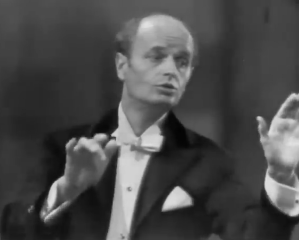
The other day I was able to add a name to the list of my musical heroes: Ferenc Fricsay (1914 – 1963), a Hungarian conductor whose recordings of Beethoven’s symphonies are considered unsurpassable by people whose knowledge of and love for the music entitle them to hold opinions like that. All I can say for myself is that his conducting of Beethoven gives me the pleasure that I look for from music, in abundance.
The pleasure that I look for from music I can get from other sources as well — it’s any pleasure that frees me from competitive and selfish impulses. It’s the kind of pleasure that I get eating vanilla ice cream. I can enjoy the ice cream without needing to believe that I am enjoying it better than anyone else, and I feel no need to have all the vanilla ice cream in the world to myself. When Christ returns in glory to judge the living and the dead, I hope He finds me enjoying a vanilla ice cream cone or listening to a recording of a performance by Ferenc Fricsay.
Fricsay was in poor health most of his life and died young. He kept conducting as long as he was physically able, without any apparent diminution of the joy that music gave him.
In YouTube, search for “Ferenc Fricsay Rehearses and Conducts Smetana’s Moldau”; there you will find a movie, made in 1960 for German television, of Fricsay rehearsing the Symphony Orchestra of the South-German Radio Stuttgart, in spite of pain and weakness.
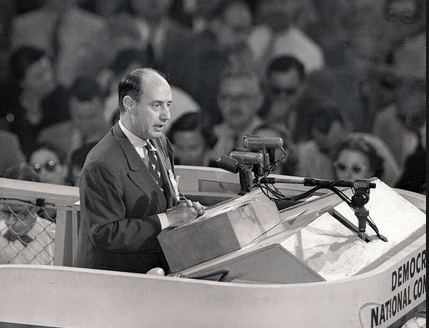
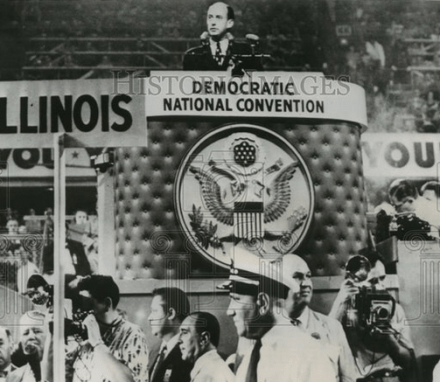
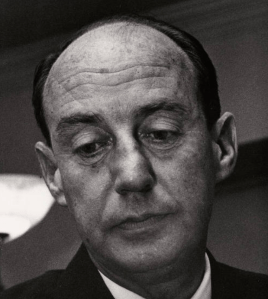
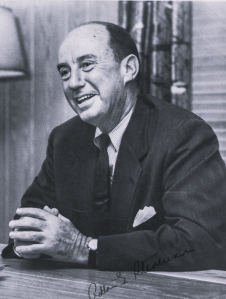
On July 25, 1952, Governor Adlai Stevenson of Illinois was drafted by the the Democratic National Convention in Chicago to be the party’s candidate for President of the United States. It was the improbable beginning of a political campaign that is still remembered, by older Democrats at least, as a model for what political campaigns can and should be. Stevenson began his campaign by urging his fellow Democrats to talk sense to the American people, to tell them the truth — and he then proceeded to follow his own advice, to the best of his remarkable abilities. That he lost the election, by one of the widest margins in modern American history, seemed only to add luster to his foredoomed campaign.
For no one believed that Stevenson, or any other Democrat, could be elected President in 1952. President Truman was deeply unpopular, largely because of his inability to end the Korean War; Democrats had occupied the White House for twenty years, and the voters were quite reasonably wondering if it weren’t time for a change; and the Republican candidate for President was Dwight David Eisenhower, an authentic war hero who was liked and admired by people in both parties. Stevenson himself would later say that running against Eisenhower was like running against the ketsup on the kitchen table.
Adlai Stevenson Accepting the 1952 Democratic Presidential Nomination
And in fact, Stevenson lost by a landslide. Eisenhower carried 39 of the 48 states, and received 55% of the popular vote. Stevenson carried only 9 states, all of them southern or border states where voting for a candidate of the party of Lincoln was still unthinkable. He even lost liberal, elitist Massachusetts — by over 100,000 votes. In addition, the Republicans won control of both houses of Congress, although by small margins.
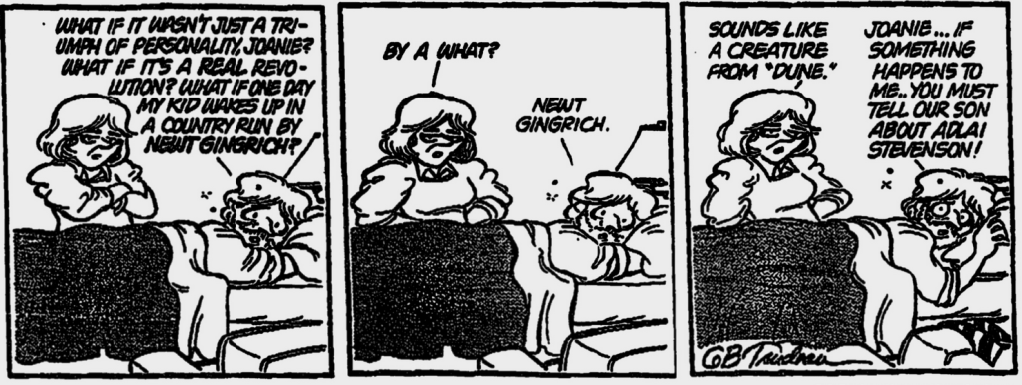
But in spite of having led his party into electoral catastrophe, Stevenson developed a stubbornly loyal following within the party, and he would be the party’s voice and conscience for the remainder of the decade. His influence would extend far beyond the era of his political activity and would cross party lines. Political figures as diverse as Ted Kennedy, Donald Rumsfeld, and Henry Kissinger claimed to have been inspired to enter public life by Stevenson’s example. And the cartoon character Mike Doonesbury would take to bed wondering what would happen to our country if it were no longer inspired by Stevenson’s example.
Shortly after Stevenson’s death in 1965, the journalist Eric Severeid, who knew him well, wrote, ““All I know as a political reporter is that Adlai Stevenson injected humor and happiness and sophistication into American political life, and you have to have spent half your life listening to the normal run of American politicians to really understand what a fantastic accomplishment that was.”
In this post I will try to describe the qualities of Stevenson’s 1952 campaign for the presidency that made it so memorable.
**********
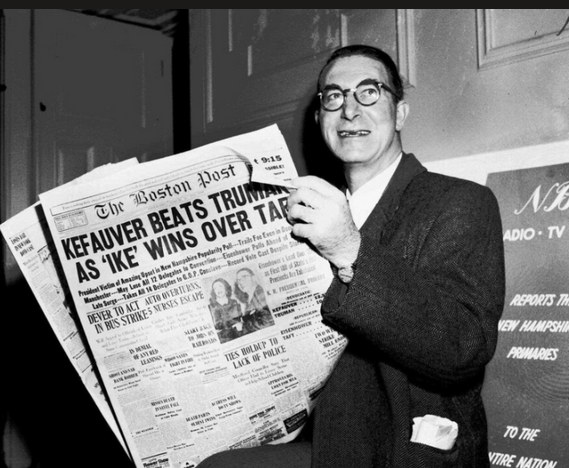
Stevenson’s nomination was owing to a set of unusual circumstances. President Truman had decided not to seek re-election after losing the New Hampshire primary to Senator Estes Kefauver of Tennessee. Going into the convention, Kefauver had more delegates pledged to him than any other contender for the nomination, but was still short of the number that he needed to be nominated. None of the other contenders for the nomination had a significant amount of support outside of their home states.
Estes Kefauver (1903 — 1963)
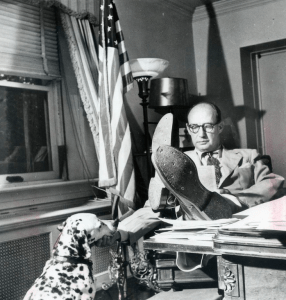
Truman detested Kefauver, who, to be fair to Truman, was widely disliked within the party for his sanctimonious manner. He and other party bosses began to look for someone other than Kefauver to be the party’s nominee, and they settled on Stevenson, who had been elected Governor of Illinois by the largest margin in state history. During the war, he had worked in the Department of the Navy and the State Department and had been a member of the original American delegation to the United Nations. But Stevenson had already announced that he would seek a second term as governor, and felt honor-bound to follow through on that commitment. Besides, his work as governor was well respected, he and his dalmation dog “King Arthur” were beloved figures in the streets of Springfield, and he was almost certain to be re-elected.
In the absence of a strong contender for the nomination, the Democrats were facing the prospect of a long convention, requiring many ballots to settle on a candidate. Although party officials had far more influence over conventions than they do today, Truman was powerless to avert this outcome.
This was the situation when Stevenson, as governor of the state hosting the convention, was invited to deliver a welcoming address. He told the delegates:
Here on the prairies of Illinois and the Middle West we can see a long way in all directions. We look to east, to west, to north and to south. Our commerce, our ideas, come and go in all directions. Here there are no barriers, no defenses, to ideas and aspirations. We want none; we want no shackles on the mind or the spirit, no rigid patterns of thought, no iron conformity. We want only the faith and conviction that triumph in free and fair contest.
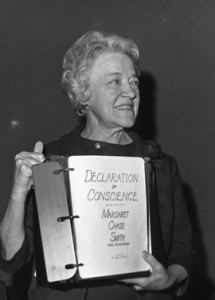
Stevenson’s eloquence impressed the delegates, and even the least attentive among them must have realized that Stevenson was here criticizing Senator Joseph McCarthy and the spirit of fear and suspicion that McCarthy had introduced into American life two years earlier, when he began his campaign to expose alleged Communists and Communist sympathizers in the State Department and other branches of the government. Stevenson, it was clear to the delegates, had courage; among national political leaders, only Senator Margaret Chase Smith had previously dared to criticize McCarthy, in a speech before the Senate that she titled her “Declaration of Conscience.”
A draft Stevenson movement took shape among the delegates; one of the originators of the movement later recalled, “We started with a bicycle and suddenly we had a bandwagon.” Jacob Arvey, the Democratic boss of Chicago, finally got Stevenson to allow his name to be placed in nomination. Adlai Ewing Stevenson became the Democratic Party’s candidate for President of the United States on the third ballot.
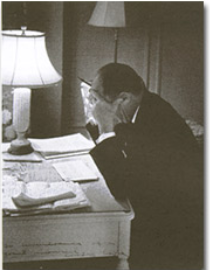
Stevenson had twenty four hours to produce an acceptance speech. He had never used speech writers, and did not do so now, although he asked several friends and advisors for comments on his first draft.
The speech that he wrote would be one of the best that he wrote for the campaign, and one of the most famous speeches in American political history. Stevenson began by explaining why he had not sought the nomination that he now accepted:
I would not seek your nomination for the Presidency, because the burdens of that office stagger the imagination. Its potential for good or evil, now and in the years of our lives, smothers exultation and converts vanity to prayer.
This explanation proved controversial. Some people welcomed it as a sign that at last someone asking to be made president understood how much harm a president — a mere mortal — might do with the godlike powers of the office. Other people thought it showed that Stevenson was altogether too sensitive to be president.
He moved on to the most famous passage in the speech:
The ordeal of the twentieth century, the bloodiest, most turbulent era of the whole Christian age, is far from over. Sacrifice, patience, understanding, and implacable purpose may be our lot of years to come. Let’s face it. Let’s talk sense to the American people. Let’s tell them the truth, that there are no gains without pains, that there — that we are now on the eve of great decisions, not easy decisions, like resistance when you’re attacked, but a long, patient, costly struggle which alone can assure triumph over the great enemies of man — war, poverty, and tyranny — and the assaults upon human dignity which are the most grievous consequences of each.
One might admire Stevenson’s eloquence and still wonder whether it was good politics to warn the public that it would be having to undertake “a long patient costly struggle” of any sort; this was the public that had just engaged in a long patient costly struggle against depression and war. Stevenson understood this but felt that the public needed to be prepared for what the country might have to face in the years ahead.
When Stevenson came to the end of his speech, Eric Sevareid, who was covering the convention for CBS News, turned to a colleague and asked, “How are we going to report on a candidate who writes better than we do?” In fact, some people found the speech excessively literary.
Other people found it a refreshing change from the usual political cant and rhodomontade. Many of the country’s writers, artists, and scholars embraced Stevenson’s candidacy enthusiastically; John Steinbeck wrote an admiring preface for a paperback volume of Stevenson’s writings; celebrities such as Lauren Bacall and Judy Garland began to show up at Stevenson rallies.
During the subsequent campaign, Stevenson spoke often about employment, taxation, inflation and the other bread-and-butter issues that decide elections. But McCarthyism — and the hyper-patriotism that it was fostering — was never far from his thoughts, and he criticized it often, if seldom mentioning McCarthy by name.
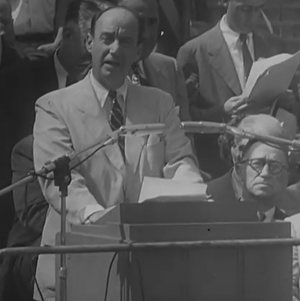
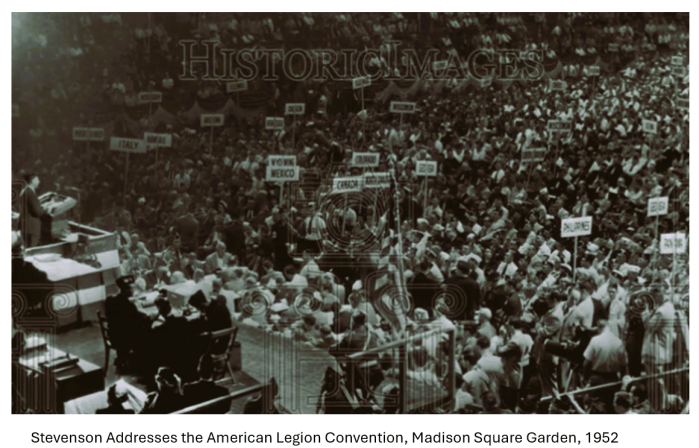
On August 27, he made his most pointed criticism of McCarthyism in front of an audience that he did not expect to hear gladly what he had to say, the annual convention of the American Legion, in New York City. McCarthy had questioned the loyalty of General George C. Marshall. He told the legionnaires:
“We talk a great deal about patriotism. What do we mean by patriotism in the context of our times? I venture to suggest that what we mean is a sense of national responsibility which will enable America to remain master of her power — to walk with it in serenity and wisdom, with self-respect and the respect of all mankind; a patriotism that puts country ahead of self; a patriotism which is not short, frenzied outbursts of emotion, but the tranquil and steady dedication of a lifetime. The dedication of a lifetime — these are words that are easy to utter, but this is a mighty assignment. For it is often easier to fight for principles than to live up to them. . .
“There are men among use who use “patriotism” as a club for attacking other Americans.
“What can we say for the self-styled patriot who thinks that a Negro, a Jew, a Catholic, or a Japanese-American is less an American than he? That betrays the deepest article of our faith, the belief in individual liberty and equality which has always been the heart and soul of the American idea.
“What can we say for the man who proclaims himself a patriot—and then for political or personal reasons attacks the patriotism of faithful public servants? I give you, as a shocking example, the attacks which have been made on the loyalty and the motives of our great wartime Chief of Staff, General Marshall. To me this is the type of “patriotism” which is, in Dr. Johnson’s phrase, “the last refuge of scoundrels.”
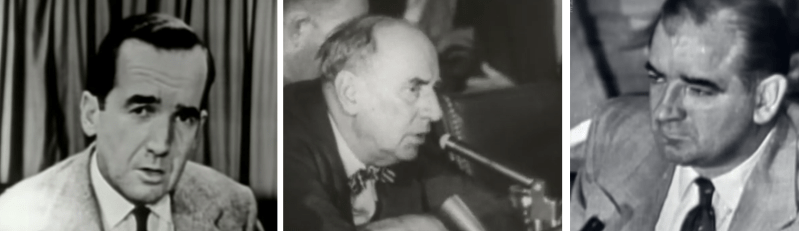
Stevenson also accused the Republicans of tolerating McCarthyism to promote their own political fortunes. He was in fact nearly alone in his criticisms of McCarthy at this time. Among national political leaders, only Senator Margaret Chase Smith of Maine had spoken out against McCarthy; it was two years before Edward R. Murrow would broadcast his famous editorial denouncing McCarthy, and two years before the venerable Boston lawyer Joseph Welch would ask McCarthy “Have you no sense of decency sir, at long last?” during the nationally televised Army-McCarthy hearings.
Edward R. Murrow, Joseph Welch, Joseph McCarthy
On the day before the election, he addressed a group of supporters with these elegant but prescient words:
Looking back, I am content. Win or lose, I have told you the truth as I see it. I have said what I meant and meant what I said. I have not done as well as I should have liked to have done, but I have done my best, frankly and forthrightly. No man can do more, and you are entitled to no less.
No one was really surprised when, on election day, Eisenhower was victorious, although the size of his victory seemed to Stevenson like a gratuitous rebuke. When the official results had been reported, Stevenson told a group of supporters in Springfield, Illinois:
Someone asked me, as I came in down on the street, how I felt. I was reminded of a story that a fellow townsman of ours used to tell Abraham Lincoln. They asked him how he felt once after an unsuccessful election. He said he said he felt like a little boy who had stubbed his toe in the dark. That he was too old to cry, but it hurt too much to laugh.
**********
Then something happened that defied the political laws of gravity. After leading his party to electoral catastrophe, Stevenson was embraced by it and would remain its recognized leader and voice for the rest of the decade. He was constantly in demand as speaker or writer about the issues of the day; he sought and easily won his party’s 1956 presidential nomination.
In his run at the presidency in 1956, Stevenson questioned the new practice of using paid advertising in political campaigns. It degraded the political process to market candidates or platforms as if they were soap, Stevenson objected. And where were candidates to get the money to pay for the advertising, if not from wealthy donors with an interest in legislation that the candidates might be able to stop or shape? Stevenson foresaw the establishment of our current system of legalized bribery conducted under the aegis of the First Amendment’s protection of freedom of speech.
He also proposed that the United States place a moratorium on its testing of nuclear weapons in the atmosphere, until the United Stated and the Soviet Union could agree upon a treaty that permanently banned atmospheric testing by either country. Vice-president Nixon called the proposal “catastrophic nonsense”. But growing public concern over increasing amount of strontium-90 in the air, the water, and the food chain kept the idea alive in government circles, and in 1963 President Kennedy signed a Partial Test Ban Treaty with the Soviet Union that incoporated the main points of Stevenson’s proposal. It may be that the main tangible legacy of the wittiest, most eloquent politician of the twentieth century is that our breakfast cereal is less radioactive than it would have been, had he not spoken out against radioactive breakfast cereal.
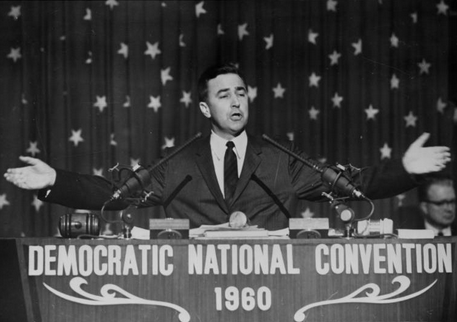
At the 1960 Democratic Convention in Los Angeles, Stevenson was nominated for president by Senator Eugene McCarthy, who eight years later would become one of the principle opponents of the Vietnam War. “Let us not reject this man who made us all proud to be Democrats!” McCarthy implored the convention. Stevenson supporters immediately flooded the convention floor and brought proceedings to a halt. The convention managers let the vociferous demonstration run its course. It was the Democratic Party’s farewell to the man who had been the voice and inspiration of the party for eight years. John F. Kennedy of Massachusetts was nominated on the first ballot.
<Senator Eugene McCarthy Nominates Stevenson
**********
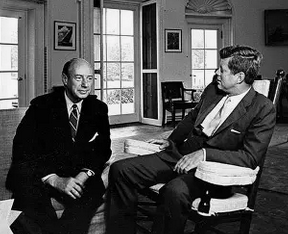
Stevenson hoped to be asked to be Secretary of State in the Kennedy administration, but Kennedy offered him the choice of Attorney General, Ambassador to England, or Ambassador to the United Nations. Stevenson chose the latter.
Stevenson’s tenure as Ambassador to the United Nations got off to a difficult start. One of Kennedy’s first decisions as president was to go ahead with a plan — inherited from the Eisenhower administration — to remove Fidel Castro from power by backing an invasion of the island by a group of anti-Castro exiles. When rumors about the plan began to appear in the press, Kennedy told Stevenson that the rumors were not true, and Stevenson repeated the lie at the United Nations. When the invasion occurred, and failed disastrously, Stevenson was made to look like a liar, and he thought of resigning. He decided against doing so; the new administration did not need any more bad press.
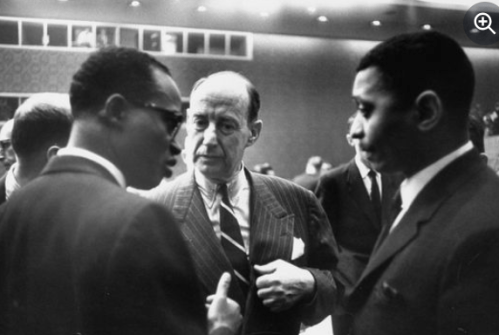
Stevenson found that he had not forfeited the respect of the international community and went on to serve in his post with distinction. He continually urged the wealthiest nations of the world to do more to help the poorest nations, he spoke up for human rights, and he became an outstanding advocate for disarmament — he is said to have had nightmares about nuclear war.
And he would play an important part in a drama that brought the world closer to nuclear war than it has ever been before or since. During the Cuban missile crisis, he urged Kennedy to offer to scrap our “Jupiter” missiles in Turkey if Russia would withdraw its missiles from Cuba. Most of Kennedy’s other advisors thought that this proposal was too “soft”; that it savored of Munich and Neville Chamberlain. While Kennedy was considering what choice of action to take, Stevenson forced Russia to admit that it had missiles in Cuba by showing photographs of the missiles, taken by a U-2 aircraft. Kennedy then made Russia the offer that Stevenson had proposed: to withdraw our Jupiter missiles from Turkey if Russia withdrew its missiles from Cuba. Russia agree to the proposal, ending the crisis. It did not immediately become public that Kennedy had made any concession to Russia; the public was made to believe that it was Kennedy’s unyielding toughness alone that had brought an end to the crisis.
**********
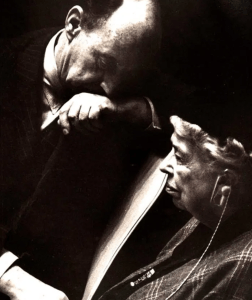
One of the compensations of his last years was his friendship with Eleanor Roosevelt, who became his supporter, advisor, and confidant. He shared with her many convictions, most importantly a belief in the supreme importance of human rights. When she died in 1962, he spoke at a memorial service for her at the United Nations; he said:
The United States, the United Nations, the world has lost one of its great citizens. Mrs. Eleanor Roosevelt is dead; and a cherished friend of all mankind is gone. Yesterday, I said that I had lost more than a friend — I had lost an inspiration: for she would rather light candles than curse the darkness and her glow had warmed the world.
Adlai Stevenson died of a heart attack in London, England on July 14, 1965. His death surprised most people who knew him, and some believed that he was killed by the stress of having to sit on his growing doubts about the wisdom of President Johnson’s escalation of the war in Vietnam. Eric Severeid, who had a long talk with him two days before he died, believed that he died of exhaustion/.
Several days before he died, he spoke the following words avt a conference in Geneva; his concern for the environment, going back to his call for a ban on atmospheric testing of nuclear weapons, here finds its fullest expression:
We travel together, passengers on a little space ship, dependent on its vulnerable reserves of air and soil; all committed for our safety to its security and peace; preserved from annihilation only by the care, the work, and I will say, the love we give our fragile craft. We cannot maintain it half fortunate, half miserable, half confident, half despairing, half slave to the ancient enemies of man half free in a liberation of resources undreamed of until this day. No craft, no crew can travel with such vast contradictions. On their resolution depends the survival of us all.
**********
Seventy-four years after Stevenson’s first run at the presidency, it may not be immediately apparent why he became a hero to the Democrats. His support of the New Deal traditions of the Democratic party was genuine, but somewhat perfunctory. He wasn’t a champion of liberal causes such as civil rights for African Americans or the rights of other abused groups. Unlike his friend Eleanor Roosevelt, he never sought direct acquaintance with the poor in order to understand their suffering. He wasn’t at all what today is called a “progressive.”
And in some ways, he set a bad example for following generations of Democrats — indulging in wit tainted with snobbery. Reflecting on his loss to Eisenhower in 1952, he said, “The people have spoken. As for their wisdom, well, Coca Cola still outsells champagne.” When Eisenhower became president in 1953, Stevenson said “The New Dealers have been replaced by the car dealers.” When asked whether it bothered him that the popular preacher Norman Vincent Peale had endorsed Eisenhower for president, he said “Not at all. I find the Apostle Paul appealing but Peale appalling.” Great wit, but bad politics.
And he never became reconciled to the corny side of politics. For example, once when he was campaigning in Florida, a supporter handed a stuffed alligator as a gift. Instead of holding it up in the air for the benefit of the press photographers, he looked at stuffed alligator and said “For Christ’s sake what’s this?”
And yet he became a hero -to the Democrats — because he was what many of them wanted to be and wanted their fellow Americans to be. He was deeply rooted in an America that was simpler, more idealistic, more sure of itself and therefore less self-righteous than America found itself to be at mid-twentieth century.
**********
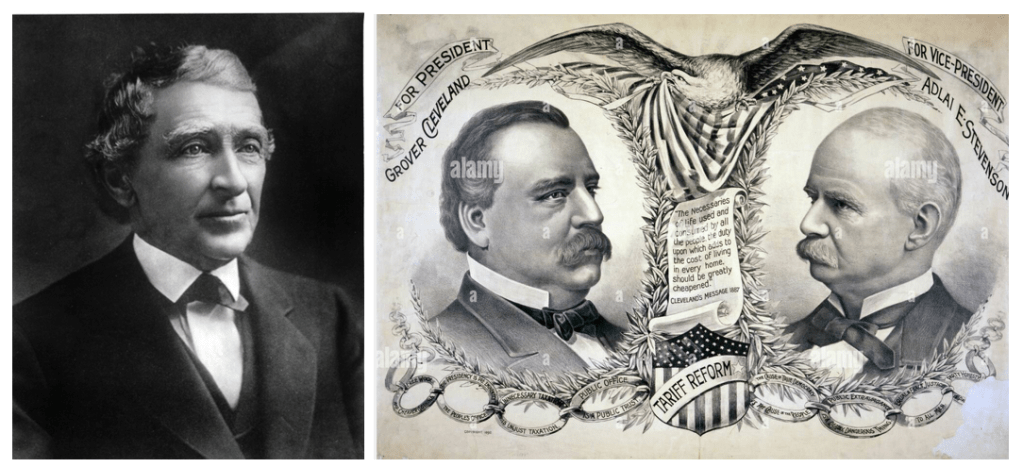
More than most politicians, he looked to the past for guidance and support — in particular, to the role his family had played in our country’s history. His grandfather Adlai Stevenson I served as vice-president of the United States during Grover Cleveland’s first administration — which historians regard as an oasis of good government in the almost bottomless miasma of the Gilded Age. And on his mother’s side of the family was a great-grandfather, Jesse Fell, who was both a close friend and political advisor of Abraham Lincoln — the one of Lincoln’s advisors, it is said, who never asked Lincoln for anything in return for his services.
Stevenson was proud of his connection to Lincoln through Jesse Fell, he studied Lincoln all his life, and there has probably been no politician before or since who was so thoroughly steeped in Lincoln’s words and thought. His feelings about his grandfather Adlai Stevenson I may have been ambivalent; as a young Democratic lawyer, he supported Stephen Douglas against Lincoln for the United States Senate. But Grandfather Stevenson set an example of dignity in his bearing and fairness in his dealing with others that won him the respect of members of both parties.
**********
The phrase “human dignity” occurs in crucial contexts in Adlai Stevenson’s speeches. This simple idea — that every human being possesses a dignity that others ought to consider inviolable — was the central tenet of his political philosophy.
His concern for the dignity of others explains his contempt for Joseph McCarthy — that violator of the dignity of others — and his distaste for Richard Nixon — who was always willing to surrender his own dignity to advance his political career
And it may explain why, although he was roughly handled by democracy, he never lost faith in the democratic ideals that were espoused and vindicated by his political hero, Abraham Lincoln.
**********
Shortly after Stevenson’s death, Walter Lippmann wrote:
“We must wonder whether we have buried with Adlai Stevenson some element of the promise of American life. For in this generation he stood apart — as somehow a living specimen of the kind of American that Americans themselves, and the great mass of mankind would like to think that Americans are. Shall we see his like again? Or was he the last of his noble breed? On this question hangs the American future.”
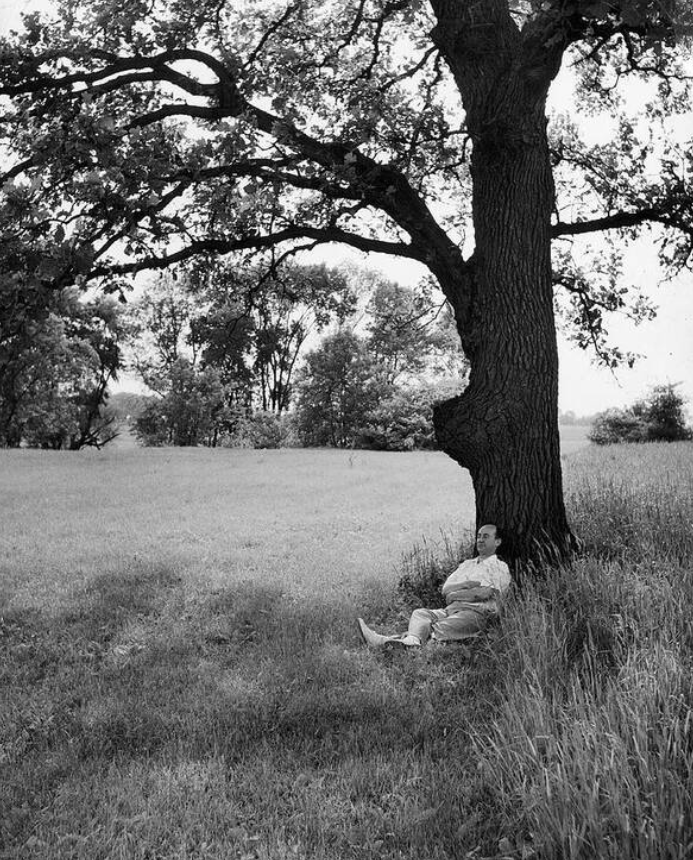
“I would like to sit in the shade with a glass of wine in hand and watch the people dance.”


 n reported, Stevenson told a group of supporters in Springfield, Illinois: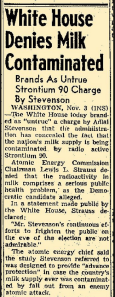
 “I would like to sit in the shade with a glass of wine in hand and watch the people dance.”
